
What is the Quotient Calculator?
The quotient calculator divides one number (the dividend, a) by another (the divisor, b) and returns three results: the whole-number quotient, the remainder left over, and the exact decimal value of the division. It is a universal arithmetic tool useful for students, programmers, and anyone working with integer division.
How to Use It
Enter the dividend in the first box and the divisor in the second box, then read off the results. For example, dividing 17 by 5 gives a quotient of 3 with a remainder of 2, because 5 fits into 17 three full times (15) leaving 2 left over.
The Formula Explained
The quotient uses floor division: \( q = \lfloor a / b \rfloor \), which rounds down to the nearest whole number. The remainder is then found by \( r = a - b \cdot q \). This guarantees that \( a = b \cdot q + r \) always holds, the fundamental identity of the division algorithm.
$$\text{Quotient} = \left\lfloor \frac{\text{Dividend }(a)}{\text{Divisor }(b)} \right\rfloor, \qquad \text{Remainder} = a - b \cdot \text{Quotient}$$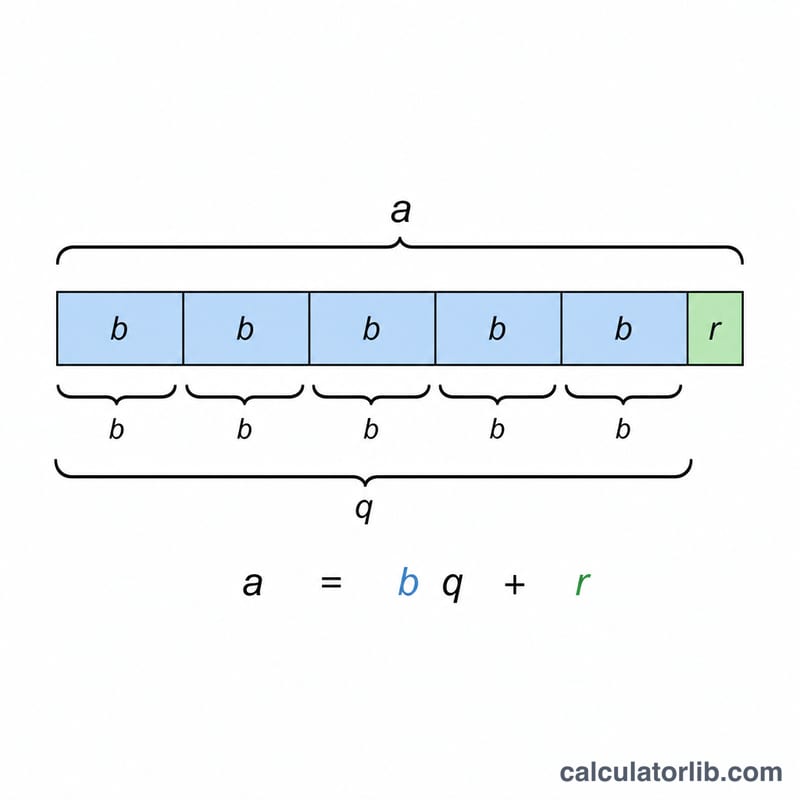
Worked Example
Divide 17 by 5: \( \lfloor 17 / 5 \rfloor = \lfloor 3.4 \rfloor = 3 \), so the quotient is 3. The remainder is \( 17 - 5 \times 3 = 17 - 15 = 2 \). The exact result is 3.4.
$$\lfloor 17 / 5 \rfloor = \lfloor 3.4 \rfloor = 3, \qquad 17 - 5 \times 3 = 17 - 15 = 2$$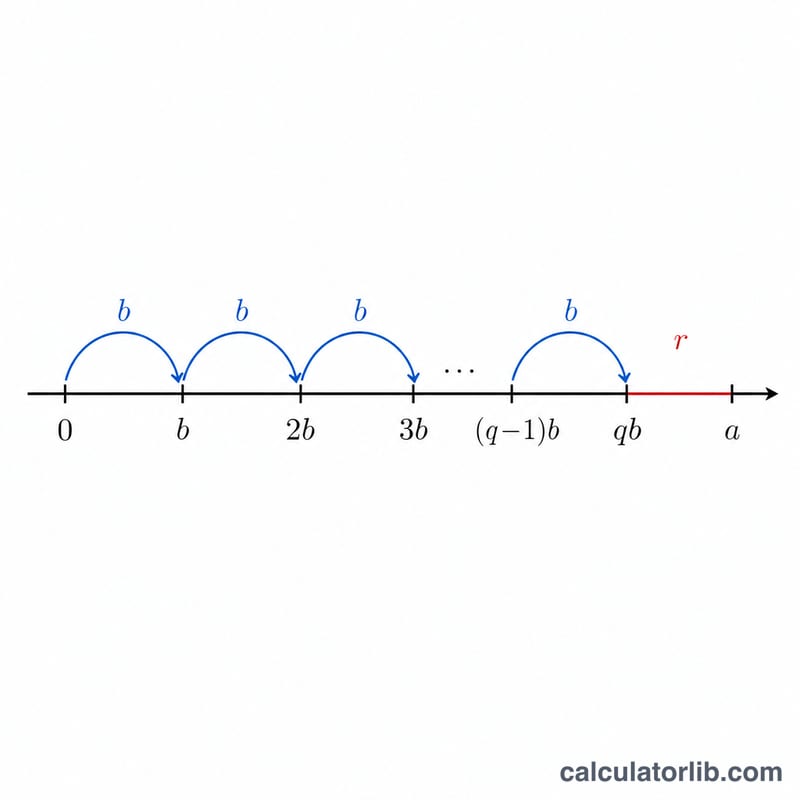
FAQ
What happens with a negative dividend? Because we use floor division, \( -17 \div 5 \) gives a quotient of \( -4 \) (floor of \( -3.4 \)) and a remainder of 3, keeping the remainder non-negative.
What if the divisor is 0? Division by zero is undefined, so the calculator returns zeros — enter a non-zero divisor.
Does it work with decimals? Yes. The quotient is still the floor of \( a/b \), and the remainder follows the same identity.