
What this calculator does
This tool compares two earthquakes by their magnitude and by the seismic energy they release. Magnitude is a logarithmic scale, so a small difference in magnitude corresponds to a huge difference in energy. Enter the magnitude of earthquake A and earthquake B, and the calculator returns the magnitude difference (\(\Delta M\)) and the energy ratio (\(J_a / J_b\)), plus the absolute seismic energy of each event in joules. This is a pure physics/seismology calculation and applies identically anywhere in the world.
The formula explained
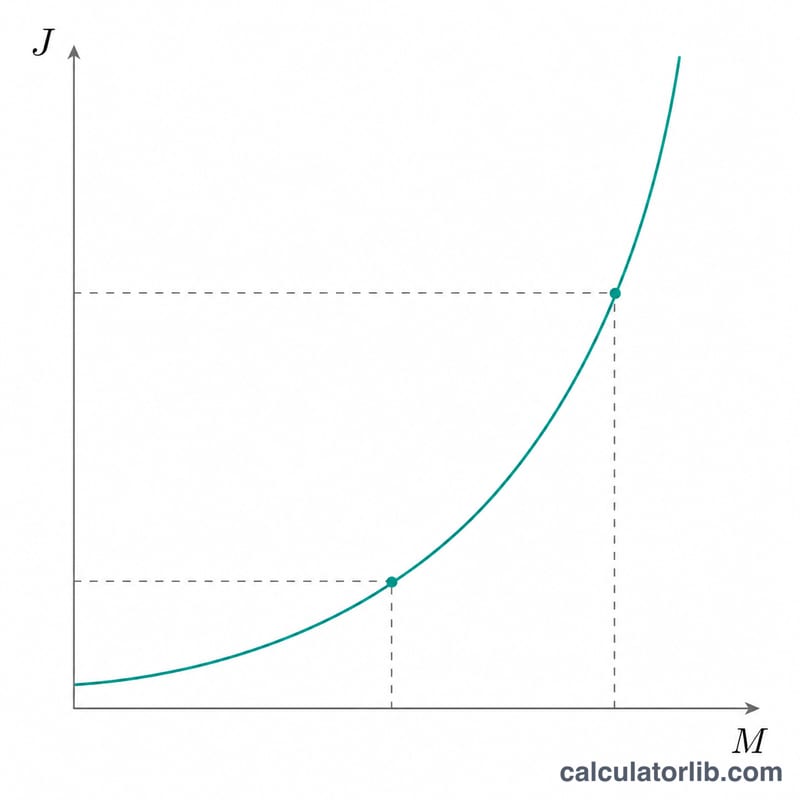
The calculator uses the standard Gutenberg-Richter energy relation in base-10 logarithmic form: \(\log_{10}(J) = 4.8 + 1.5\cdot M\), where \(J\) is the seismic energy in joules and \(M\) is the magnitude. Rearranged,
$$J = 10^{\,4.8 + 1.5M}$$When you take the ratio of two earthquakes, the constant 4.8 cancels, leaving
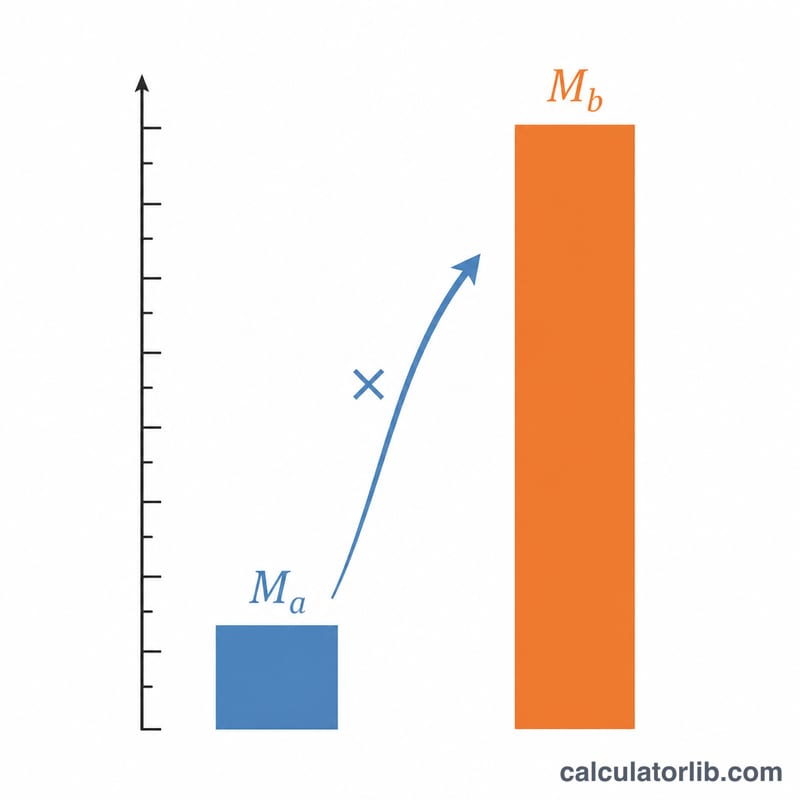
$$\frac{J_a}{J_b} = 10^{\,1.5\cdot(M_a - M_b)} = 10^{\,1.5\cdot\Delta M}$$A useful rule of thumb: each whole step up in magnitude multiplies energy by about \(10^{1.5} \approx 32\) times, and two steps multiply it by \(10^3 = 1000\) times. Note that 1 joule = 1 \(\text{N}\cdot\text{m}\).
Worked example
Compare a magnitude 9.0 earthquake (A) with a magnitude 7.9 earthquake (B). The magnitude difference is
$$\Delta M = 9.0 - 7.9 = 1.1$$The energy ratio is
$$10^{\,1.5 \times 1.1} = 10^{1.65} \approx 44.7$$so earthquake A releases roughly 45 times the energy of earthquake B. The absolute energies are
$$J_a = 10^{\,4.8 + 13.5} = 10^{18.3} \approx 2.0\times10^{18}\ \text{J}$$$$J_b = 10^{\,4.8 + 11.85} = 10^{16.65} \approx 4.5\times10^{16}\ \text{J}$$Dividing them back confirms the same ratio.
FAQ
Why is a magnitude 9 so much stronger than a magnitude 7? Because energy grows by a factor of about 32 per magnitude unit. A two-unit difference means about 1000 times more energy released.
What if both magnitudes are equal? Then \(\Delta M = 0\) and the energy ratio is \(10^0 = 1\), meaning equal energy.
What if A is smaller than B? The magnitude difference is negative and the energy ratio is less than 1, indicating earthquake A is the weaker of the two.