
What this calculator does
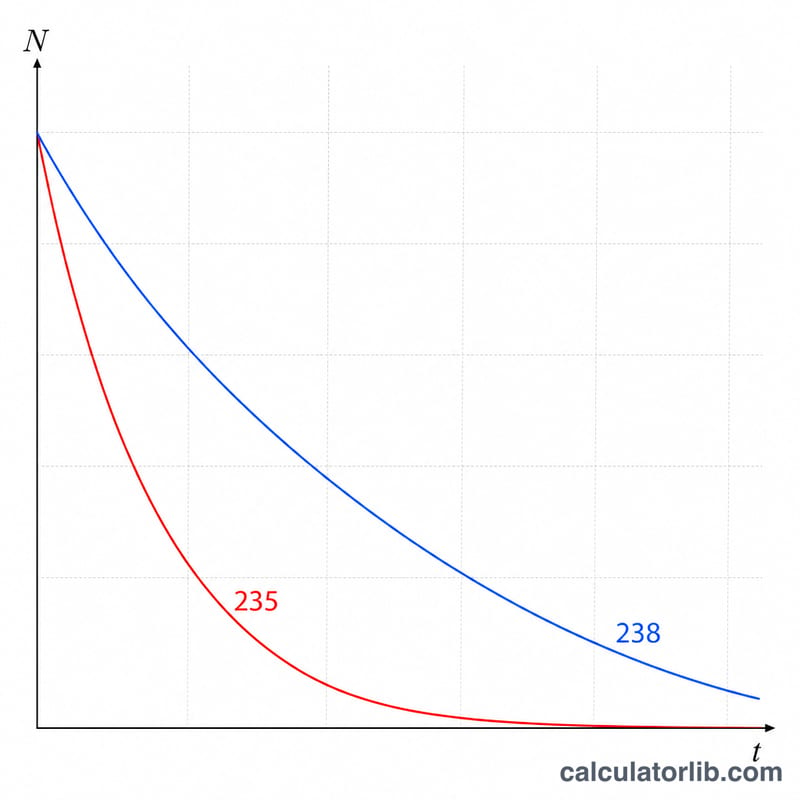
Natural uranium everywhere in the solar system shares the same isotopic composition today: about 0.720% U-235 and 99.275% U-238 by atom count. Because U-235 decays far faster than U-238 (half-lives of 703.8 million years versus 4.468 billion years), the U-235 fraction was higher in the distant past. This calculator inverts that relationship: you enter the U-235 atom fraction a sample of natural uranium once had, and it estimates how many years ago that composition existed.
How to use it
Enter the past U-235 abundance as an atom fraction (a number between 0 and 1) or switch the unit dropdown to percent and enter it as a percentage. The default of 0.03 (3%) is a representative higher-than-present enrichment. The tool returns the time before present in years and in million years.
The formula explained
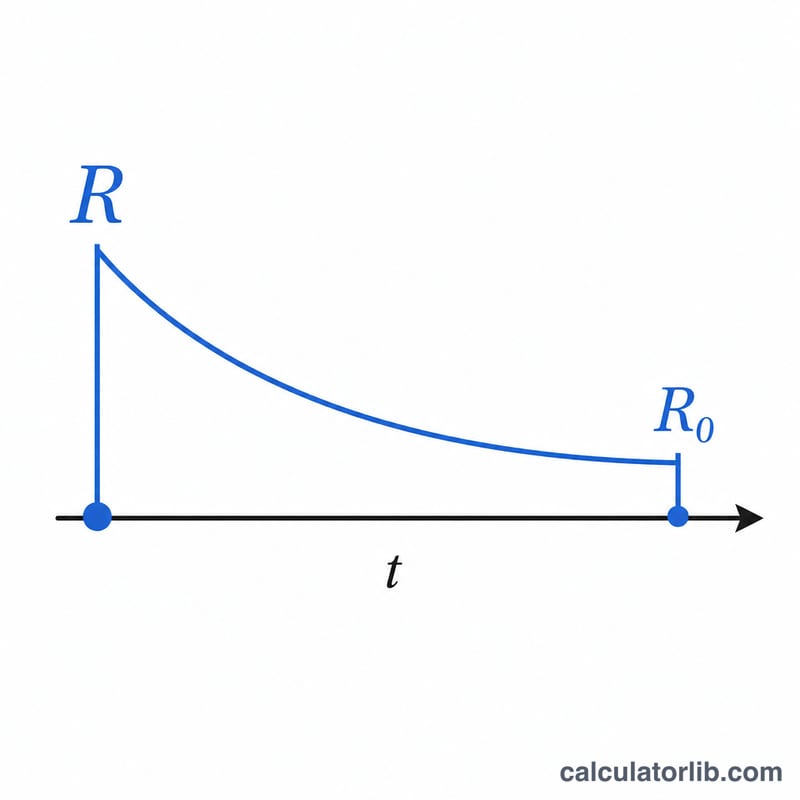
Radioactive decay gives \(N(t) = N_0 e^{-\lambda t}\), with \(\lambda = \ln(2)/T_{\text{half}}\). Looking backward in time, more of each isotope existed, so the past ratio of U-235 to U-238 is \(R = R_0 e^{(\lambda_{235} - \lambda_{238}) t}\), where \(R_0\) is the present ratio. Converting fractions to ratios with \(R = f/(1-f)\) and solving for \(t\) gives
$$t = \dfrac{\ln(R/R_0)}{\lambda_{235} - \lambda_{238}}$$
With \(\lambda_{235} = 9.8487\times10^{-10}/\text{yr}\) and \(\lambda_{238} = 1.55136\times10^{-10}/\text{yr}\), their difference is \(8.29734\times10^{-10}/\text{yr}\).
Worked example
For a past U-235 fraction of 0.03: \(R_0 = 0.0072/0.9928 = 0.0072522\), \(R = 0.03/0.97 = 0.0309278\), and \(\ln(R/R_0) = \ln(4.2646) = 1.45035\). Dividing by \(8.29734\times10^{-10}\) gives
$$t = 1.748\times10^{9}\ \text{years}$$
or about 1,748 million years ago.
FAQ
Why does a higher U-235 fraction mean further in the past? U-235 decays roughly six times faster than U-238, so longer ago there was proportionally more U-235.
What if I enter a fraction below 0.720%? The result becomes negative, indicating a future time, since U-235 keeps depleting relative to U-238. This tool is intended for past dating.
How accurate is it? It is a simplified two-isotope (U-235 + U-238) closed-system model that ignores U-234 and trace isotopes and assumes no contamination, matching the original reference tool's intent.