
What Is a Radical Calculator?
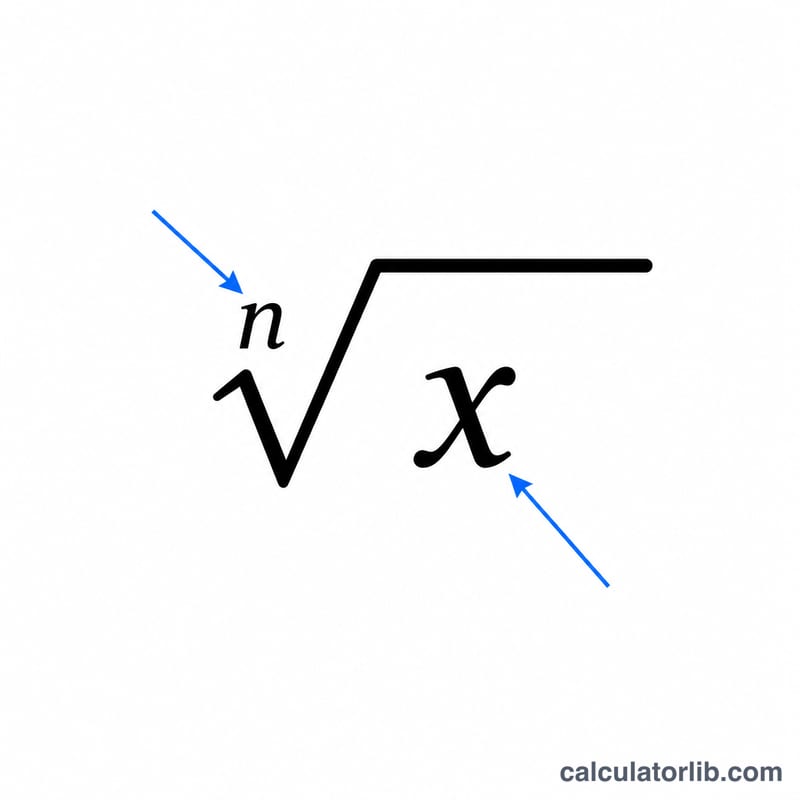
A radical calculator computes the n-th root of a number — the inverse of raising a number to the n-th power. The radicand is the value under the radical sign, and the index (\(n\)) tells you which root to take: 2 for a square root, 3 for a cube root, and so on. This tool works for any positive radicand and any real index, and it also handles odd roots of negative numbers.
How to Use It
Enter the radicand (\(x\)) — the number you want to find the root of — and the index (\(n\)), the degree of the root. Press calculate and the tool returns \(x^{1/n}\). For a plain square root, set the index to 2; for a cube root, set it to 3. The index may also be a decimal (for example 2.5).
The Formula Explained
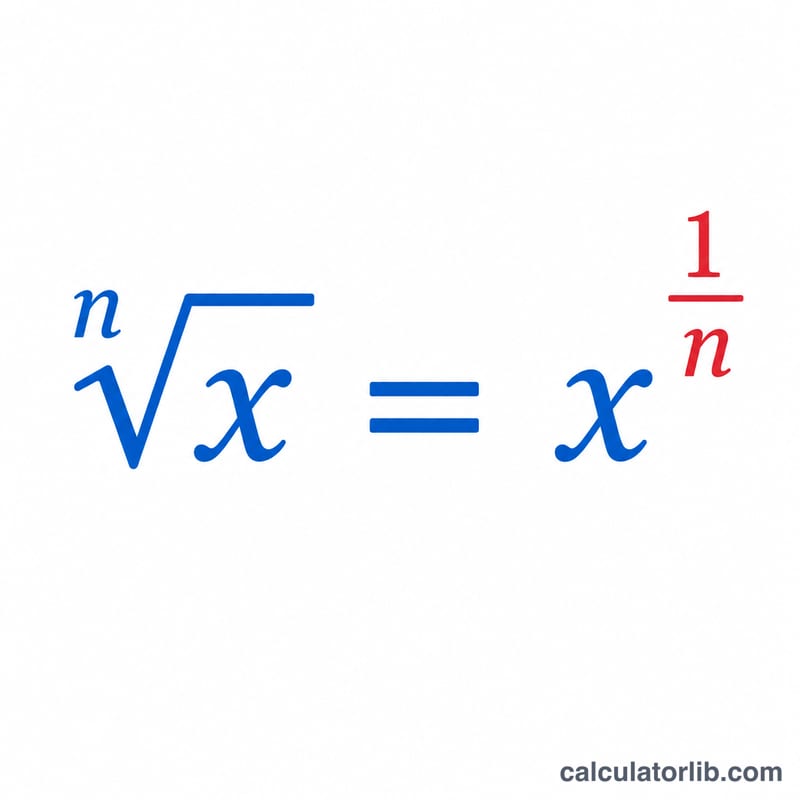
The core identity is:
$$\sqrt[n]{x} = x^{\frac{1}{n}}$$Taking the n-th root is the same as raising \(x\) to the reciprocal power \(1/n\). For negative radicands a real result exists only when \(n\) is an odd whole number — in that case the calculator returns the negative real root (e.g. the cube root of −8 is −2). Even roots of negative numbers have no real value, so the tool reports that instead.
Worked Example
Find the cube root of 27. Here \(x = 27\) and \(n = 3\), so $$\text{result} = 27^{1/3} = 3,$$ because \(3 \times 3 \times 3 = 27\). Likewise the 4th root of 16 is \(16^{1/4} = 2\), since \(2^4 = 16\).
FAQ
Can the index be a fraction? Yes. Any positive real index works for a positive radicand; for example the 0.5th root of 9 equals \(9^2 = 81\).
Why can't I take the square root of a negative number? No real number squared gives a negative result. Even roots of negatives are imaginary, so only odd integer roots of negative radicands return a real value here.
What is the index for a square root? The square root uses an index of 2, which is why it is often written without a small number above the radical sign.