
What is the Radioactivity (Becquerel) Calculator?
This calculator finds the activity in becquerel (Bq) — the number of nuclear decays per second — emitted by a given mass of a pure radioactive isotope. One becquerel equals one disintegration per second. Pick an isotope from the list (which auto-fills its half-life and molar mass) or enter your own values, then enter the mass of substance to get the total activity and the activity per gram. The tool assumes a 100% pure single isotope.
How to use it
1) Choose a radioactive substance, or type a custom half-life and molar mass. 2) Set the half-life unit (seconds, minutes, hours, days, or years; a Julian year is 365.25 days). 3) Enter the quantity x and its mass unit (g, mg, or micrograms). The result shows total Bq, the same value in a readable prefixed unit (kBq, MBq, GBq, TBq, PBq, EBq), and Bq per gram.
The formula
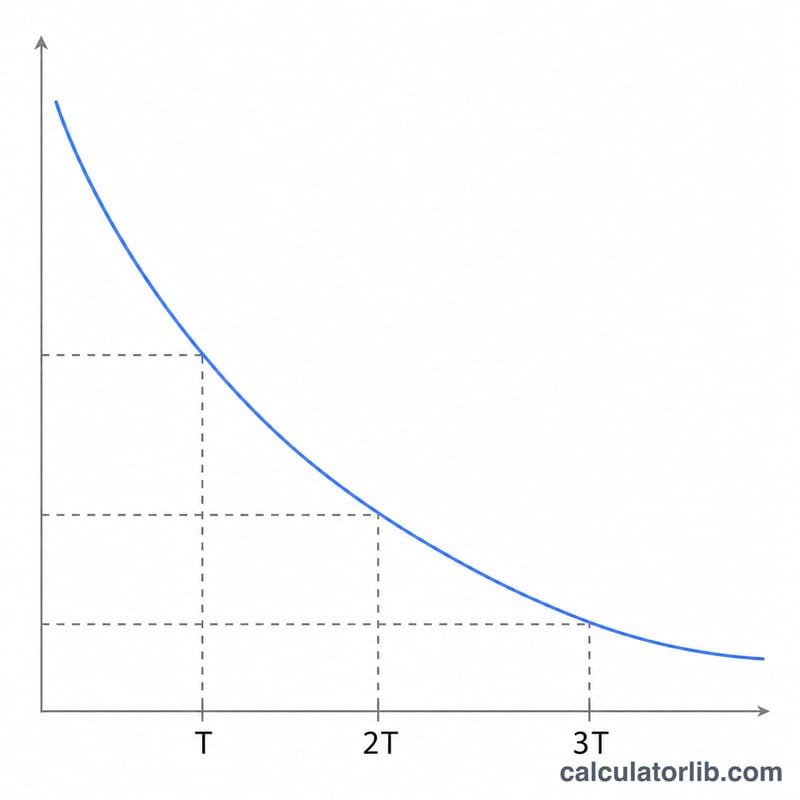
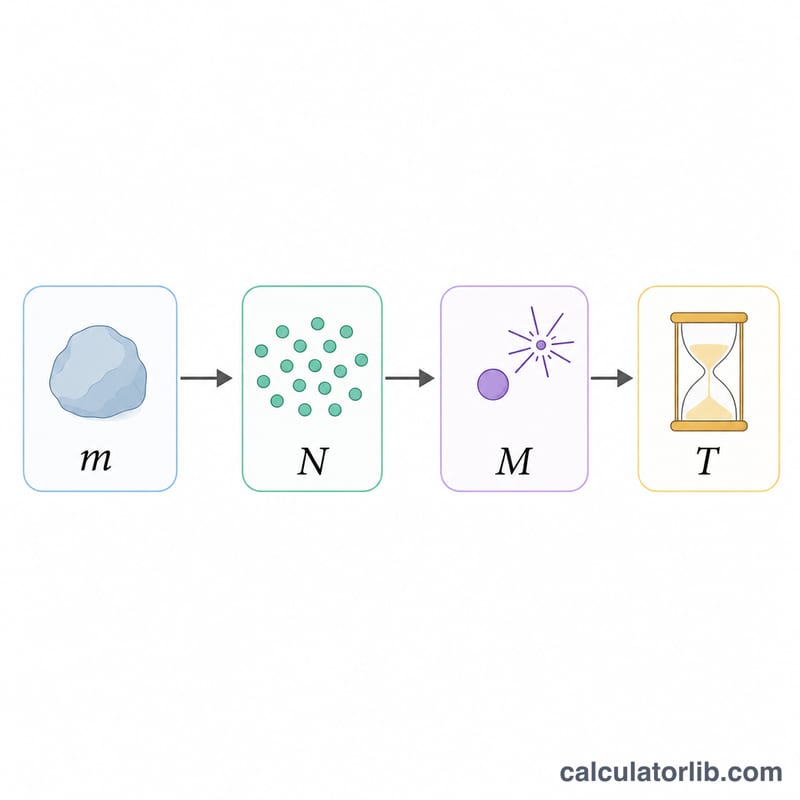
The number of atoms is \(N = (\text{mass in grams} / M) \times N_A\), where \(N_A = 6.02214 \times 10^{23}\) per mol. Activity \(A = N \times \lambda\), where the decay constant \(\lambda = \ln(2) / T\) and \(T\) is the half-life in seconds. So $$\text{Bq} = \frac{\text{massGrams}}{\text{molarMass}} \times N_A \times \frac{\ln(2)}{T}$$
Worked example
Iodine-131, half-life 8.0252 days, molar mass 131 g/mol, mass 100 g. $$T = 8.0252 \times 86400 = 693{,}377.28 \text{ s}$$ $$N = \frac{100}{131} \times 6.02214 \times 10^{23} = 4.597 \times 10^{23} \text{ atoms}$$ $$\lambda = \frac{\ln(2)}{693377.28} = 9.9966 \times 10^{-7} \text{ per s}$$ $$\text{Bq} = 4.597 \times 10^{23} \times 9.9966 \times 10^{-7} = 4.595 \times 10^{17} \text{ Bq}$$ or about 459.5 PBq. Per gram \(= 4.595 \times 10^{15}\) Bq/g.
FAQ
What is a becquerel? One Bq is one radioactive decay per second. The older unit, the curie (Ci), equals \(3.7 \times 10^{10}\) Bq.
Why convert the half-life to seconds? Because Bq counts decays per second, the decay constant must be in per-second units, so \(T\) must be in seconds.
Does this assume pure isotope? Yes — it assumes 100% isotopic concentration. For a mixture, scale by the fraction of the radioactive isotope present.