
What this calculator does
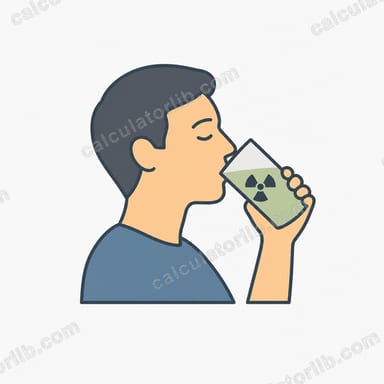
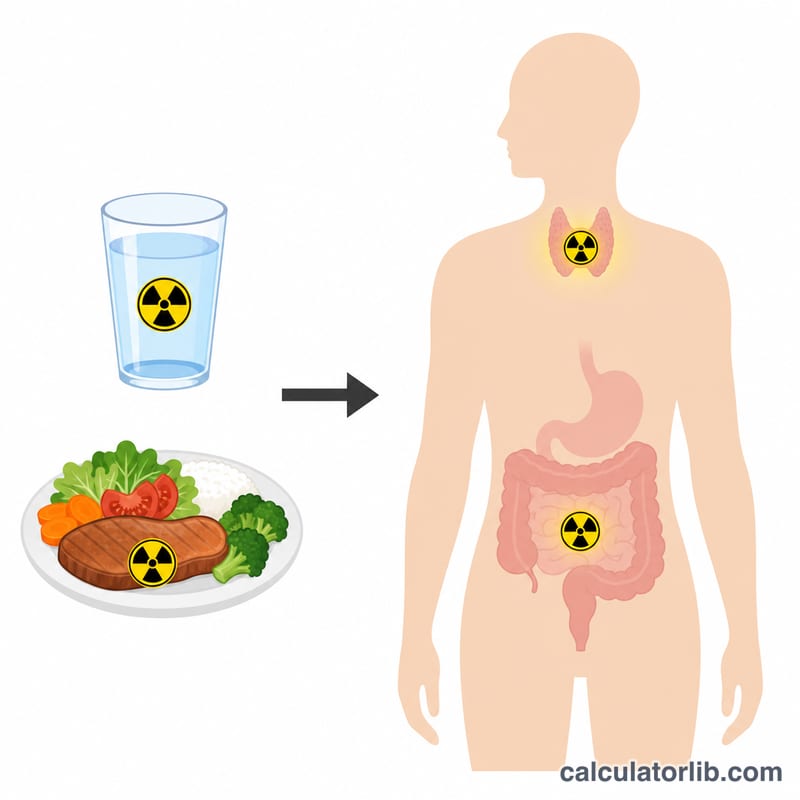
This tool estimates the committed internal effective dose a person receives by taking radioactive material into the body through oral intake - that is, by drinking contaminated water and eating contaminated food. It converts the ingested activity (measured in becquerels, Bq) into an effective dose (sieverts, Sv) using internationally recognized ICRP dose coefficients. It is limited to the three isotopes most relevant after a reactor accident: Iodine-131 (I-131), Cesium-134 (Cs-134) and Cesium-137 (Cs-137). The underlying physics is universal and not specific to any one country.
Key units
One becquerel (Bq) equals one nuclear decay per second and measures the activity (strength) of a source. The sievert (Sv) is the unit of effective dose, representing impact on the body; \(1\ \text{Sv} = 1000\ \text{mSv} = 1{,}000{,}000\ \text{uSv}\). A dose coefficient (committed effective dose per unit intake) converts ingested activity into dose; ICRP gives these in Sv/Bq, and this tool displays them in uSv/Bq.
How to use it
Pick an age group to load ICRP-72 default oral dose coefficients and typical daily intake volumes, then override any field as needed. Enter the activity concentration (Bq/kg) in water and in food for each isotope, your daily intake of water and food (kg/day), and the number of days. Concentrations default to 0, so an isotope you leave blank simply contributes nothing.
The formula
For each isotope, intake activity = days x (water concentration x water intake + food concentration x food intake). The dose is that activity multiplied by the isotope's oral dose coefficient. Summing the three isotopes gives the total committed effective dose.
$$E = \text{Days} \sum_{i} e_i \left( C_{w,i}\,\text{Water} + C_{f,i}\,\text{Food} \right)$$ $$\text{where}\quad \left\{ \begin{aligned} e_i &= \text{dose coefficient: } \text{I-131},\ \text{Cs-134},\ \text{Cs-137} \\ C_{w,i} &= \text{water conc.: } \text{I-131},\ \text{Cs-134},\ \text{Cs-137} \\ C_{f,i} &= \text{food conc.: } \text{I-131},\ \text{Cs-134},\ \text{Cs-137} \end{aligned} \right.$$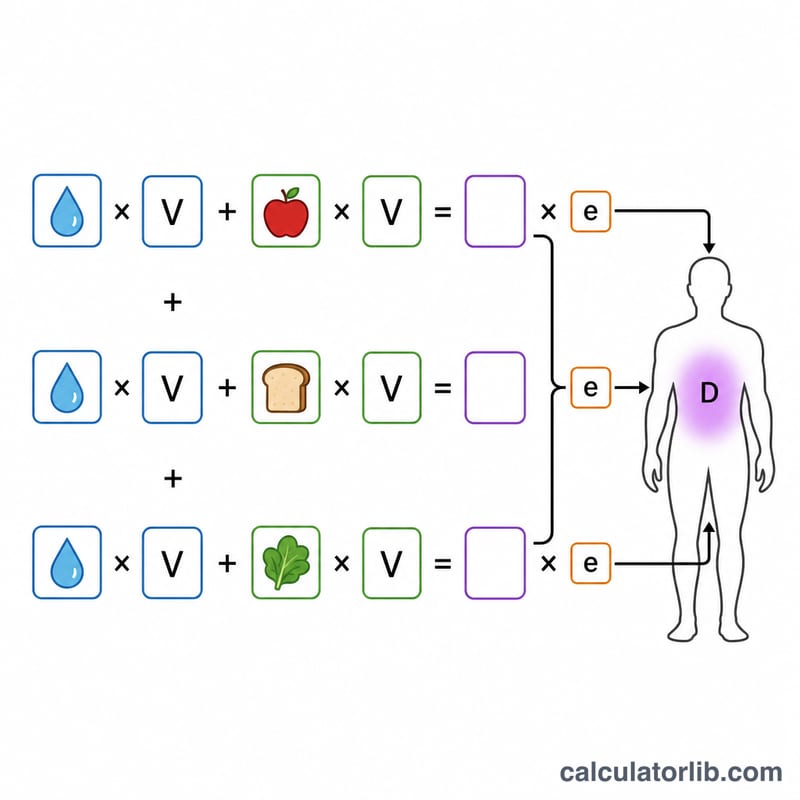
Worked example
Adult, 30 days, 2 kg/day water and 1.5 kg/day food. Coefficients (uSv/Bq): I-131 0.022, Cs-134 0.019, Cs-137 0.013. Water: I-131 100, Cs-134 50, Cs-137 50 Bq/kg; Food: Cs-134 100, Cs-137 100 Bq/kg. I-131:
$$30 \times (100 \times 2) = 6000\ \text{Bq} \times 0.022 = 132\ \text{uSv}$$Cs-134:
$$30 \times (50 \times 2 + 100 \times 1.5) = 7500\ \text{Bq} \times 0.019 = 142.5\ \text{uSv}$$Cs-137:
$$7500 \times 0.013 = 97.5\ \text{uSv}$$Total
$$= 372\ \text{uSv} = 0.372\ \text{mSv} = 3.72 \times 10^{-4}\ \text{Sv}$$FAQ
Is this an instantaneous dose? No. It is the committed effective dose integrated over 50 years for adults and to age 70 for children, as defined by ICRP.
Does it include external radiation? No - only internal dose from ingestion.
Can I use it for other radionuclides? No; it covers only I-131, Cs-134 and Cs-137. Always defer to official authorities for safety decisions.