
What is the Equivalent Dose Calculator?
This tool converts an absorbed radiation dose (measured in grays, Gy) into an equivalent dose (measured in sieverts, Sv). While absorbed dose describes the raw energy deposited per kilogram of tissue, different types of radiation cause different amounts of biological harm for the same energy. The equivalent dose accounts for this by applying a radiation weighting factor (\(w_R\)) defined by the International Commission on Radiological Protection (ICRP).
How to Use It
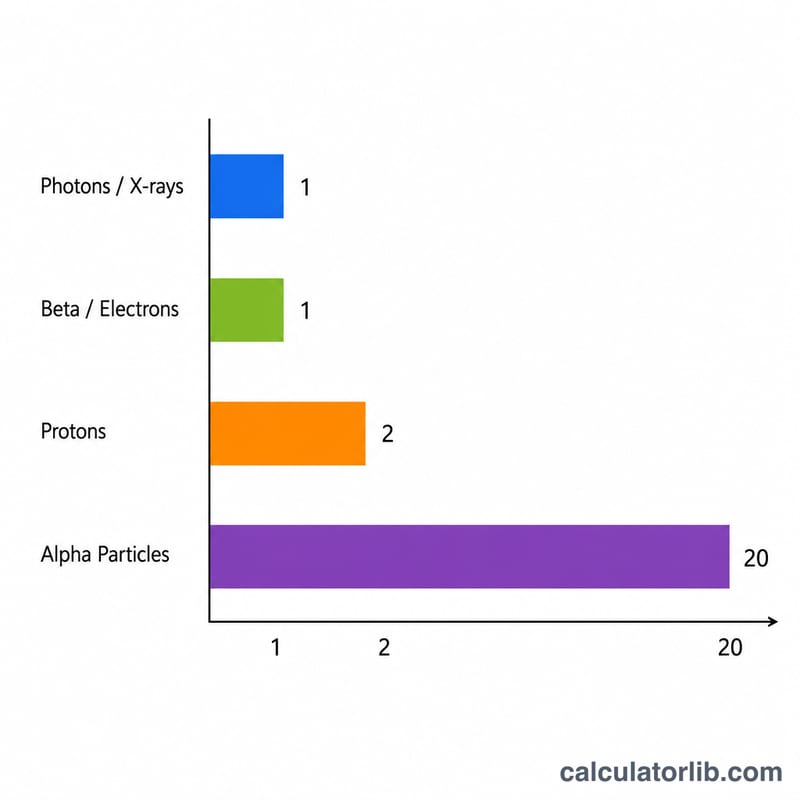
Enter the absorbed dose in grays, then choose the radiation type. Each type maps to a standard weighting factor: X-rays, gamma rays and electrons use \(w_R = 1\); protons = 2; neutrons range from 5 to 20 depending on energy; alpha particles and heavy ions = 20. If you have a specific weighting factor, select "Custom" and type it in. The calculator returns the equivalent dose in sieverts and also in millisieverts (mSv) for everyday comparison.
The Formula Explained
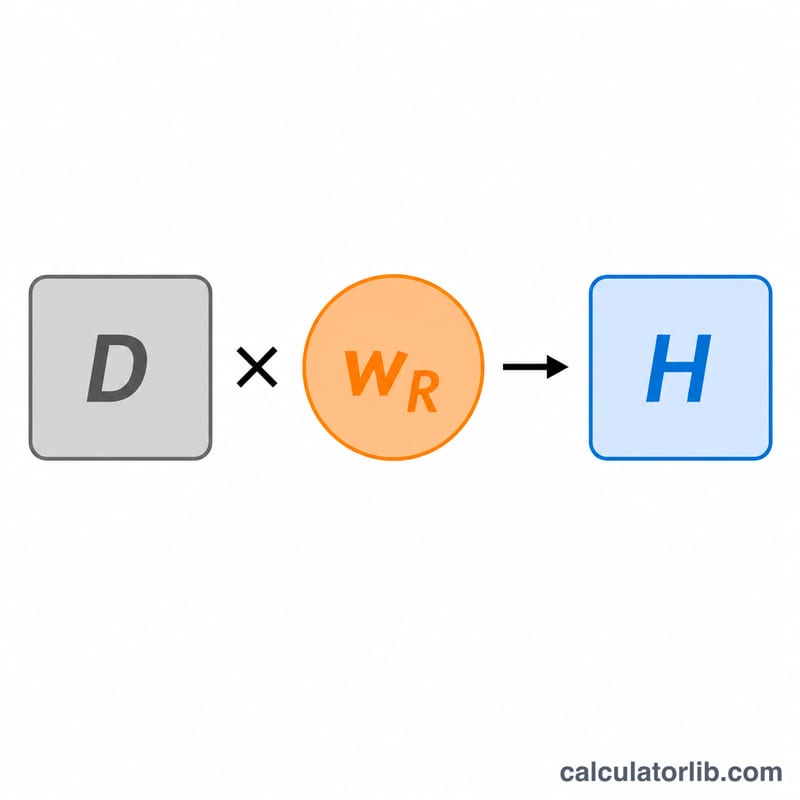
The relationship is simply $$H_T = D \times w_R$$ where \(H_T\) is the equivalent dose in sieverts, \(D\) is the absorbed dose in grays, and \(w_R\) is the dimensionless radiation weighting factor. Because \(w_R\) is unitless, 1 Gy of gamma radiation (\(w_R = 1\)) equals 1 Sv, but 1 Gy of alpha radiation (\(w_R = 20\)) equals 20 Sv.
Worked Example
Suppose tissue absorbs 0.05 Gy of alpha radiation (\(w_R = 20\)). The equivalent dose is $$0.05 \times 20 = 1 \text{ Sv}$$ or 1000 mSv — a very large dose, illustrating why alpha emitters are especially dangerous internally.
FAQ
Is equivalent dose the same as effective dose? No. Effective dose additionally weights for the sensitivity of each organ (tissue weighting factor). Equivalent dose applies only the radiation weighting factor.
Why use sieverts instead of grays? Sieverts better reflect biological risk, allowing different radiation types to be compared on a common scale.
What is a typical background dose? The global average natural background is roughly 2.4 mSv per year, useful as a reference point for the result.