
What Is the Thevenin Equivalent?
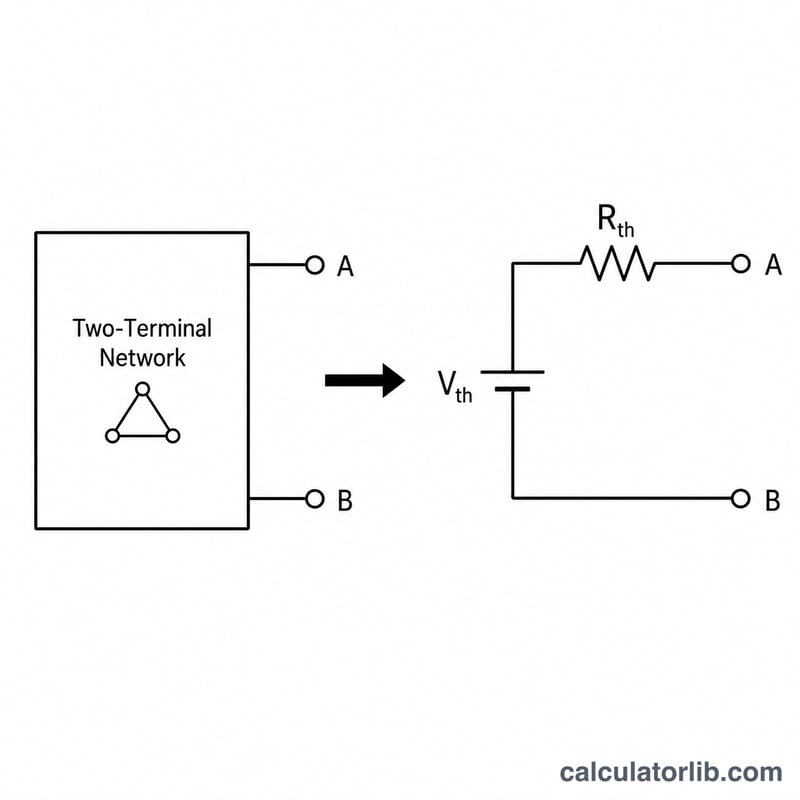
Thevenin theorem states that any linear two-terminal network of voltage sources, current sources and resistors can be replaced by a single voltage source (\(V_{th}\)) in series with a single resistance (\(R_{th}\)). This greatly simplifies analysis when you only care about what happens at one pair of terminals — for example when attaching a varying load. This calculator derives the equivalent from two easy lab measurements: the open-circuit voltage and the short-circuit current.
How to Use the Calculator
Enter the open-circuit voltage (\(V_{oc}\)) — the voltage measured across the terminals with nothing connected — and the short-circuit current (\(I_{sc}\)) — the current that flows when the terminals are shorted together. The tool returns the Thevenin voltage (which equals \(V_{oc}\)) and the Thevenin resistance (\(V_{oc}\) divided by \(I_{sc}\)).
The Formula Explained
The Thevenin voltage is simply the open-circuit terminal voltage: \(V_{th} = V_{oc}\), because no current flows through the internal resistance and there is no voltage drop. The Thevenin resistance is found by shorting the terminals: \(R_{th} = V_{oc} / I_{sc}\). This works because under short circuit the full source voltage appears across \(R_{th}\), driving the short-circuit current.
$$V_{th} = \text{Voc (V)} \qquad R_{th} = \frac{\text{Voc (V)}}{\text{Isc (A)}}$$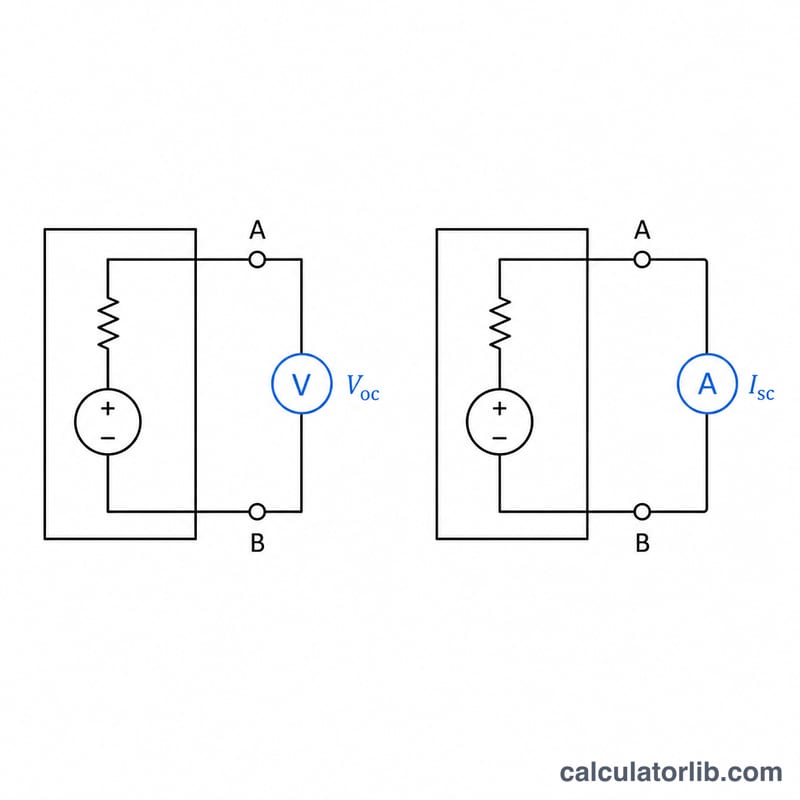
Worked Example
Suppose you measure \(V_{oc} = 12\ \text{V}\) and short the terminals to read \(I_{sc} = 3\ \text{A}\). Then \(V_{th} = 12\ \text{V}\) and
$$R_{th} = \frac{12}{3} = 4\ \Omega$$The original network behaves exactly like a 12 V source in series with a 4-ohm resistor.
FAQ
Why divide voltage by short-circuit current? Shorting the terminals removes the external load, so the only thing limiting the current is \(R_{th}\) itself. Ohm law then gives \(R_{th} = V_{oc} / I_{sc}\).
Is Rth the same as Norton resistance? Yes — the Thevenin and Norton equivalents share the same internal resistance, and \(I_{sc}\) equals the Norton current source value.
What if Isc is zero? A zero short-circuit current implies infinite resistance, so a finite Rth cannot be computed; the calculator returns 0 to avoid dividing by zero.