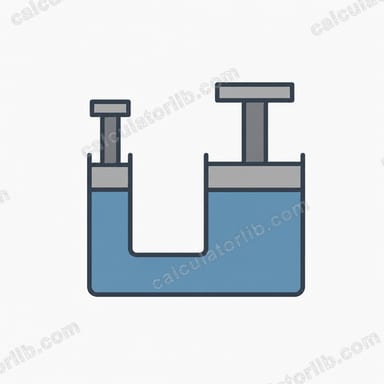

What is the Hydraulic Press Force Calculator?
This tool computes the output force of a hydraulic press based on Pascal's law, which states that pressure applied to a confined fluid is transmitted undiminished in every direction. Because pressure is the same on both pistons, a small input force acting on a small piston produces a much larger output force on a large piston. This is the principle behind hydraulic jacks, brakes, car lifts, and industrial presses.
How to use it
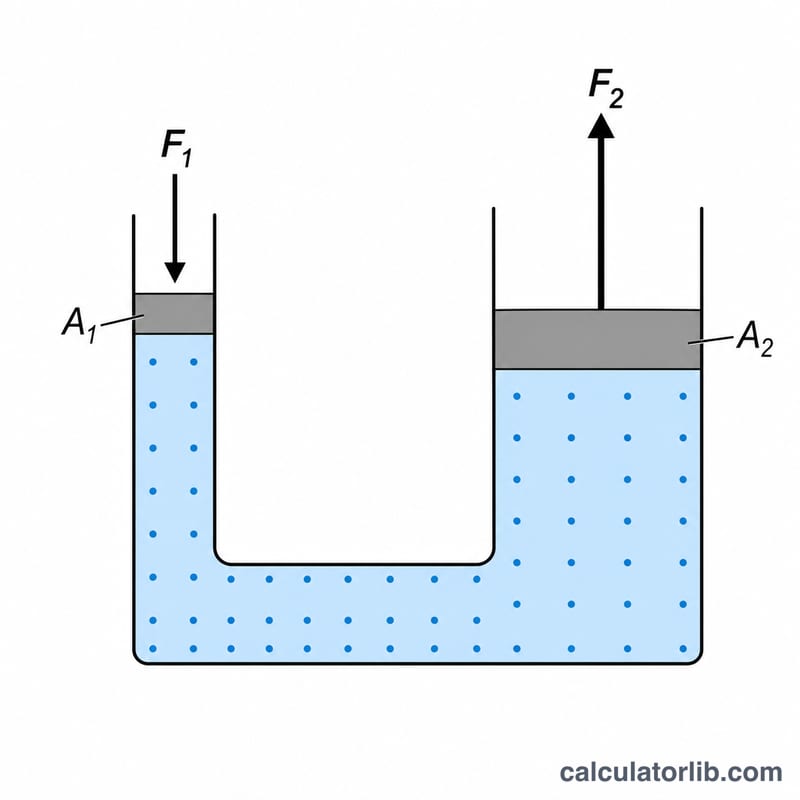
Enter the input force F1 applied to the small piston (in newtons), the area of the small input piston A1, and the area of the large output piston A2. Use the same area units for both pistons (here, cm²). The calculator returns the output force F2, the force-multiplication ratio, and the system pressure.
The formula explained
Pressure equals force divided by area, and pressure is equal on both sides: \( F_1 / A_1 = F_2 / A_2 \). Rearranging gives $$F_2 = F_1 \times \frac{A_2}{A_1}$$ The ratio \( A_2/A_1 \) is the mechanical advantage — a larger output piston multiplies force, but the larger piston moves a proportionally smaller distance, conserving energy.
Worked example
Suppose \( F_1 = 500 \text{ N} \) pushes on a small piston of area \( A_1 = 5 \text{ cm}^2 \), and the output piston has area \( A_2 = 50 \text{ cm}^2 \). Then \( A_2/A_1 = 10 \), so $$F_2 = 500 \times 10 = 5{,}000 \text{ N}$$ The system pressure is $$500 \text{ N} \div 0.0005 \text{ m}^2 = 1{,}000{,}000 \text{ Pa} \ (1 \text{ MPa})$$
FAQ
Does the press create free energy? No. The output force is larger but moves a shorter distance, so work in equals work out (minus friction losses).
What units should I use? Force in newtons; both areas in the same unit (cm² here). The ratio is unitless, so F2 comes out in newtons.
How is pressure calculated? Pressure \( = F_1 / A_1 \) with \( A_1 \) converted to square metres (\( 1 \text{ cm}^2 = 0.0001 \text{ m}^2 \)), giving the result in pascals.