
What this calculator does
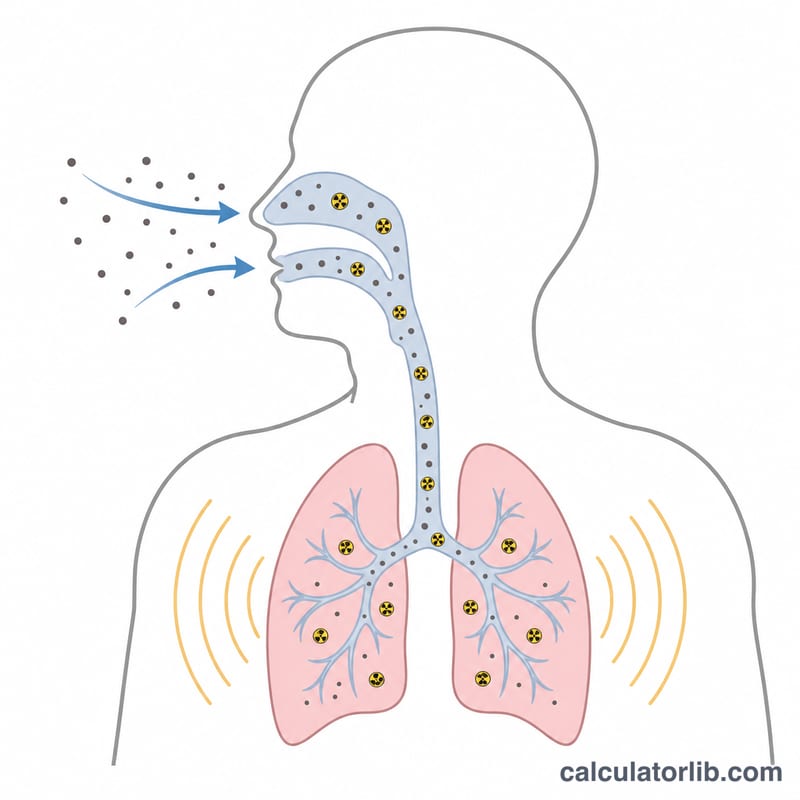
This tool estimates the committed effective internal radiation dose a person receives from breathing air contaminated with radioactive material. It covers three commonly reported radionuclides: Iodine-131 (I-131), Cesium-134 (Cs-134) and Cesium-137 (Cs-137). The physics of dose assessment is universal; the default dose-coefficient values shown here follow the published ICRP-type committed effective dose coefficients used worldwide and tabulated by Japan's National Institute of Radiological Sciences (NIRS).
Key units
1 becquerel (Bq) is one nuclear disintegration per second and measures the strength of radioactivity, or here the activity concentration in air. 1 sievert (Sv) is the effective dose unit expressing biological impact on the human body. The dose coefficient (committed effective dose per unit intake) depends on both the radionuclide and the person's age group, because organ size, metabolism and breathing rate differ by age.
How to use it
Pick an age group to load default breathing rate and dose coefficients (you may edit any of them). Enter the air activity concentration in \(\text{Bq/m}^3\) for each nuclide and the number of days of exposure. The calculator returns the dose per nuclide and the total in microsievert (uSv), millisievert (mSv) and sievert (Sv).
The formula explained
For each radionuclide the activity inhaled is concentration (\(\text{Bq/m}^3\)) x breathing volume (\(\text{m}^3\text{/day}\)) x days, giving total Bq inhaled. Multiplying by the dose coefficient (uSv/Bq) gives dose in uSv. The total is the sum across nuclides: Dose = activity concentration x dose coefficient x breathing volume per day x number of days.
$$\begin{gathered} E = B \cdot D \sum_{i} C_i \, e_i \\[1.5em] \text{where}\quad \left\{ \begin{aligned} B &= \text{Breathing Rate (m}^3\text{/day)} \\ D &= \text{Days} \\ C_i \, e_i &= \text{C}_{I131}\,e_{I131} + \text{C}_{Cs134}\,e_{Cs134} + \text{C}_{Cs137}\,e_{Cs137} \end{aligned} \right. \end{gathered}$$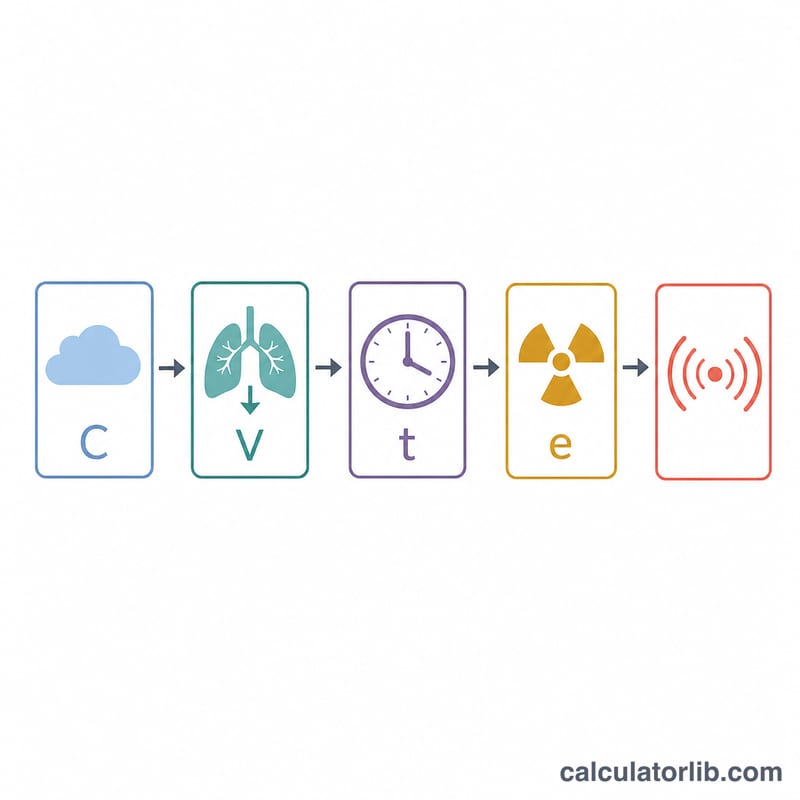
Worked example
Adult, breathing rate 22.2 \(\text{m}^3\text{/day}\), 1 day. Concentrations: I-131 100, Cs-134 50, Cs-137 50 \(\text{Bq/m}^3\). Intakes: 2220, 1110, 1110 Bq. Doses:
$$2220 \times 0.0074 = 16.428 \ \text{uSv}$$$$1110 \times 0.0066 = 7.326 \ \text{uSv}$$$$1110 \times 0.0039 = 4.329 \ \text{uSv}$$$$\text{Total} = 28.083 \ \text{uSv} = 0.028083 \ \text{mSv}$$FAQ
Is decay modeled? No. The committed effective dose is integrated over 50 years (adults) or to age 70 (children); this is already built into the dose coefficients.
Why does age change the result? Younger people have different breathing rates and metabolism, so their dose coefficients differ.
Is this a regulatory assessment? No. It is a simplified screening estimate; real assessments use more nuclides, ingestion pathways and time-dependent intake.