What this calculator does
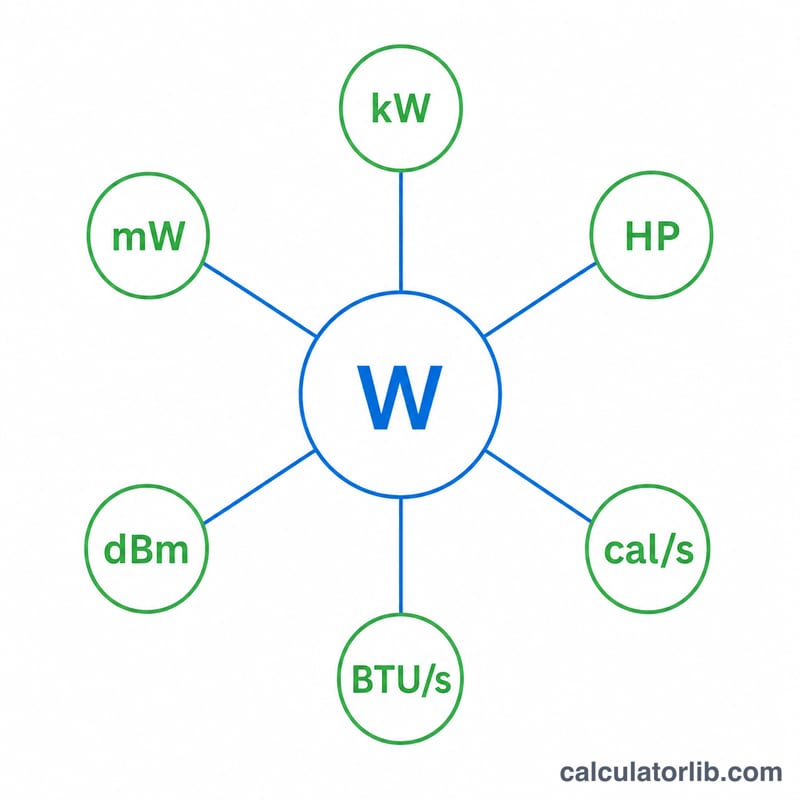
The Power Unit Conversion Calculator converts a single power value (a rate of doing work or transferring energy) into every common unit at once. It covers metric SI units (milliwatt, watt, kilowatt), the logarithmic radio-frequency scale dBm, mechanical units (kilogram-force metre per second, metric horsepower PS, imperial horsepower HP, foot pound-force per second) and thermal units (calorie/second, kilocalorie/second, BTU/second). One entry instantly fills the whole table.
How to use it
Type the numeric power into the Power field, choose the Unit that value is expressed in, and pick the number of significant digits for display. The result panel shows the equivalent value in all eleven units, grouped by unit system, plus the underlying SI value in watts.
The formula explained
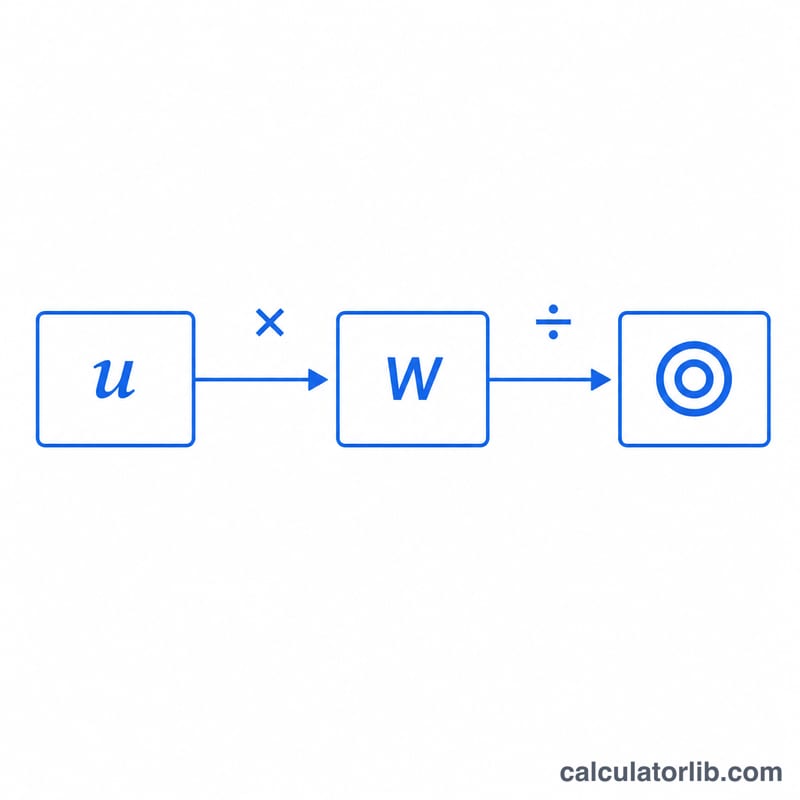
Every linear unit has a fixed factor giving watts per unit (for example 1 kW = 1000 W, 1 PS = 735.49875 W, 1 HP = 745.69987 W). The tool first converts your input to watts with \(P_{\text{W}} = \text{value} \times \text{factor}\), then divides by each target factor: \(\text{out} = P_{\text{W}} / \text{factor}_{\text{target}}\). The dBm scale is the exception: it is logarithmic, so $$P_{\text{W}} = 0.001 \times 10^{\,\text{dBm}/10}$$ on the way in and \(\text{dBm} = 10 \times \log_{10}(P_{\text{W}} / 0.001)\) on the way out. Because dBm needs a logarithm, it is only defined for positive power.
Worked example
Enter value = 1 and unit = Kilowatt. That is \(P_{\text{W}} = 1000 \text{ W}\). Dividing 1000 W by each factor gives 1,000,000 mW, 1000 W, 1 kW, 60 dBm, 101.9716 kgf-m/s, 1.35962 PS, 1.34102 HP, 737.5621 ft-lbf/s, 238.8459 cal/s, 0.238846 kcal/s and 0.947817 BTU/s.
Conversion Factors Used (Watts per Unit)
The calculator converts every input to watts first, then from watts to each target unit: \(P_{\text{W}} = \text{Value} \times k_{\text{Unit}}\). The factors are:
| Unit | Watts per unit | Note |
|---|---|---|
| Milliwatt (mW) | 0.001 W | exact |
| Kilowatt (kW) | 1000 W | exact |
| Kilogram-force metre per second (kgf·m/s) | 9.80665 W | exact, from standard gravity |
| Metric horsepower (PS) | 735.49875 W | 75 kgf·m/s |
| Imperial (mechanical) horsepower (HP) | 745.69987 W | 550 ft·lbf/s (rounded; the exact value has more decimals) |
| Foot-pound force per second (ft·lbf/s) | 1.3558179 W | rounded |
| Calorie per second (cal/s, IT) | 4.1868 W | International Table calorie |
| Kilocalorie per second (kcal/s) | 4186.8 W | 1000 cal/s |
| BTU per second (BTU/s, IT) | 1055.05585262 W | International Table BTU |
dBm is a logarithmic unit referenced to 1 mW, so 0 dBm = 1 mW. The conversions are \(P_{\text{mW}} = 10^{\text{dBm}/10}\) and \(\text{dBm} = 10\log_{10}(P_{\text{mW}})\). A different kind of horsepower (boiler, electrical at 746 W) has a different factor, so check which one your source uses.
dBm to Watt Reference Values
| dBm | Power | Watts |
|---|---|---|
| -30 dBm | 1 µW | 0.000001 W |
| -10 dBm | 100 µW | 0.0001 W |
| 0 dBm | 1 mW | 0.001 W |
| 3 dBm | ≈ 2 mW (1.995 mW) | ≈ 0.002 W |
| 10 dBm | 10 mW | 0.01 W |
| 20 dBm | 100 mW | 0.1 W |
| 30 dBm | 1 W | 1 W |
| 40 dBm | 10 W | 10 W |
| 60 dBm | 1 kW | 1000 W |
Rules of thumb: every +10 dB multiplies power by ten, and every +3 dB roughly doubles it (exactly \(10^{0.3} \approx 1.995\)). Every -3 dB roughly halves it. Because dBm is logarithmic, you cannot add dBm values directly as if they were watts.
Typical Power Levels in Different Units
Values are computed from the exact factors above (1 HP = 745.69987 W, 1 PS = 735.49875 W, 1 BTU/s = 1055.05585262 W) and rounded to the digits shown.
| Example | W | kW | HP (imperial) | PS (metric) | dBm |
|---|---|---|---|---|---|
| Wi-Fi router transmit power (~100 mW) | 0.1 | 0.0001 | 0.000134102 | 0.000135962 | 20 |
| 60 W light bulb | 60 | 0.06 | 0.080461 | 0.081577 | 47.78 |
| 1 kW heater | 1000 | 1 | 1.341022 | 1.359622 | 60 |
| 100 HP car engine | 74569.987 | 74.569987 | 100 | 101.387 | 78.73 |
| 1 BTU/s heat load | 1055.056 | 1.055056 | 1.414853 | 1.434477 | 60.23 |
Example of the arithmetic for the engine: \(100 \times 745.69987\ \text{W} = 74569.987\ \text{W}\), then \(74569.987 / 735.49875 \approx 101.387\ \text{PS}\). For the bulb in dBm: \(10\log_{10}(60000\ \text{mW}) \approx 47.78\ \text{dBm}\).
FAQ
Why are there two horsepowers? Metric horsepower (PS) equals 75 kgf-m/s ~ 735.5 W, while the imperial/mechanical horsepower (HP) equals 550 ft-lbf/s ~ 745.7 W. They differ by about 1.4%, so they are kept separate.
Which calorie is used? The IT (international steam table) calorie of 4.1868 J, and the IT BTU of 1055.05585262 J, matching standard engineering tables.
What does dBm show for zero power? dBm is undefined (negative infinity) for zero or negative power, since the logarithm of zero diverges.