
What is the Speed Unit Conversion Calculator?
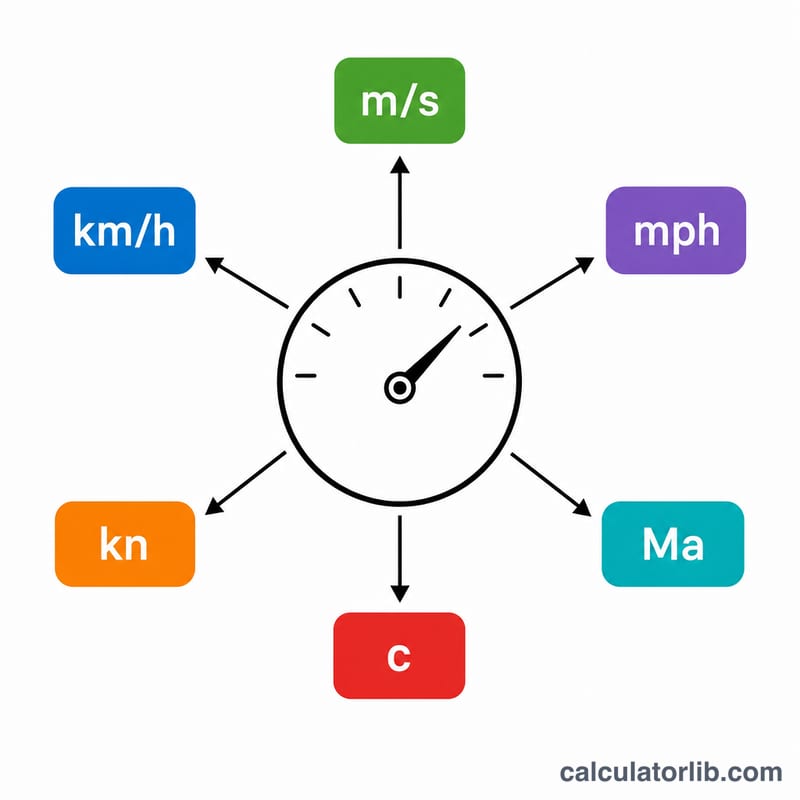
This calculator converts a single speed value, entered in any one supported unit, into every other supported speed unit at once. Supported units span metric (metre per second, kilometre per hour), imperial / yard-pound (feet per second, feet per minute, feet per hour, miles per second, miles per minute, miles per hour), nautical (knots), sound-based units (Mach, speed of sound in the atmosphere), and the speed of light in vacuum. It is a universal physics/units tool and applies everywhere.
How to use it
Enter the speed magnitude, choose the unit that magnitude is expressed in, and pick how many significant digits you want in the output. The results table then lists the equivalent value in all units, grouped by category (Metric, Imperial/yard-pound, Nautical, Sound, Light).
The formula explained
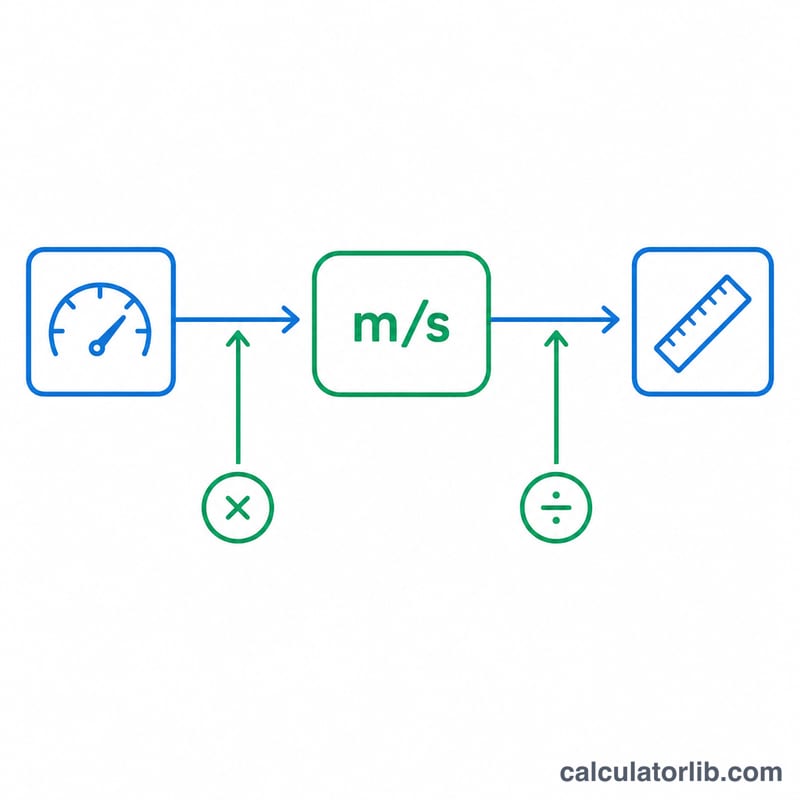
Each unit has a fixed conversion factor to SI (metres per second). The conversion is purely linear in two steps. Step 1 normalizes to SI: \(v_{\text{SI}} = \text{speedValue} \times \text{factor(inputUnit)}\). Step 2 converts SI to each target unit: \(\text{value\_in\_unit} = v_{\text{SI}} / \text{factor(targetUnit)}\). Combined:
$$\text{value} = \text{speedValue} \times \frac{\text{factor(inputUnit)}}{\text{factor(targetUnit)}}$$
Key factors (to m/s): \(\text{km/h} = 1/3.6\), \(\text{fps} = 0.3048\), \(\text{mph} = 0.44704\), \(\text{knot} = 1852/3600\), speed of sound \(\approx 331.5\), speed of light \(= 299792458\).
Worked example
Input: 1 km/h.
$$v_{\text{SI}} = 1 \times 0.277777\ldots = 0.277777\ldots \text{ m/s}$$
Then:
$$\text{asMetrePerSecond} = 0.277778$$
$$\text{asFeetPerSecond} = \frac{0.277778}{0.3048} = 0.911344$$
$$\text{asMilesPerHour} = \frac{0.277778}{0.44704} = 0.621371$$
$$\text{asKnots} = \frac{0.277778}{0.514444} = 0.539957$$
These reproduce the standard conversion table for 1 km/h.
FAQ
Does Mach depend on temperature? Yes. The real speed of sound varies with air temperature, pressure and altitude. This tool uses a fixed reference of about \(331.5\) m/s (dry air near 0°C), so Mach values are approximate.
Is the speed of light exact? Yes, the speed of light in vacuum is defined exactly as \(299{,}792{,}458\) m/s in SI.
Can I enter negative speeds? Mathematically yes — the scaling is linear, so a negative input simply produces negative outputs, though negative speed is physically unusual.