
What is vector addition?
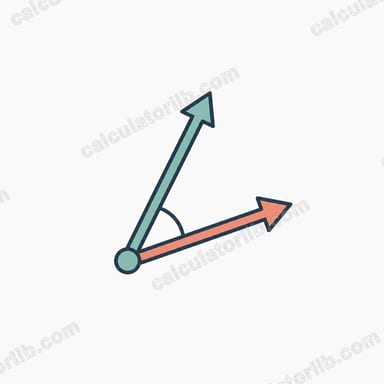
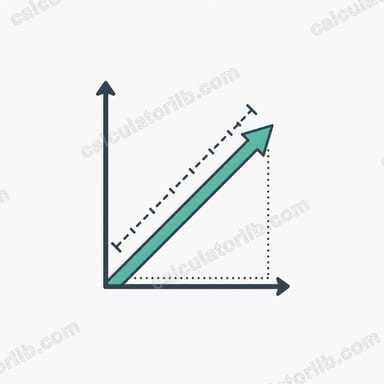
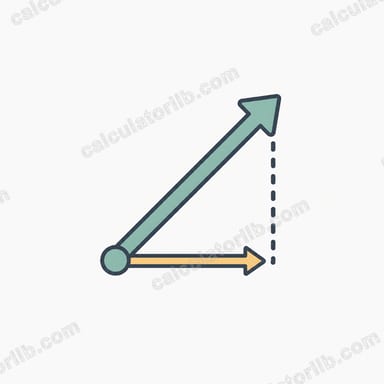
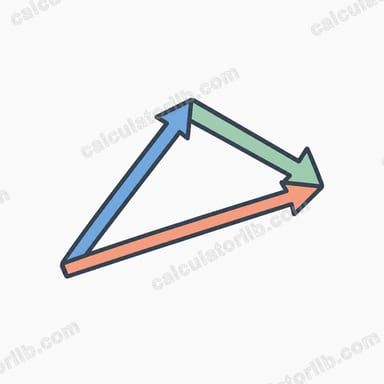
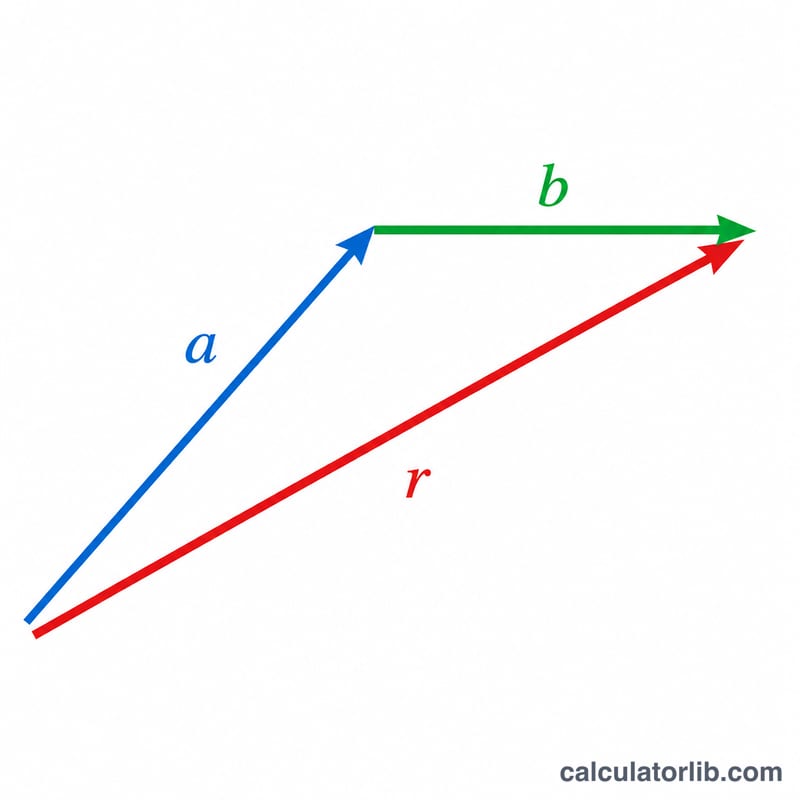
Vector addition combines two vectors into a single resultant vector. It works component by component: you simply add the x-components together, the y-components together, and the z-components together. Geometrically this is the "head-to-tail" rule — place the tail of vector B at the head of vector A, and the resultant runs from the tail of A to the head of B. This calculator handles both 2D vectors (leave the z values at 0) and full 3D vectors.
How to use this calculator
Enter the x, y and (optionally) z components of Vector A and Vector B, then read off the resultant. The tool returns each component of A + B and the overall magnitude (length) of the resultant vector. For 2D problems, just leave the z fields as 0.
The formula explained
For each component index i, the resultant satisfies \((a + b)_i = a_i + b_i\). Written out, the resultant is:
$$\vec{R} = \vec{A} + \vec{B} = \left( \text{A}_x + \text{B}_x,\ \text{A}_y + \text{B}_y,\ \text{A}_z + \text{B}_z \right)$$The magnitude is found with the Euclidean norm: the square root of the sum of the squared components.
$$\left| \vec{R} \right| = \sqrt{ \left( \text{A}_x + \text{B}_x \right)^2 + \left( \text{A}_y + \text{B}_y \right)^2 + \left( \text{A}_z + \text{B}_z \right)^2 }$$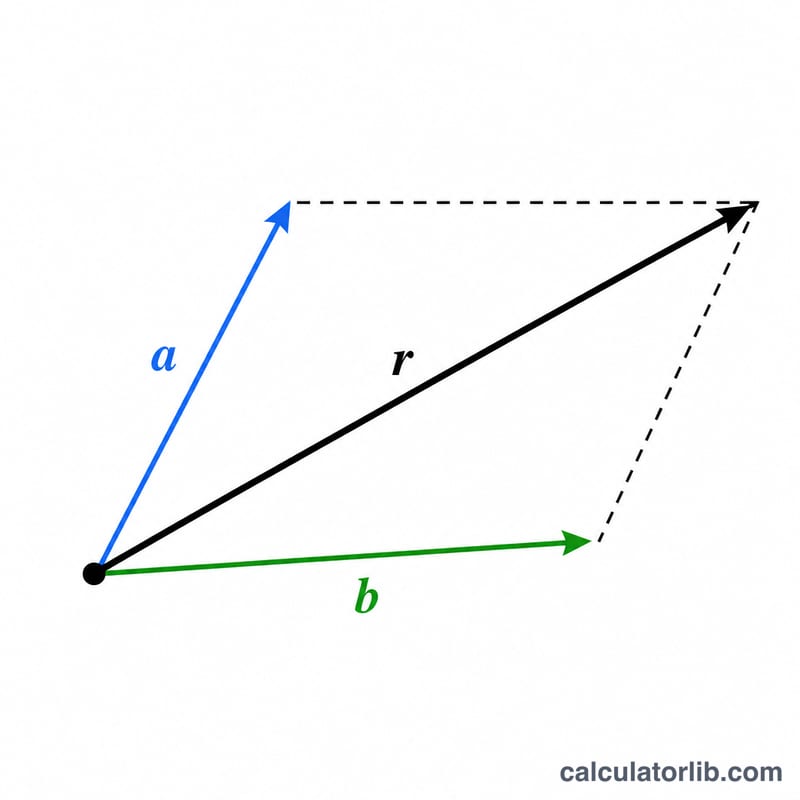
Worked example
Add \(A = (3, 4, 0)\) and \(B = (1, 2, 0)\). Component-wise: \(x = 3 + 1 = 4\), \(y = 4 + 2 = 6\), \(z = 0 + 0 = 0\), so \(A + B = (4, 6, 0)\). The magnitude is:
$$\sqrt{4^2 + 6^2 + 0^2} = \sqrt{16 + 36} = \sqrt{52} \approx 7.2111$$FAQ
Can I add vectors of different dimensions? Treat a 2D vector as a 3D vector with \(z = 0\); addition is only defined when both vectors have the same number of components.
Is vector addition commutative? Yes — \(A + B = B + A\), because real-number addition of each component is commutative.
What does the magnitude mean? It is the length of the resultant arrow, useful in physics for combining forces, velocities, or displacements.