
What are the Euler numbers?
The Euler numbers Eₙ are a famous integer sequence that appears in the Taylor expansion of the hyperbolic secant 1/cosh(x). They are sometimes called the secant numbers (up to sign). This is pure mathematics and applies identically everywhere — there is no region-specific rule. This tool prints a table of Eₙ for any index range you choose.
How to use it
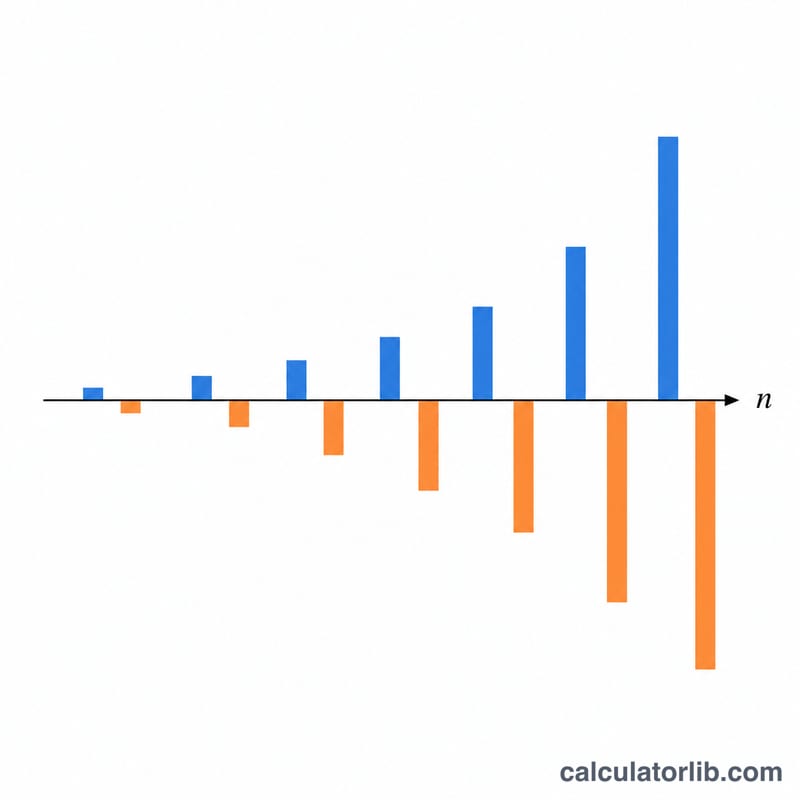
Enter the start (nMin) and end (nMax) of the ordinal range, then pick a display precision in significant digits. The calculator lists every integer index n from nMin to nMax inclusive together with its Euler number. Because the values grow super-exponentially, exact big-integer arithmetic is used internally and very large numbers are shown in scientific notation.
The formula
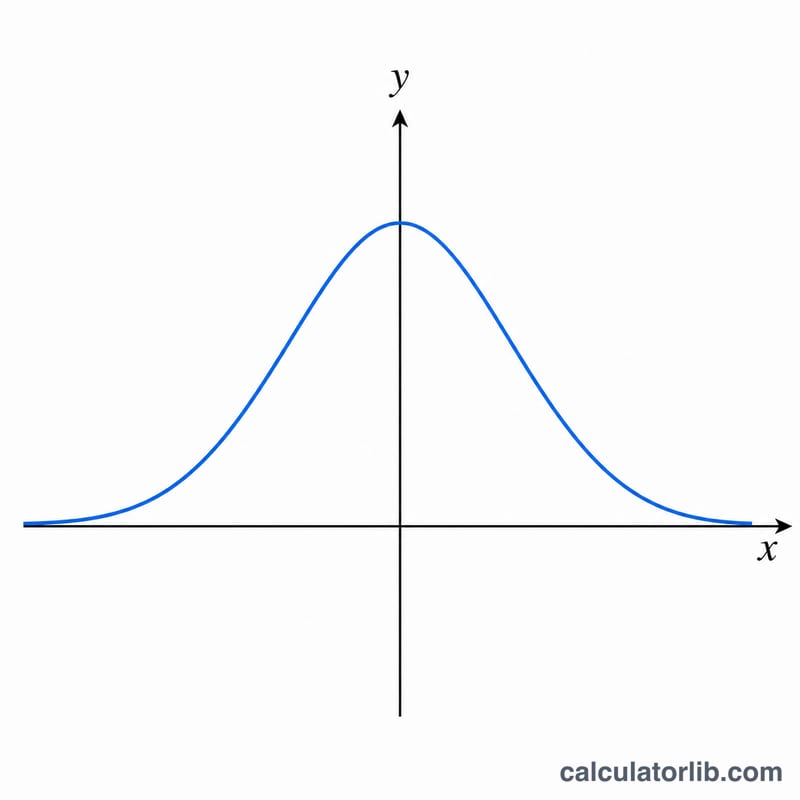
The generating function is \( \frac{1}{\cosh(x)} = \sum E_n / n! \cdot x^n \). All odd-index Euler numbers are exactly zero. The even-index numbers follow the exact recurrence:
$$E_0 = 1, \text{ and for } m \ge 1: E_{2m} = -\sum_{k=0}^{m-1} \binom{2m}{2k} \cdot E_{2k}.$$
The signs alternate automatically: \(E_0 = 1\), \(E_2 = -1\), \(E_4 = 5\), \(E_6 = -61\), \(E_8 = 1385\).
Worked example
For nMin = 0, nMax = 8 the table contains 9 rows: \(n=0 \rightarrow 1\), \(n=1 \rightarrow 0\), \(n=2 \rightarrow -1\), \(n=3 \rightarrow 0\), \(n=4 \rightarrow 5\), \(n=5 \rightarrow 0\), \(n=6 \rightarrow -61\), \(n=7 \rightarrow 0\), \(n=8 \rightarrow 1385\).
FAQ
Why are odd entries always 0? Because \( 1/\cosh(x) \) is an even function, so only even powers of x appear in its expansion.
Are these the same as Euler's number e? No. Euler's number \( e \approx 2.71828 \) is unrelated; these are integers from the secant generating function.
How large can the range be? nMax is capped at 100. The values are computed exactly with big integers, so no precision is lost.