
What Is the Fraction Exponent Calculator?
This calculator raises a fraction (a/b) to a power that can itself be a whole number or a fraction (p/q). It applies the exponent rules of algebra so you can quickly evaluate expressions like \((2/3)^2\) or \((4/9)^{1/2}\) without manual arithmetic. It is a universal math tool — the rules hold everywhere.
How to Use It
Enter the base fraction as its numerator (a) and denominator (b). Then enter the exponent as a numerator (p) and a denominator (q). For a plain whole-number power, leave the exponent denominator as 1 — for example, an exponent of 2/1 simply means squared. Press calculate to see the result along with the simplified base value and the decimal exponent.
The Formula Explained
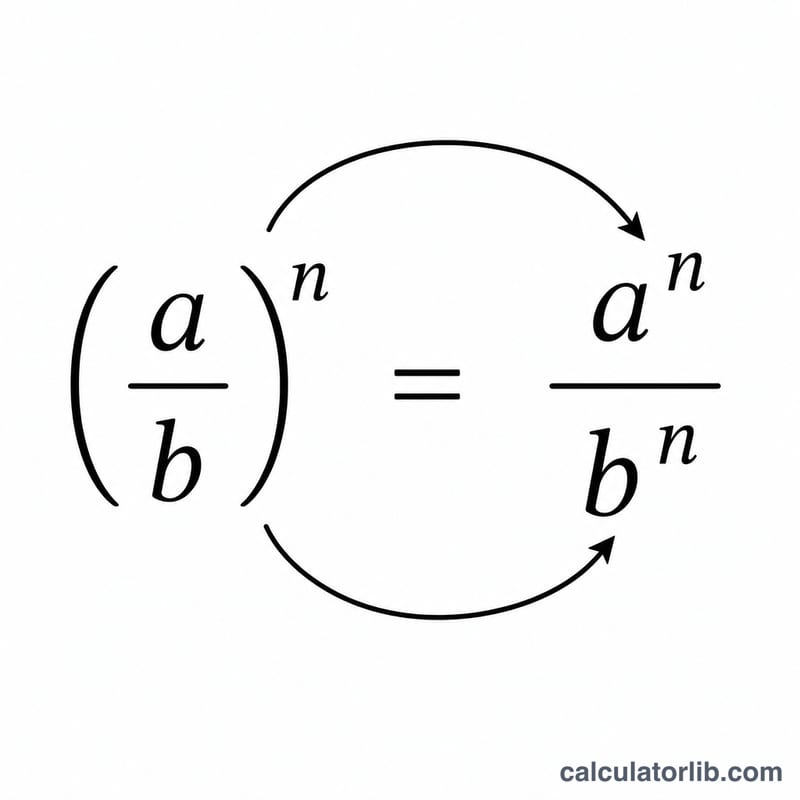
The power-of-a-fraction rule says \((a/b)^n = a^n / b^n\): every part of the fraction gets the exponent. When the exponent is itself a fraction p/q, it combines a power and a root:
$$x^{\frac{p}{q}} = \left(x^p\right)^{\frac{1}{q}}$$which is the same as the q-th root of x raised to p. The calculator first reduces the base to a single decimal value, then applies the combined exponent using the power function.
Worked Example
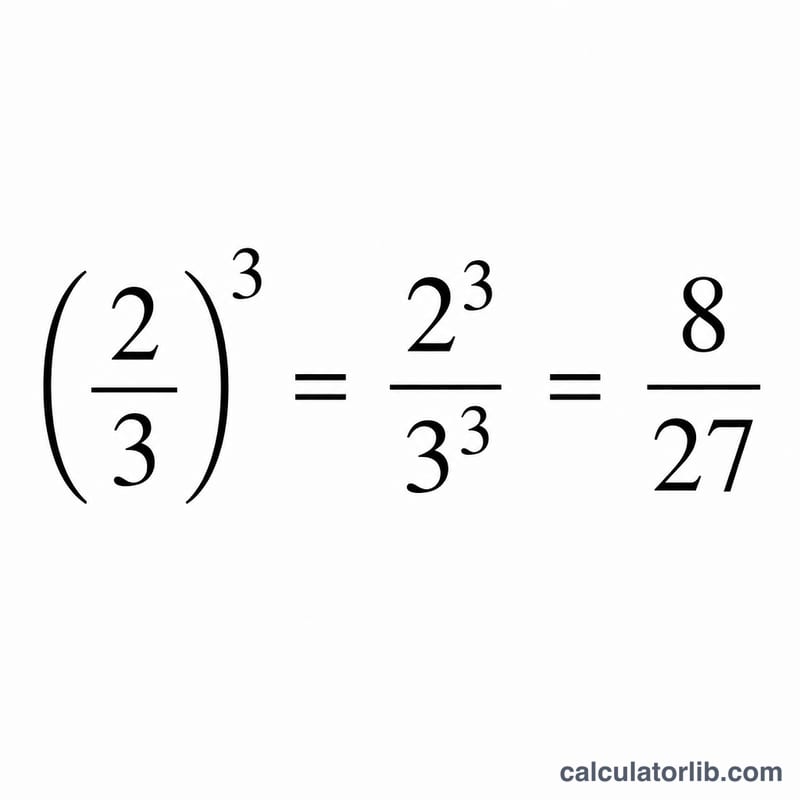
Suppose you want \((2/3)^2\). The base is \(2 \div 3 = 0.6667\) and the exponent is \(2 \div 1 = 2\). Then
$$\left(\frac{2}{3}\right)^2 = \frac{2^2}{3^2} = \frac{4}{9} \approx 0.4444$$As a second example, \((4/1)^{1/2}\) is the square root of 4, which equals 2.
FAQ
Can the exponent be negative? Yes. A negative exponent gives the reciprocal: \((a/b)^{-n} = (b/a)^n\).
What about a fractional exponent on a negative base? Even roots of negative numbers are not real, so the result may be undefined (shown as NaN).
Why do I get a long decimal? Roots and many powers are irrational, so the answer is shown rounded to several decimal places.