
What Is a Negative Exponent?
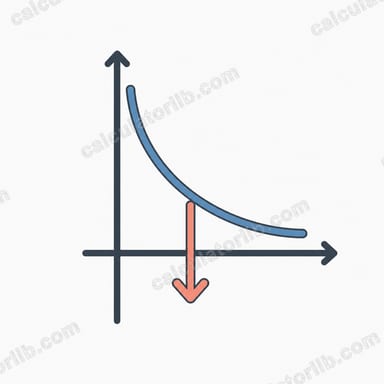
A negative exponent tells you to take the reciprocal of the base raised to the positive version of that exponent. In symbols, \(a^{-n} = 1 / a^{n}\). So instead of multiplying the base by itself, you divide 1 by the base multiplied by itself n times. This rule keeps the laws of exponents consistent and is fundamental in algebra, scientific notation, and calculus.
$$a^{-n} = \frac{1}{a^{n}}$$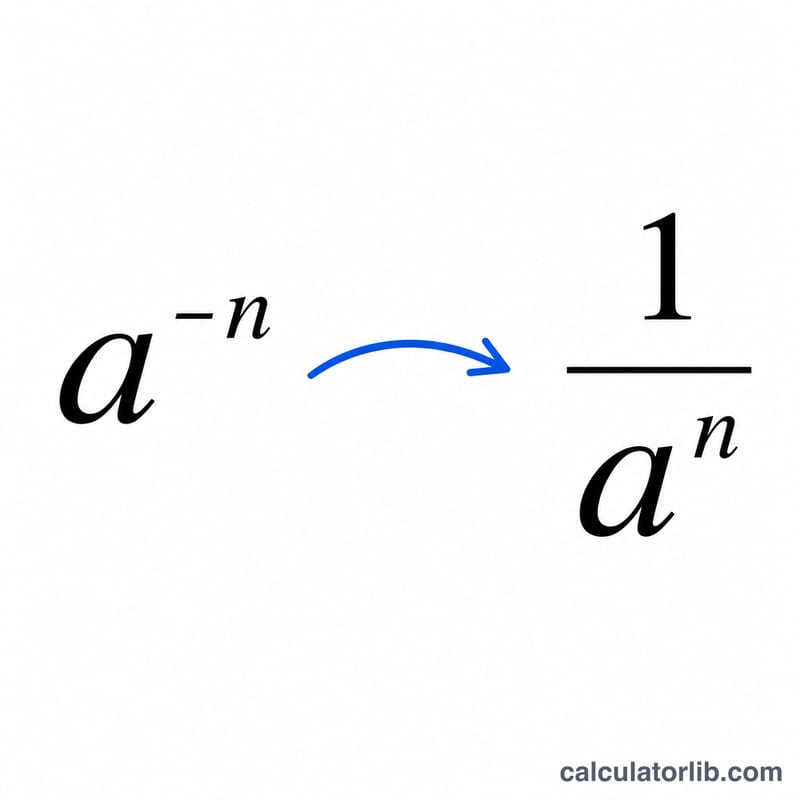
How to Use This Calculator
Enter the base (a) and the exponent (n). The exponent you type is treated as the negative power automatically — for example, entering base 2 and exponent 3 computes \(2^{-3}\). The tool returns the final value plus the positive power \(a^{n}\) so you can see the reciprocal clearly. Decimals and fractional exponents are supported.
The Formula Explained
The expression \(a^{-n}\) is defined as 1 divided by \(a^{n}\). This works because of the quotient rule of exponents: \(a^{m} / a^{m+n} = a^{-n}\), which simplifies to \(1 / a^{n}\). Note that the base cannot be zero, since dividing by zero is undefined.
Worked Example
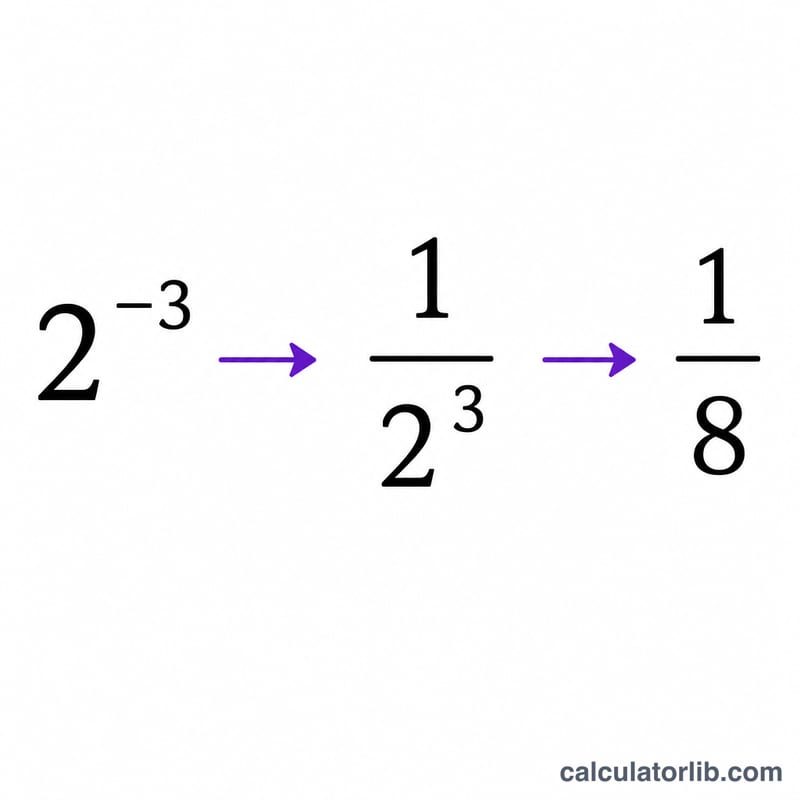
Compute \(2^{-3}\). First find the positive power: \(2^{3} = 8\). Then take the reciprocal: \(1 / 8 = 0.125\). So \(2^{-3} =\) 0.125. Likewise, \(5^{-2} = 1 / 25 = 0.04\), and \(10^{-1} = 1 / 10 = 0.1\).
FAQ
What is a number to a negative power? It is the reciprocal of that number to the positive power — flip it to a fraction.
Can the base be negative? Yes. For example, \((-2)^{-2} = 1 / (-2)^{2} = 1 / 4 = 0.25\). Fractional exponents of negative bases may be undefined in real numbers.
What happens if the base is 0? 0 raised to a negative exponent is undefined because it requires dividing by zero.