
What is the upper-tail probability P(Z > z)?
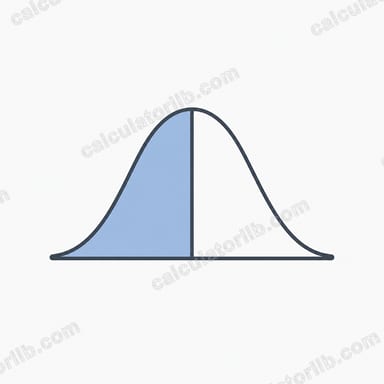
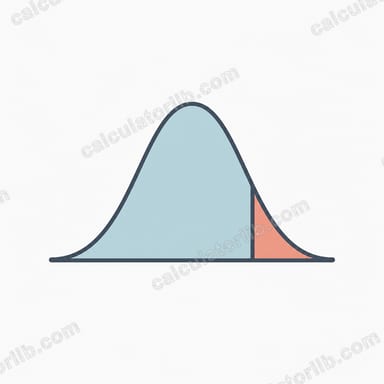
For the standard normal distribution (mean 0, standard deviation 1), the upper-tail probability \(P(Z > \text{z})\) is the area under the bell curve to the right of a given z-score. It answers questions like "what fraction of observations fall above this value?" Because the total area under the curve equals 1, the upper tail is simply 1 minus the cumulative probability: \(P(Z > \text{z}) = 1 - \Phi(\text{z})\), where \(\Phi(\text{z})\) is the standard normal cumulative distribution function.
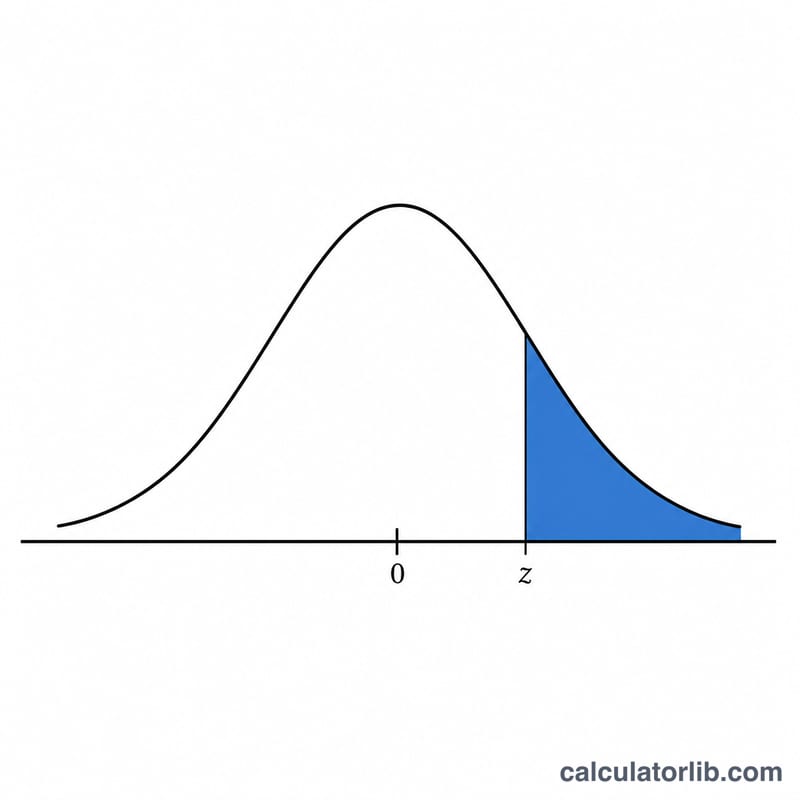
How to use this calculator
Enter a z-score — the number of standard deviations a value sits above (positive) or below (negative) the mean. The calculator returns the upper-tail probability \(P(Z > \text{z})\), the cumulative probability \(\Phi(\text{z}) = P(Z \le \text{z})\), and the percentile rank (\(\Phi\) expressed as a percentage). A z of 0 gives exactly 0.5 for the upper tail, since the normal curve is symmetric.
The formula explained
The cumulative distribution function is written using the error function: $$\Phi(\text{z}) = \frac{1}{2}\left[1 + \operatorname{erf}\!\left(\frac{\text{z}}{\sqrt{2}}\right)\right]$$ This calculator evaluates erf with the Abramowitz & Stegun rational approximation, which is accurate to about seven decimal places. The upper tail is then \(1 - \Phi(\text{z})\), and the percentile rank is \(100 \times \Phi(\text{z})\).
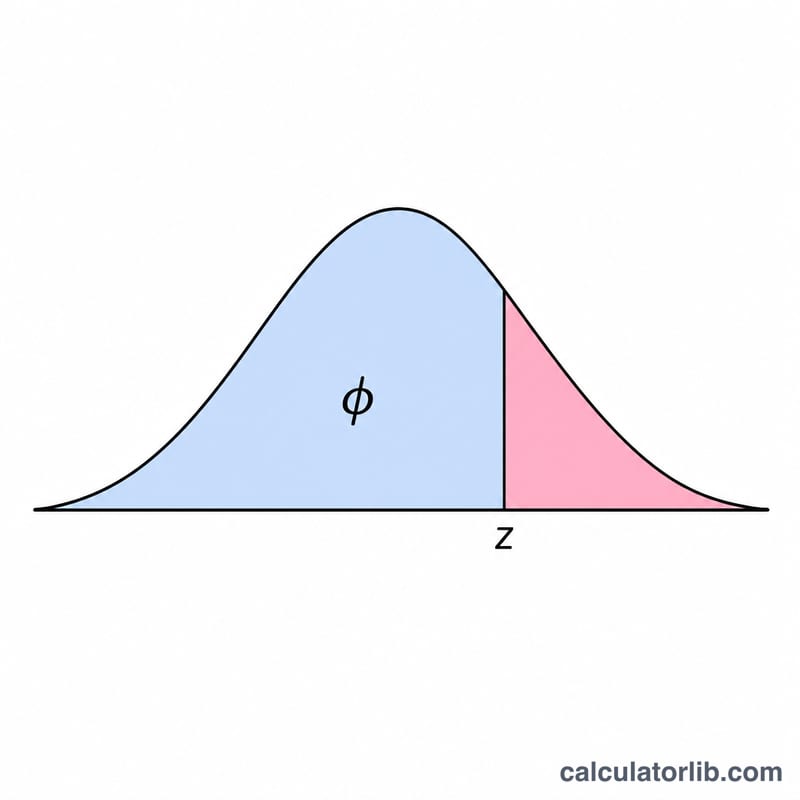
Worked example
Take \(\text{z} = 1.0\). The cumulative probability \(\Phi(1) \approx 0.8413\), so $$P(Z > 1) = 1 - 0.8413 \approx 0.1587$$ This means about 15.87% of a normal distribution lies more than one standard deviation above the mean, and a z-score of 1 corresponds to roughly the 84th percentile.
FAQ
What does a negative z-score give? For \(\text{z} = -1.0\), \(\Phi(-1) \approx 0.1587\), so the upper tail \(P(Z > -1) \approx 0.8413\) — about 84% of the distribution lies above it.
Is this a one-tailed p-value? Yes. For a right-tailed hypothesis test, \(P(Z > \text{z})\) is exactly the one-sided p-value for your test statistic.
How accurate is the result? The approximation has a maximum error of about \(1.5 \times 10^{-7}\), more than enough for typical statistical work.