
What is linear velocity?
Linear velocity (also called tangential velocity) is the speed at which a point on a rotating object moves along its circular path. It depends on how far the point is from the axis of rotation (the radius r) and how fast the object spins (the angular velocity ω). The relationship is the simple, universal equation $$v = r\cdot\omega$$
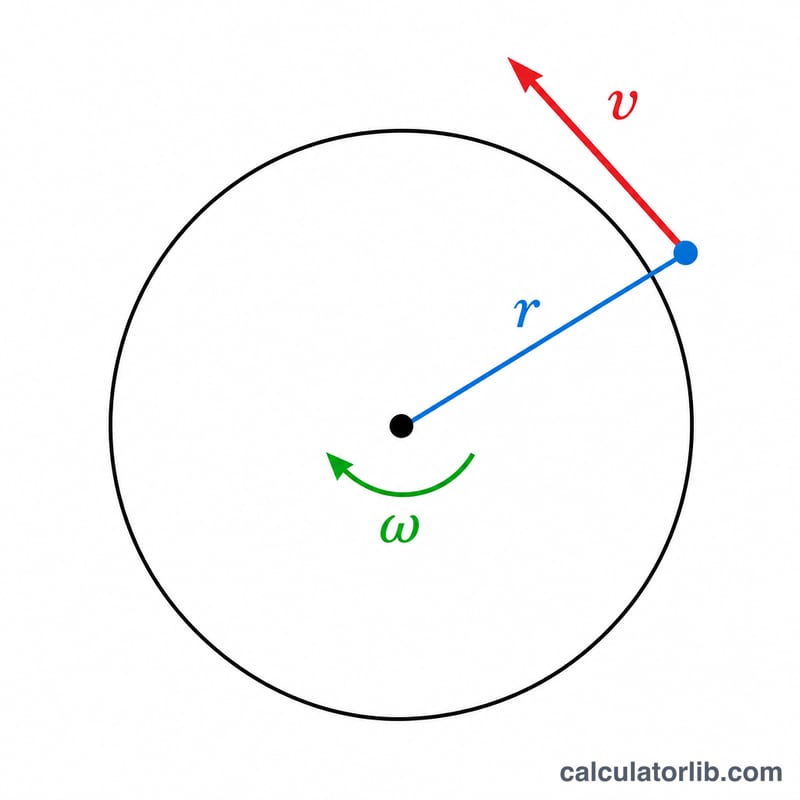
How to use this calculator
Enter the radius r in meters and the angular velocity ω in radians per second (rad/s). The calculator multiplies them to return the linear velocity v in meters per second (m/s). If your angular speed is in revolutions per minute (rpm), convert first: \(\omega \text{ (rad/s)} = \text{rpm} \times 2\pi / 60\).
The formula explained
In the equation $$v = r\cdot\omega$$ ω must be in radians per second so that the result comes out in consistent SI units. A larger radius means a point sweeps a longer arc per rotation, so it moves faster even though the angular velocity is the same. This is why the outer edge of a spinning disc travels faster than a point near its center.
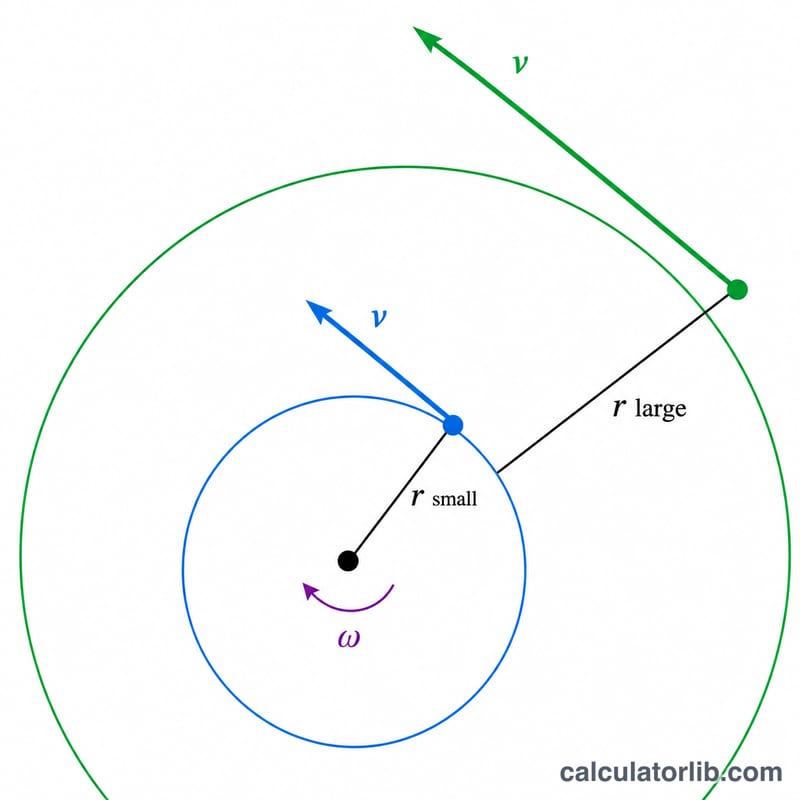
Worked example
A wheel of radius 0.5 m spins at 10 rad/s. Its linear velocity at the rim is $$v = 0.5 \times 10 = 5 \text{ m/s}$$ Double the radius to 1 m and the rim speed doubles to 10 m/s for the same angular velocity.
FAQ
What units should I use? Use meters for radius and rad/s for angular velocity to get m/s. Any consistent unit system works as long as ω is in radians.
How do I convert rpm to rad/s? Multiply rpm by \(2\pi/60\) (about 0.10472). For example, 60 rpm = 6.283 rad/s.
Is linear velocity the same as angular velocity? No. Angular velocity measures rotation rate (rad/s) and is the same everywhere on the object; linear velocity (m/s) depends on distance from the axis.