
What This Calculator Does
This tool computes the standard enthalpy change of a chemical reaction (\(\Delta H_{rxn}\)) using Hess's Law. You provide the combined standard enthalpies of formation (\(\Delta H_f^{\circ}\)) for all products and for all reactants — each already multiplied by its stoichiometric coefficient — and the calculator returns the net heat of reaction in kilojoules per mole (kJ/mol).
The Formula Explained
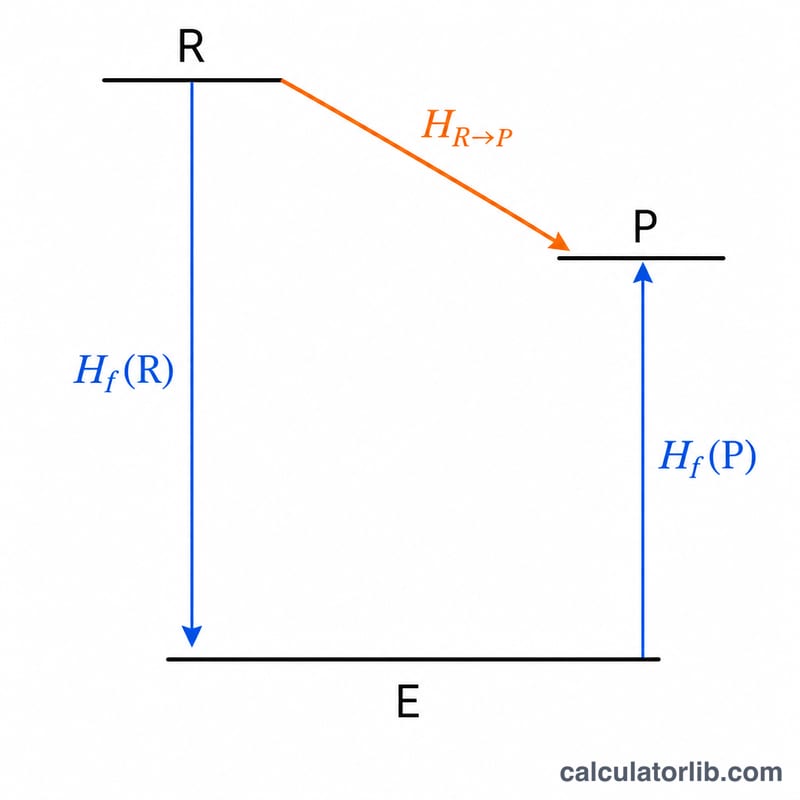
Hess's Law states that enthalpy is a state function, so the total enthalpy change depends only on the initial and final states, not the path taken. This gives the simple relationship:
$$\Delta H_{rxn} = \sum \Delta H_f^{\circ}\text{ Products} - \sum \Delta H_f^{\circ}\text{ Reactants}$$
The standard enthalpy of formation of any pure element in its most stable form (such as O₂, N₂, or solid carbon as graphite) is zero, which simplifies many calculations.
How to Use It
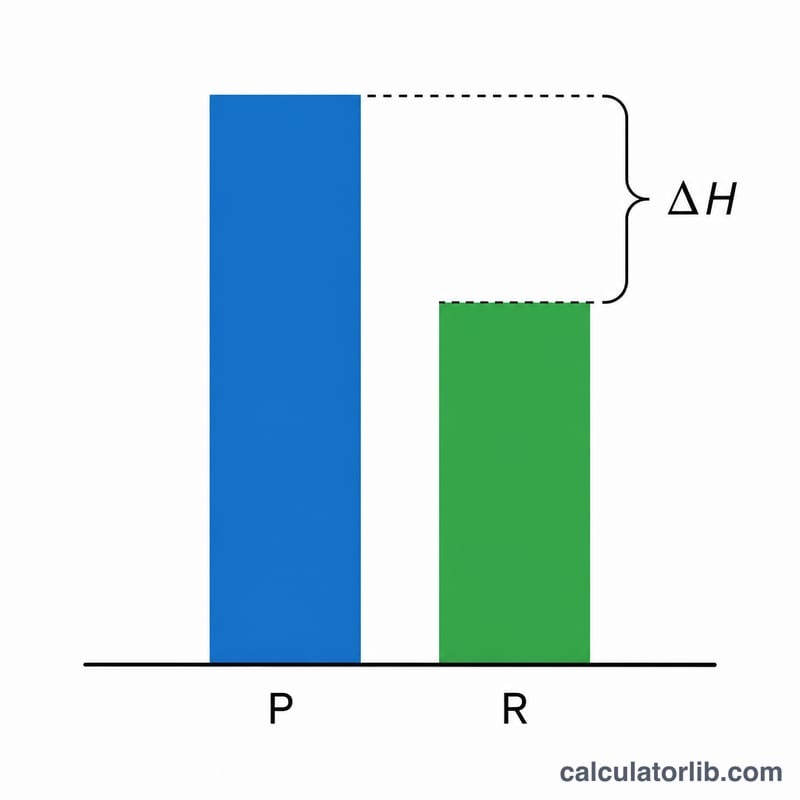
1. Look up the \(\Delta H_f^{\circ}\) of each product and reactant in a standard table. 2. Multiply each value by the number of moles (coefficient) in the balanced equation. 3. Add up the products into one box and the reactants into the other. 4. Read the result: a negative \(\Delta H\) means the reaction is exothermic (releases heat); a positive \(\Delta H\) means it is endothermic (absorbs heat).
Worked Example
Combustion of methane: CH₄ + 2O₂ → CO₂ + 2H₂O(l).
Products: \(\Delta H_f(\text{CO}_2) = -393.5\) and \(2 \times \Delta H_f(\text{H}_2\text{O}) = 2 \times (-285.8) = -571.6\), totaling −965.1 kJ/mol. Reactants: \(\Delta H_f(\text{CH}_4) = -74.8\) and \(2 \times \Delta H_f(\text{O}_2) = 0\), totaling −74.8 kJ/mol.
$$\Delta H_{rxn} = -965.1 - (-74.8) = -890.3 \text{ kJ/mol}$$ — strongly exothermic.
FAQ
Do I need to include the coefficients? Yes. Multiply each \(\Delta H_f\) value by the mole count from the balanced equation before summing.
What about elements? Elements in their standard state have \(\Delta H_f = 0\), so they contribute nothing.
What does the sign mean? Negative \(\Delta H\) = exothermic (heat released); positive \(\Delta H\) = endothermic (heat absorbed).