
What Is Curie's Law?
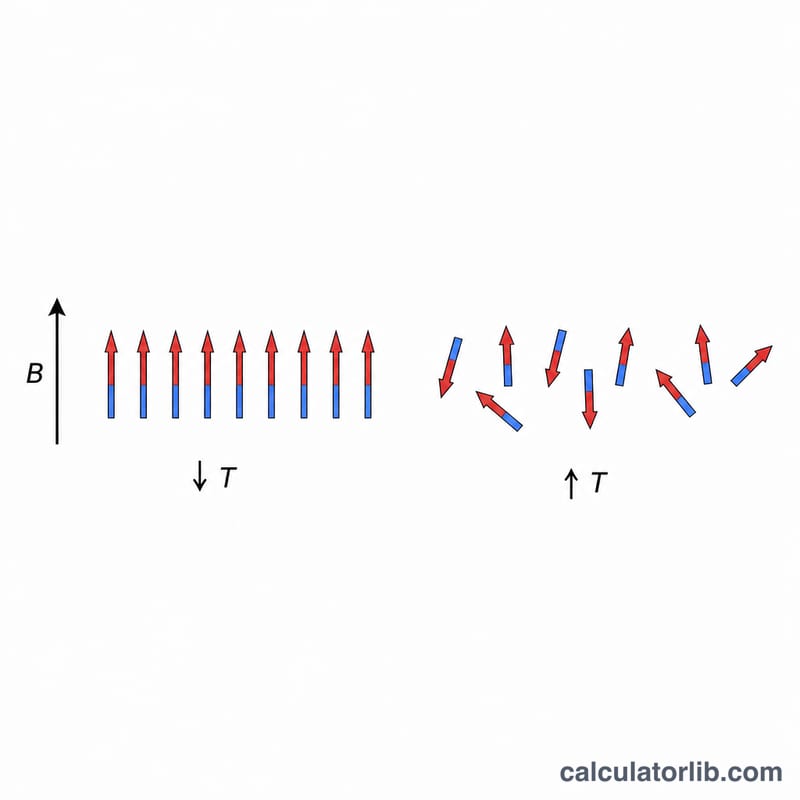
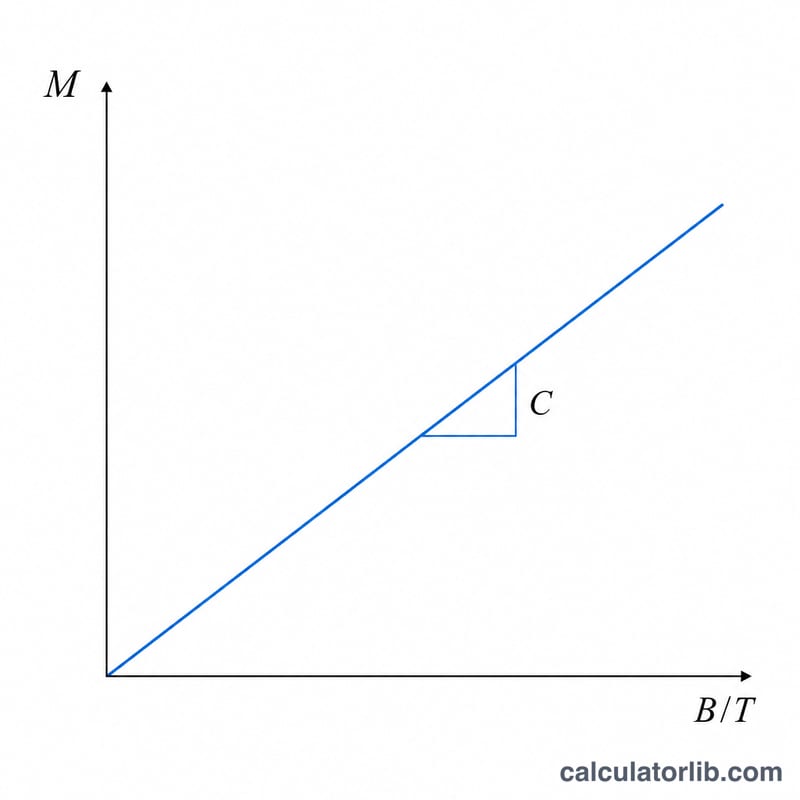
Curie's Law, named after physicist Pierre Curie, describes how a paramagnetic material responds to an applied magnetic field. It states that the magnetization (M) of a paramagnet is directly proportional to the applied magnetic field (B) and inversely proportional to the absolute temperature (T). In other words, as you heat a material its magnetization weakens, and as you increase the field its magnetization grows. The law holds well for paramagnetic substances at high temperatures or low magnetic fields.
How to Use This Calculator
Enter three values: the Curie constant C (a material-specific property), the magnetic field B in teslas, and the absolute temperature T in kelvin. The calculator returns the magnetization M. Make sure temperature is in kelvin (K = °C + 273.15) and is greater than zero, since dividing by zero temperature is undefined.
The Formula Explained
The relationship is simply $$M = \frac{\text{C} \cdot \text{B (T)}}{\text{T (K)}}$$ The Curie constant C captures the density and magnetic moment of the material's atoms. Multiplying by the field B increases alignment of the magnetic dipoles, while dividing by temperature T accounts for thermal agitation that randomizes those dipoles. The competition between field-driven ordering and heat-driven disorder is what produces the inverse-temperature dependence.
Worked Example
Suppose a paramagnetic sample has a Curie constant \(C = 1 \text{ K}\cdot\text{A/(m}\cdot\text{T)}\), sits in a field of \(B = 0.5 \text{ T}\), and is held at \(T = 300 \text{ K}\). Then $$M = \frac{1 \times 0.5}{300} = 0.0016667 \text{ A/m}$$ If you cooled the sample to 150 K, the magnetization would double to about \(0.0033333 \text{ A/m}\).
FAQ
Does Curie's Law work for all materials? No. It applies to paramagnetic materials. Ferromagnets follow the Curie–Weiss law instead and have a critical Curie temperature.
Why must temperature be in kelvin? Curie's Law uses absolute temperature, so values must be measured from absolute zero. Using Celsius gives wrong results.
What happens as temperature rises? Magnetization decreases because thermal motion increasingly disrupts the alignment of magnetic dipoles.