
What Is Electrical Mobility?
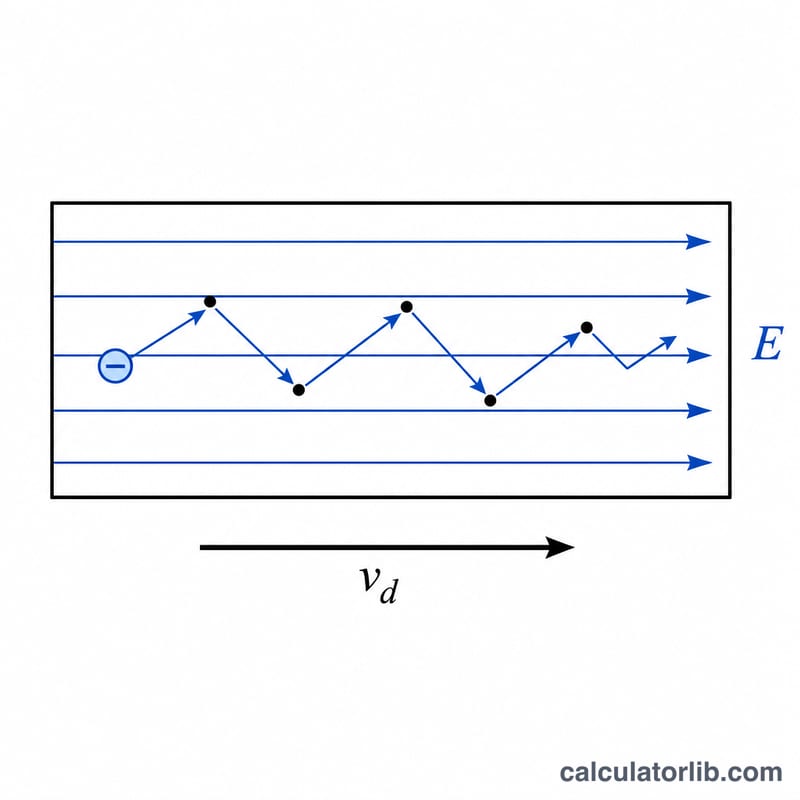
Electrical mobility (μ) measures how quickly a charged particle — such as an electron or hole — moves through a material in response to an applied electric field. It is defined as the magnitude of the drift velocity per unit electric field, \(\mu = v_d / E\), and from the Drude model it equals the charge times the relaxation time divided by the carrier's effective mass: \(\mu = q\tau/m\). The SI unit is square metres per volt-second, m²/(V·s).
How to Use This Calculator
Enter three values: the carrier charge q in coulombs (the electron charge is about 1.602×10⁻¹⁹ C), the mean free time or relaxation time τ in seconds, and the carrier's effective mass m in kilograms (the free-electron mass is 9.109×10⁻³¹ kg). The calculator returns the mobility instantly. You can type values in scientific notation such as 1.602e-19.
The Formula Explained
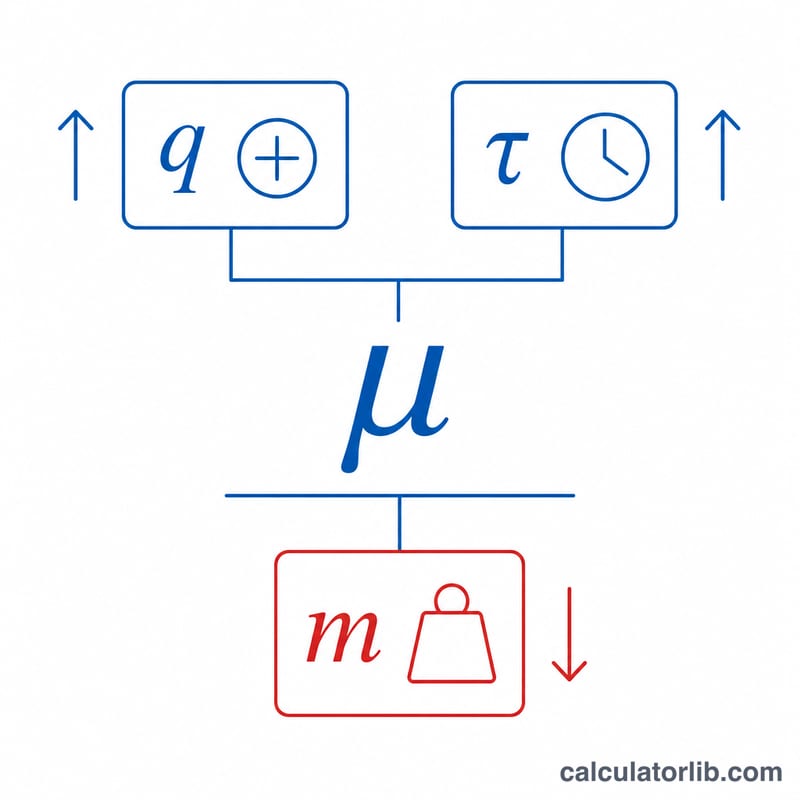
The Drude model treats carriers as particles that accelerate under a field E and lose momentum through scattering every τ seconds on average. The steady drift velocity is \(v_d = (q\tau/m)\cdot E\), so the mobility \(\mu = v_d / E\) simplifies to $$\mu = \frac{\text{Charge }q \cdot \text{Relaxation time }\tau}{\text{Effective mass }m}$$ Larger charge or longer scattering time increases mobility, while a heavier effective mass reduces it.
Worked Example
For an electron with \(q = 1.602\times10^{-19}\ \text{C}\), \(\tau = 2.5\times10^{-14}\ \text{s}\) and \(m = 9.109\times10^{-31}\ \text{kg}\): $$\mu = \frac{1.602\times10^{-19} \times 2.5\times10^{-14}}{9.109\times10^{-31}} \approx 4.396\times10^{-3}\ \text{m}^2/(\text{V}\cdot\text{s})$$ a typical metallic value.
FAQ
Does mobility depend on the field? In the simple model it does not — μ is a material property. At very high fields velocity saturation makes it field-dependent.
What is effective mass? It is the apparent mass a carrier has inside a crystal lattice, which can differ from the free-electron mass.
Can I use it for ions in gases or liquids? Yes — the same \(\mu = v_d/E\) definition applies, though τ and m then describe the ion.