
What is the Effectiveness-NTU method?
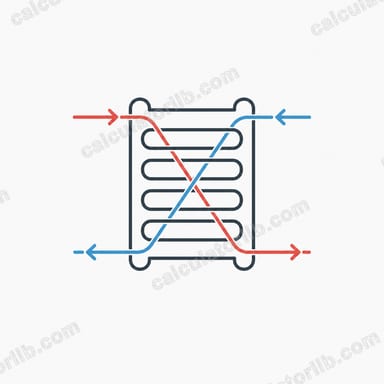
The effectiveness-NTU (ε-NTU) method is a standard technique in heat-transfer engineering for analysing heat exchangers when the outlet temperatures are not known in advance. Instead of solving the log-mean-temperature-difference equations iteratively, it relates the exchanger's actual heat transfer to the maximum thermodynamically possible heat transfer through a single dimensionless number, the effectiveness ε. This calculator evaluates a pure-counterflow heat exchanger.
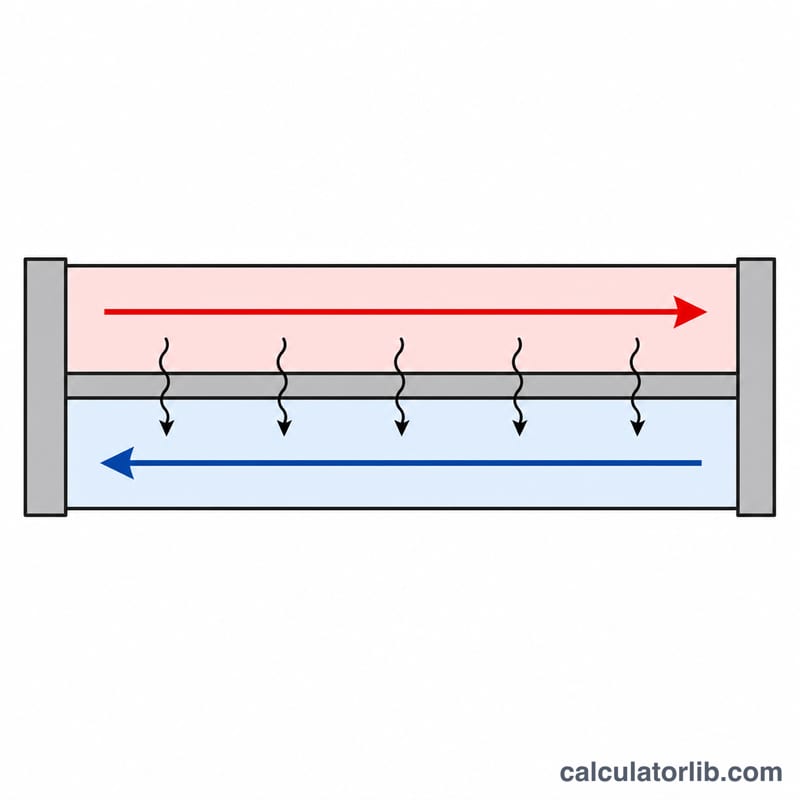
How to use this calculator
Enter three values: the overall thermal conductance UA (the product of the overall heat-transfer coefficient and area, in W/K), the smaller heat-capacity rate Cmin, and the larger rate Cmax (both in W/K, where \(C = \dot{m}\cdot c_p\)). The tool returns the Number of Transfer Units, the capacity ratio Cr, and the counterflow effectiveness.
The formula explained
First \(\text{NTU} = \text{UA} / \text{Cmin}\) sizes the exchanger relative to its smallest stream. The capacity ratio \(C_r = \text{Cmin} / \text{Cmax}\) describes how balanced the two streams are. Counterflow effectiveness is then
$$\varepsilon = \frac{1 - e^{-\text{NTU}(1 - C_r)}}{1 - C_r\, e^{-\text{NTU}(1 - C_r)}}$$When the streams are perfectly balanced (\(C_r = 1\)) this simplifies to
$$\varepsilon = \frac{\text{NTU}}{1 + \text{NTU}}$$The actual heat duty is
$$Q = \varepsilon \cdot \text{Cmin} \cdot (T_{\text{hot,in}} - T_{\text{cold,in}})$$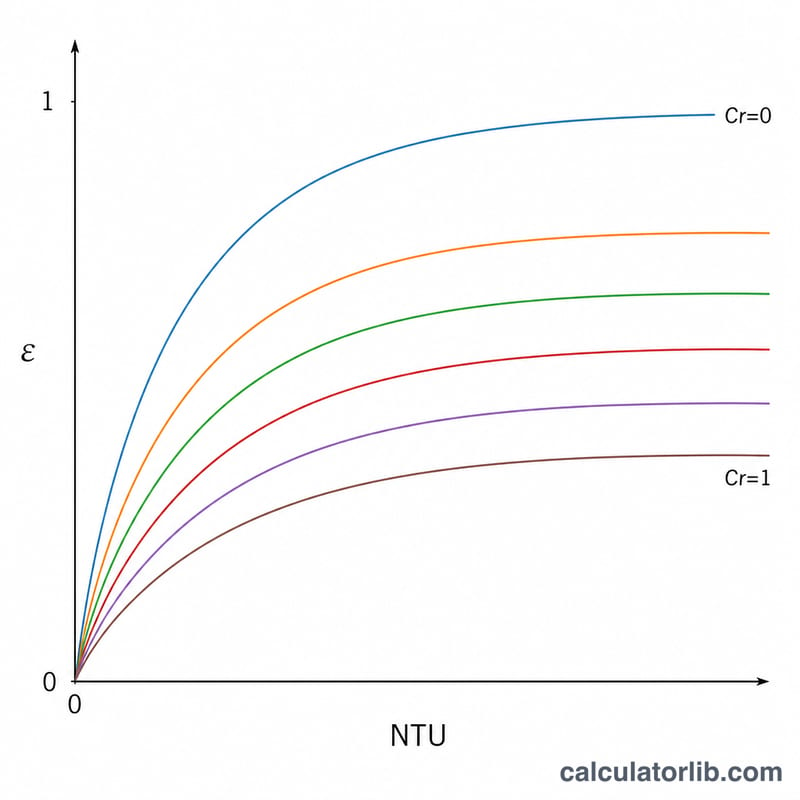
Worked example
Suppose UA = 1000 W/K, Cmin = 500 W/K and Cmax = 800 W/K. Then \(\text{NTU} = 1000/500 = 2\) and \(C_r = 500/800 = 0.625\). The exponent term is \(e^{-2(0.375)} = e^{-0.75} \approx 0.4724\). So
$$\varepsilon = \frac{1 - 0.4724}{1 - 0.625\cdot 0.4724} \approx \frac{0.5276}{0.7048} \approx 0.7486$$i.e. about 74.9% effectiveness.
FAQ
What does effectiveness mean? It is the ratio of the actual heat transferred to the maximum that an infinitely long exchanger could transfer.
Does this work for parallel-flow or shell-and-tube? No — this tool uses the counterflow relation, which gives the highest effectiveness for a given NTU. Other configurations have different ε-NTU equations.
What if Cmin equals Cmax? The calculator detects \(C_r = 1\) and uses the limiting form \(\varepsilon = \text{NTU}/(1+\text{NTU})\).