
What is the Heat of Combustion Calculator?
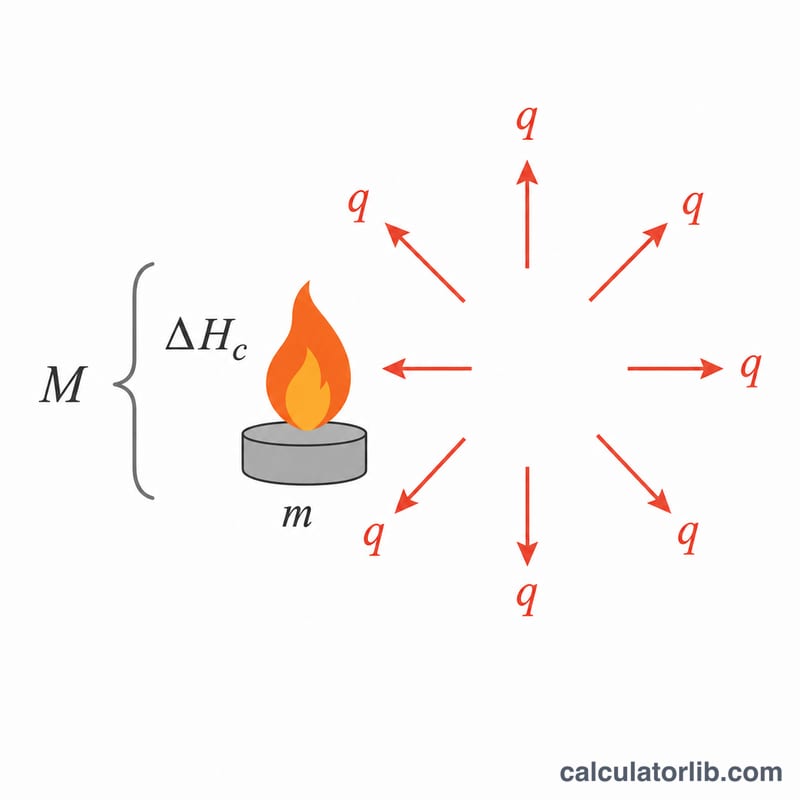
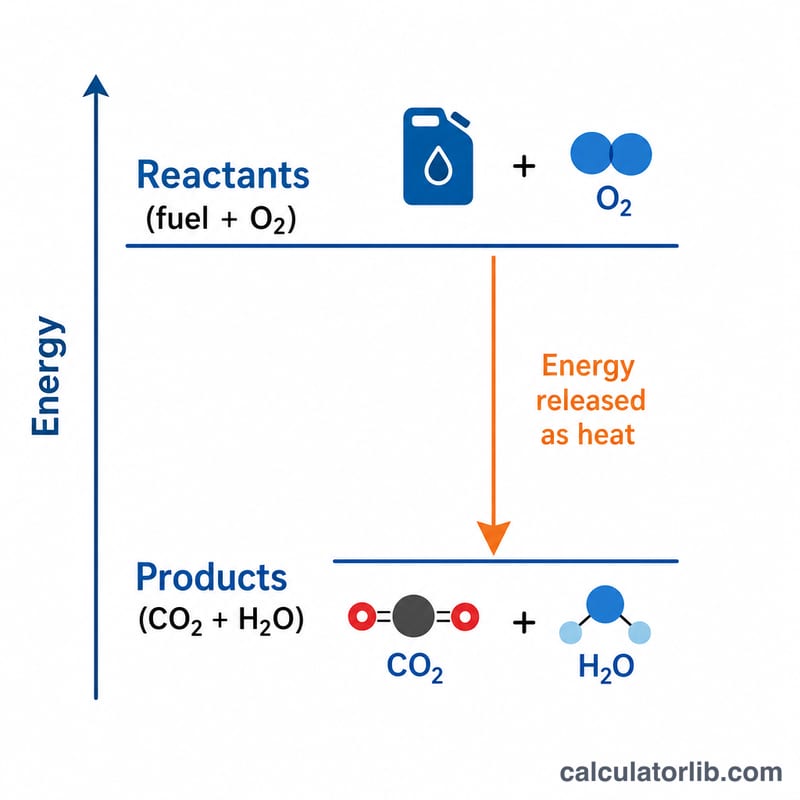
The heat of combustion is the amount of energy released when a given amount of a substance burns completely in oxygen. This calculator works out the total heat released (\(q\)) when a known mass of fuel is burned, using the substance's molar mass and its molar heat of combustion (\(\Delta H_c\)). It is widely used in chemistry, thermodynamics, and engineering to size fuels, compare energy content, and solve textbook calorimetry problems.
How to use it
Enter three values: the mass of the substance burned (in grams), its molar mass (in g/mol), and the molar heat of combustion \(\Delta H_c\) (in kJ/mol). The calculator first converts mass to moles (\(n = m \div M\)), then multiplies by \(\Delta H_c\) to give the total heat released in kilojoules. It also shows the number of moles so you can check intermediate steps.
The formula explained
The core relationship is $$q = n \times \Delta H_c$$ where \(n\) is the number of moles. Because moles equal mass divided by molar mass, the full expression is $$q = \frac{m}{M} \times \Delta H_c$$ Rearranging gives the molar heat of combustion: $$\Delta H_c = \frac{q}{n}$$ \(\Delta H_c\) values are usually negative for exothermic reactions, but they are commonly quoted as positive "heat released" magnitudes — match the sign convention of your data.
Worked example
Burning 16 g of methane (CH₄, molar mass 16 g/mol) with \(\Delta H_c = 890\) kJ/mol: $$\text{moles} = 16 \div 16 = 1\ \text{mol}$$ so $$q = 1 \times 890 = 890\ \text{kJ}$$ Doubling the mass to 32 g doubles the heat to 1,780 kJ.
FAQ
What units does this use? Mass in grams, molar mass in g/mol, \(\Delta H_c\) in kJ/mol, giving \(q\) in kJ.
Why divide by molar mass? \(\Delta H_c\) is defined per mole, so you must convert mass to moles before multiplying.
Can I find \(\Delta H_c\) instead? Yes — if you know total heat \(q\) and moles \(n\), use \(\Delta H_c = q / n\).