
What Is an Empirical Formula?
The empirical formula of a compound gives the simplest whole-number ratio of the atoms it contains. For example, glucose has the molecular formula C₆H₁₂O₆ but an empirical formula of CH₂O. This calculator turns experimental data — the mass or mass percent of each element — into that simplest ratio.
How to Use It
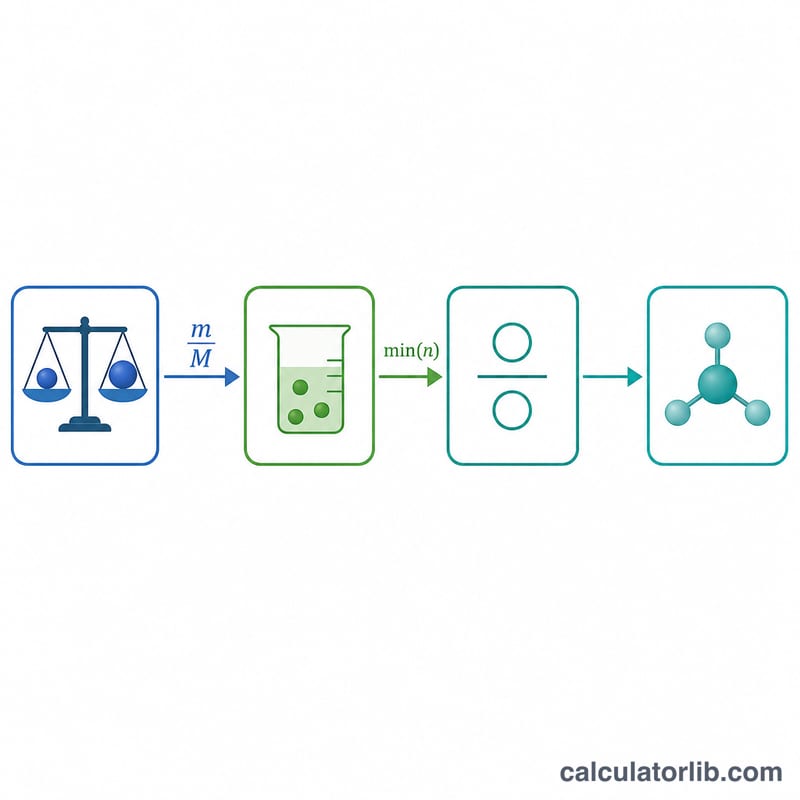
Enter the amount of each element (its mass in grams, or its mass percent if you select that mode — both work identically because percent values are treated as grams in a 100 g sample) along with its molar mass in g/mol. You can enter two to four elements; leave the optional rows blank if not needed. The calculator divides each amount by its molar mass to get moles, then divides every mole value by the smallest one.
The Formula Explained
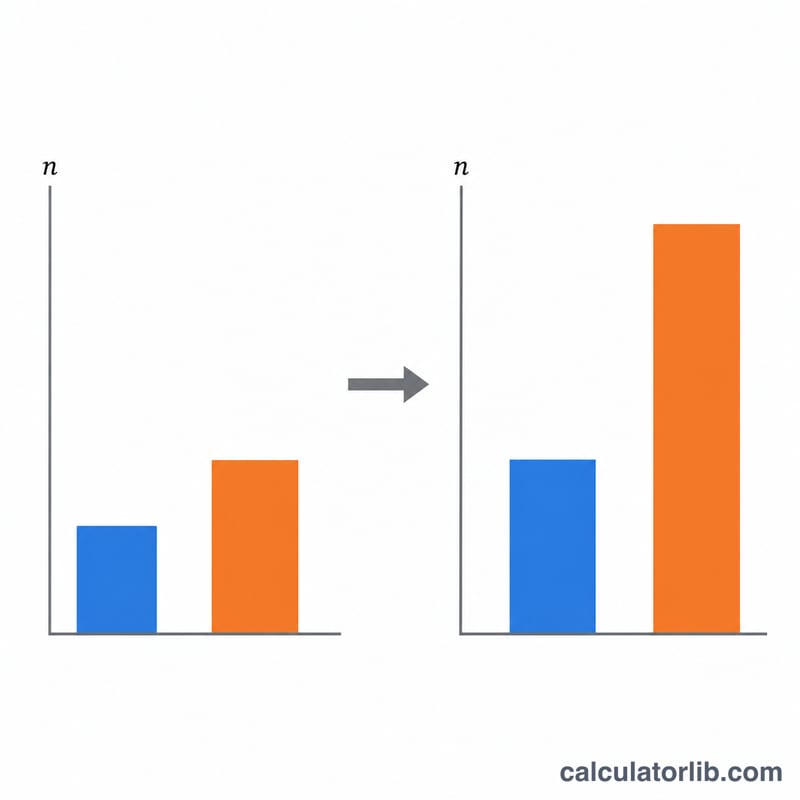
First compute moles: $$n_i = \frac{m_i}{M_i}$$ Then normalize: $$\text{ratio}_i = \frac{n_i}{\min(n)}$$ The resulting numbers, rounded to whole values, become the subscripts in the formula. If a ratio comes out close to a fraction like \(1.5\) or \(1.33\), multiply every ratio by a small integer (\(2\) or \(3\)) to clear it.
Worked Example
A compound is 40.0% C, 6.7% H, and 53.3% O. Moles: \(\text{C} = 40.0/12.01 = 3.331\), \(\text{H} = 6.7/1.008 = 6.647\), \(\text{O} = 53.3/16.00 = 3.331\). The smallest is \(3.331\), so ratios are $$\text{C } 1.00 : \text{H } 1.996 : \text{O } 1.00 \approx 1 : 2 : 1$$ giving the empirical formula CH₂O.
FAQ
Mass or percent — which do I use? Either. Mass percent is mathematically the same as grams in a 100 g sample, so both give the same ratio.
Why aren't my ratios whole numbers? Small rounding from molar masses is normal. Round values within about 0.1 of an integer; otherwise multiply all ratios by 2, 3, or 4 to clear fractions.
Does this give the molecular formula? No — the molecular formula is a whole-number multiple of the empirical formula. You need the compound's molar mass to find that multiple.