
What is a biorhythm calculator?
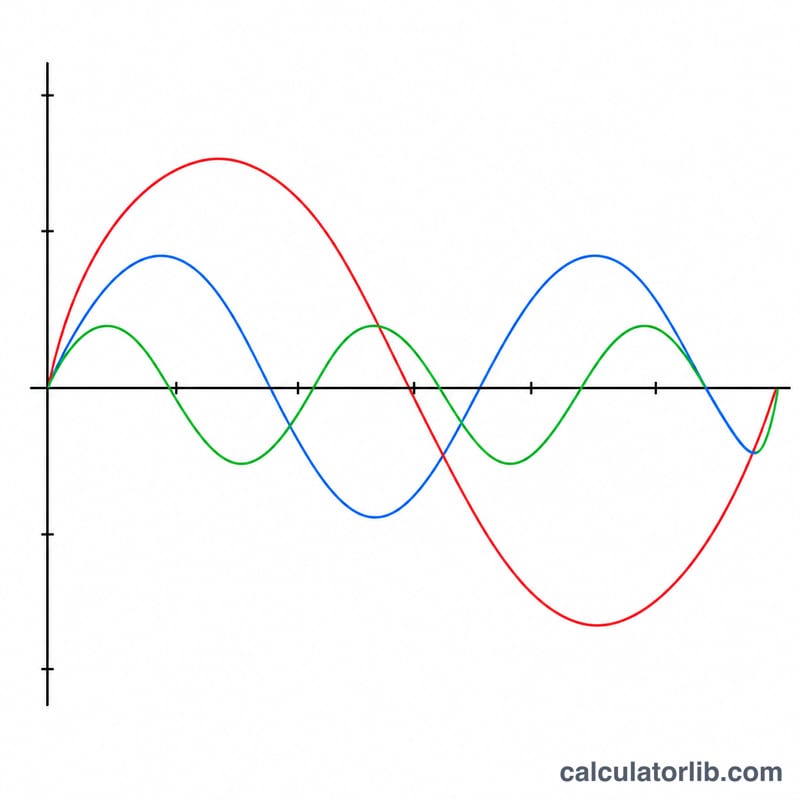
Biorhythm theory proposes that three internal cycles influence our daily condition from the moment we are born: a Physical cycle of 23 days, an Emotional (sensitivity) cycle of 28 days, and an Intellectual cycle of 33 days. Each is modelled as a simple sine wave. This calculator works for any country or culture because it depends only on the number of days between two dates. An optional era dropdown lets you enter the year using a Japanese era (Meiji, Taisho, Showa, Heisei, Reiwa) or a standard Western/CE year.
How to use it
Enter your date of birth and a reference date (the day you want to check). Choose "CE / Western" for an ordinary Gregorian year, or pick an era to convert an era-year automatically. The calculator counts the whole days elapsed since birth and evaluates each cycle on the chosen date, plus the surrounding month for context.
The formula explained
Let t be the integer number of days since birth (the day of birth is \(t = 0\)). For a cycle with period T days the value is $$\sin\!\left(\frac{2\pi t}{T}\right)$$ ranging from -1 to +1. A positive value means a high phase, a negative value a low phase, and a zero crossing marks a critical (unstable) day. The combined pattern repeats only every \(\text{LCM}(23, 28, 33) = 21{,}252\) days, about 58.2 years.
Worked example
Born 20 May 1990, checked on 15 June 2024. The day difference is \(t = 12{,}445\). Physical: $$\sin\!\left(\frac{2\pi \cdot 12445}{23}\right) \approx +0.52\ (+52\%)$$ Emotional: $$\sin\!\left(\frac{2\pi \cdot 12445}{28}\right) \approx +0.22\ (+22\%)$$ Intellectual: $$\sin\!\left(\frac{2\pi \cdot 12445}{33}\right) \approx +0.69\ (+69\%)$$ All three are positive, so this is a high-phase day, strongest intellectually.
Interpreting Your Biorhythm Result
Biorhythm theory models three independent cycles as sine waves, each oscillating between \(+100\%\) and \(-100\%\). The calculator reports a percentage and a phase for the Physical (23-day), Emotional (28-day) and Intellectual (33-day) cycle on your chosen reference date.
High phase (positive values)
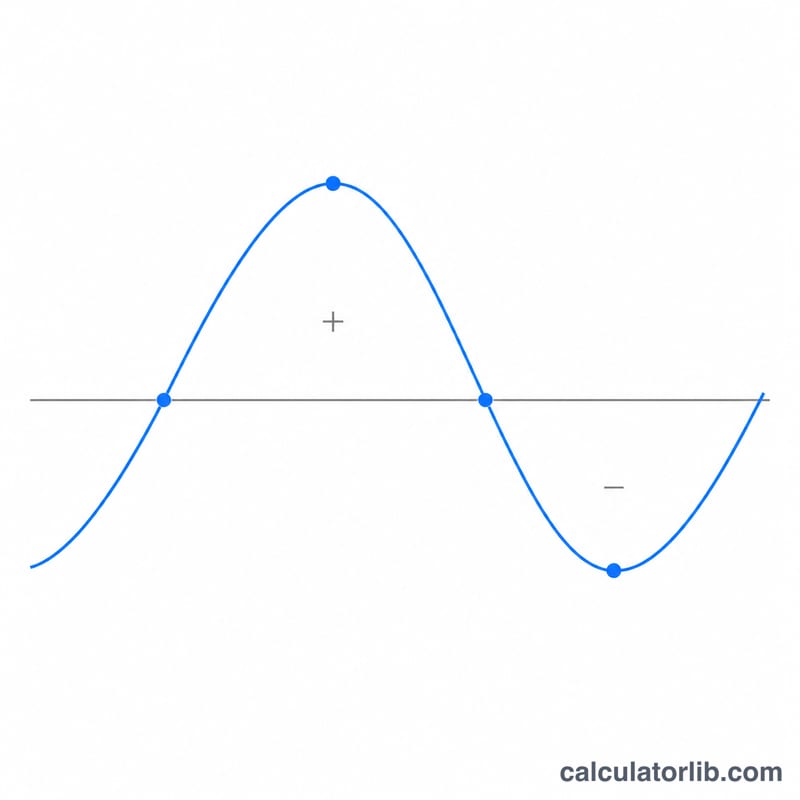
When a cycle reads above zero it is in its high phase, rising toward and around its peak of \(+100\%\). In this part of the wave the corresponding trait is said to be at its strongest: the Physical cycle suggests greater energy, stamina and coordination; the Emotional cycle suggests better mood, optimism and sensitivity; the Intellectual cycle suggests sharper reasoning, memory and focus.
Low phase (negative values)
When a cycle reads below zero it is in its low phase, near its trough of \(-100\%\). This is interpreted not as "bad luck" but as a natural recharge period — a time when energy, mood or concentration may run lower and rest, recovery and easier tasks make sense.
Zero crossings and critical days
A critical day occurs when a cycle crosses zero (transitioning between high and low). At these points the cycle is changing direction and is considered least stable. A critical day for the Physical cycle happens about every \(23/2 = 11.5\) days, for Emotional every \(14\) days, and for Intellectual every \(16.5\) days. When two or three cycles cross zero on the same date, that day is often highlighted as especially significant.
Reading the three cycles together
No single number tells the whole story — read the trio as a combination. All three high suggests an all-around strong day; mixed signals (for example high Physical but low Intellectual) suggest favoring activity over demanding mental work. Pay attention to the trend (rising vs. falling) as much as the absolute value.
Biorhythms are a pseudoscientific concept intended for entertainment and casual self-reflection only. They are not supported by scientific evidence and must never be used for medical, psychological, safety or financial decisions.
Cycle Periods & Constants Used
Each biorhythm is a pure sine wave whose only difference is its period \(T\). The day count \(t\) is the whole number of days elapsed since birth, so that \(t = 0\) on the day of birth (where every cycle equals zero).
| Cycle | Period \(T\) | Formula | Range |
|---|---|---|---|
| Physical | 23 days | \(P = \sin\!\left(\tfrac{2\pi t}{23}\right)\) | \(-1\) to \(+1\) |
| Emotional | 28 days | \(E = \sin\!\left(\tfrac{2\pi t}{28}\right)\) | \(-1\) to \(+1\) |
| Intellectual | 33 days | \(I = \sin\!\left(\tfrac{2\pi t}{33}\right)\) | \(-1\) to \(+1\) |
- Amplitude range: each cycle spans \(-1\) to \(+1\), usually shown as \(-100\%\) to \(+100\%\).
- Zero at birth: because \(\sin(0)=0\), all three cycles start at \(0\%\) on the birth date and rise into their high phase first.
- Full repeat cycle: all three cycles realign to their birth state only after the least common multiple of the three periods: \(\operatorname{LCM}(23,28,33) = 21{,}252\) days, or about \(58.2\) years. After this span the entire pattern repeats.
Key Terms Explained
- Physical cycle
- The 23-day sine wave associated with bodily energy, strength, stamina, endurance and coordination.
- Emotional (sensitivity) cycle
- The 28-day sine wave associated with mood, feelings, sensitivity, creativity and emotional stability.
- Intellectual cycle
- The 33-day sine wave associated with reasoning, memory, alertness, logic and mental focus.
- High phase
- The positive part of a cycle (value above zero), interpreted as a stronger, more capable period for that trait, peaking at \(+100\%\).
- Low phase
- The negative part of a cycle (value below zero), interpreted as a recharge or recovery period, bottoming at \(-100\%\).
- Critical day
- A day on which a cycle crosses zero, marking an unstable transition between high and low phases; days when several cycles cross at once are considered most significant.
- Zero crossing
- The exact point where a sine wave passes through \(0\), separating the high and low phases — the mathematical basis of a critical day.
- Period \(T\)
- The number of days a cycle takes to complete one full oscillation and return to the same value and direction (23, 28 or 33 days).
- Day count \(t\)
- The whole number of days between the birth date and the reference date, computed from Julian Day Numbers; \(t = 0\) on the day of birth.
- Sine wave amplitude
- The maximum displacement of the wave from its center line. Here the amplitude is \(1\), so values range from \(-1\) (\(-100\%\)) to \(+1\) (\(+100\%\)).
FAQ
Is biorhythm scientifically proven? No. It is an entertainment and self-reflection model, not validated science. Use it for fun, not medical or financial decisions.
What is a critical day? A day when a cycle crosses zero (changes sign). Such transition days are traditionally considered the most cautionary.
Can the reference date be before the birth date? Yes, the sine math still works (it is an odd function), but a date earlier than birth is usually a data-entry mistake.