

What this calculator does
The Consulting Fees Calculator turns your income goal into a concrete hourly rate. Many freelancers and consultants simply guess a number, then discover too late that it doesn't cover their taxes, software, equipment, marketing time and unpaid admin. This tool works backwards from the salary you want to take home, adds your annual overhead, and divides by the hours you can realistically bill — giving you a rate that actually keeps the business sustainable.
How to use it
Enter the annual salary you want to pay yourself, your total yearly business overhead (taxes, tools, insurance, office, downtime allowance), and how many hours per week you can genuinely bill clients across how many working weeks a year. The calculator returns your minimum hourly rate, an 8-hour day rate, your total billable hours, and an optional project fee based on estimated hours.
The formula explained
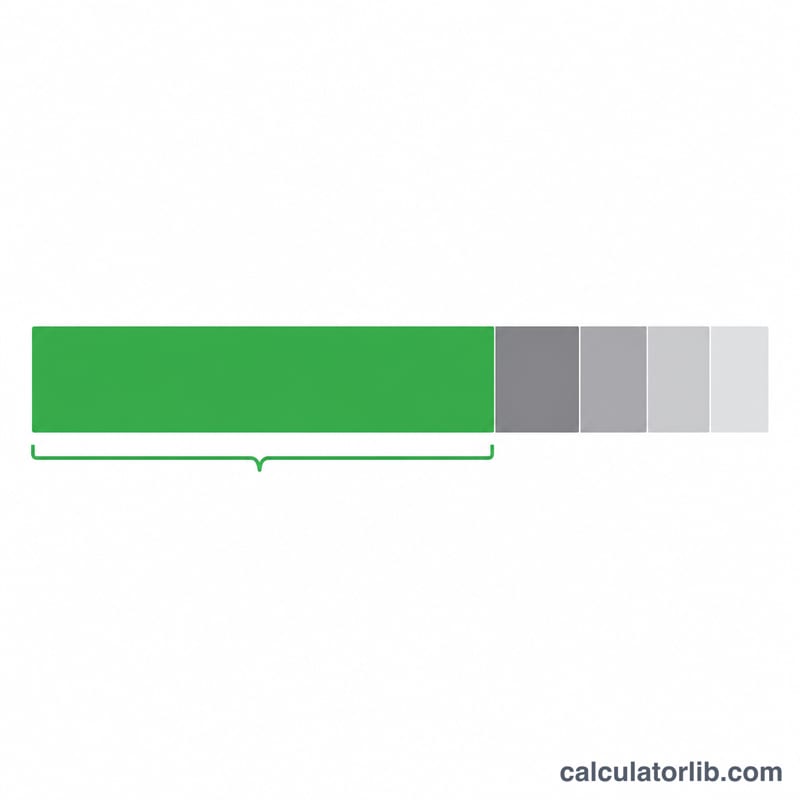
First we find your billable hours per year = hours per week × working weeks per year. Note this is usually far lower than 2,080 (40×52) because of holidays, sick days, admin, sales calls and gaps between projects. Then:
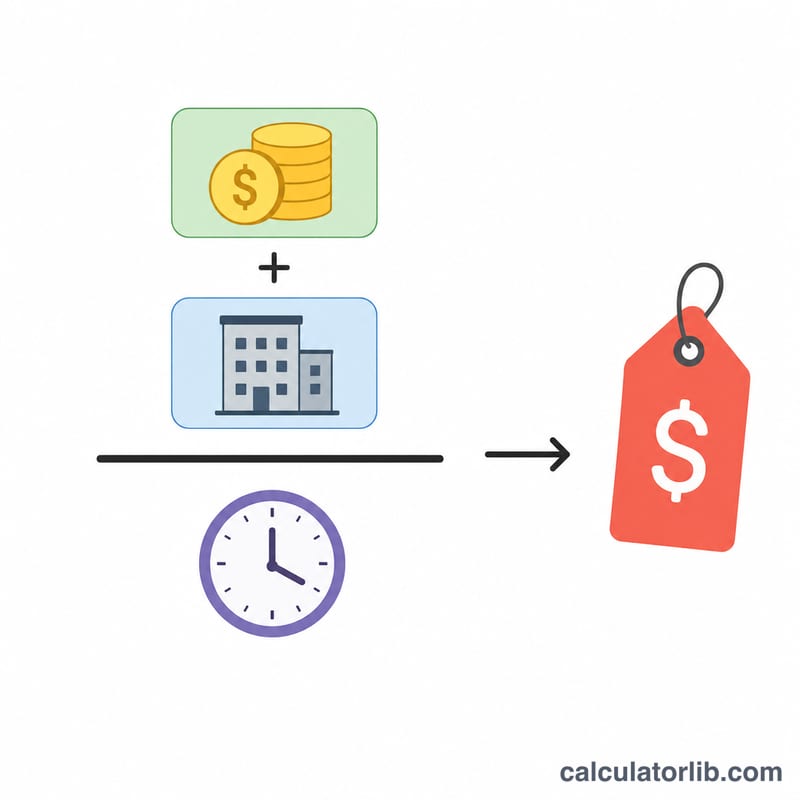
$$\text{Hourly Rate} = \frac{\text{Salary} + \text{Overhead}}{\text{Billable Hours per Year}}$$ The project fee is simply \(\text{Hourly Rate} \times \text{Estimated Hours}\).
Worked example
Suppose you want an $80,000 salary, have $20,000 of overhead, can bill 25 hours a week for 48 weeks. Billable hours = \(25 \times 48 = 1{,}200\). Hourly rate = $$\frac{80{,}000 + 20{,}000}{1{,}200} = \$83.33/\text{hour}.$$ A 40-hour project would cost \(83.33 \times 40 = \$3{,}333.33\).
FAQ
Why use fewer than 40 billable hours a week? Almost no consultant bills 100% of their time. Selling, invoicing, learning and admin all eat into the week, so 20–30 billable hours is realistic for many solo consultants.
Should overhead include taxes? Yes — treat self-employment tax, healthcare, retirement contributions and software as overhead so your rate truly supports your target take-home pay.
Is the result a floor or a ceiling? It's a floor. It's the minimum rate to hit your goal; charge more if your value or market allows.