
What Is Customer Acquisition Cost (CAC)?
Customer Acquisition Cost (CAC) is the average amount a business spends to win a single new customer. It bundles together all the sales and marketing investment over a period — ad spend, salaries, software, agency fees, content, and events — and divides it by the number of new customers acquired in that same period. CAC is one of the most important unit-economics metrics for any company, especially startups and SaaS businesses, because it tells you how efficiently you turn marketing dollars into paying customers.
How to Use This Calculator
Enter your total sales and marketing cost for a defined period (a month, quarter, or year) and the number of new customers you acquired during that same period. The calculator instantly divides the two to give you your CAC per customer. Make sure both figures cover the same time window so the result is accurate.
The Formula Explained
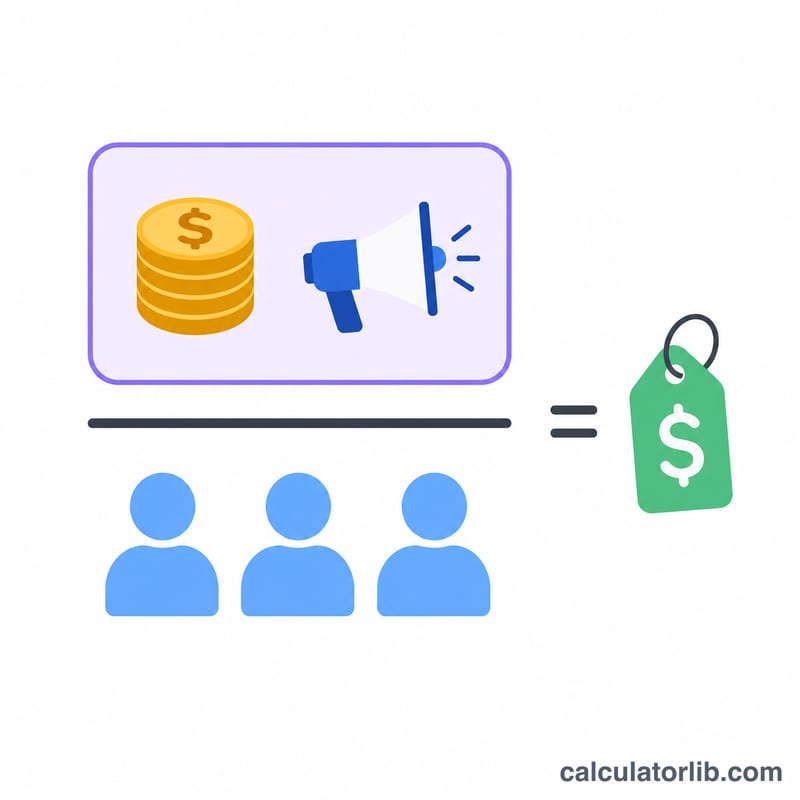
The formula is simply
$$\text{CAC} = \frac{\text{Total Sales \& Marketing Cost (\$)}}{\text{New Customers Acquired}}$$The numerator should include every fully-loaded cost tied to acquiring customers. The denominator counts only genuinely new customers, not renewals or upsells. A lower CAC means more efficient growth — but it is best read alongside Customer Lifetime Value (LTV). A healthy SaaS benchmark is an LTV:CAC ratio of 3:1 or higher.
Worked Example
Suppose your company spent $50,000 on sales and marketing last quarter and acquired 500 new customers. Then
$$\text{CAC} = \$50{,}000 \div 500 = \$100 \text{ per customer}$$If each customer is worth $400 in lifetime value, your LTV:CAC ratio is 4:1 — a strong, scalable position.
FAQ
What costs should I include? Include all marketing spend, sales team salaries and commissions, advertising, tools, and overhead directly tied to acquisition.
Should I count existing customers? No — only count brand-new customers acquired in the period. Renewals and expansions are not new acquisitions.
What is a good CAC? It depends on your industry and price point. The key is that CAC stays well below the lifetime value of a customer, ideally a 3:1 LTV:CAC ratio or better.