
What is the CPC and CPM Calculator?
This calculator turns your raw advertising numbers into the two metrics marketers rely on most: CPC (Cost Per Click) and CPM (Cost Per Mille, or cost per 1,000 impressions). Enter how much you spent, how many clicks you earned, and how many times your ad was shown, and you instantly see what each click and each thousand views actually cost you. It also reports your click-through rate (CTR) as a bonus.
How to use it
Enter your Total Cost — the full amount spent on the campaign. Enter the number of Clicks the ads received and the number of Impressions (times the ad was displayed). The calculator divides cost by clicks for CPC, and divides cost by impressions then multiplies by 1,000 for CPM. CTR is clicks divided by impressions, expressed as a percentage.
The formula explained
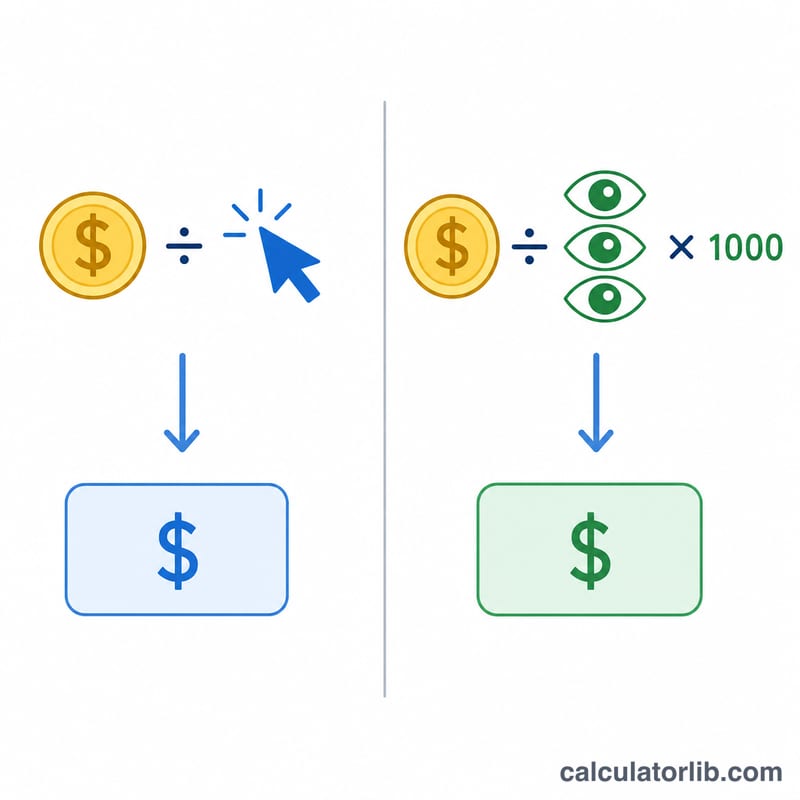
$$\text{CPC} = \frac{\text{Total Cost (\$)}}{\text{Clicks}}$$ tells you the average price of a single click. $$\text{CPM} = \frac{\text{Total Cost (\$)}}{\text{Impressions}} \times 1000$$ standardizes spend to a per-thousand-view basis, which is the standard unit for display and brand awareness buys. A low CPC means efficient direct response; a low CPM means cheap reach.
Worked example
Suppose you spent $500, received 250 clicks, and earned 100,000 impressions. $$\text{CPC} = 500 \div 250 = \mathbf{\$2.00}$$ $$\text{CPM} = (500 \div 100{,}000) \times 1000 = \mathbf{\$5.00}$$ $$\text{CTR} = (250 \div 100{,}000) \times 100 = \mathbf{0.25\%}$$
FAQ
Should I optimize for CPC or CPM? Use CPC when you want measurable actions (sales, sign-ups). Use CPM when your goal is reach and brand awareness.
What is a good CPC? It varies widely by industry and platform — anywhere from a few cents to several dollars. Compare against your own historical campaigns.
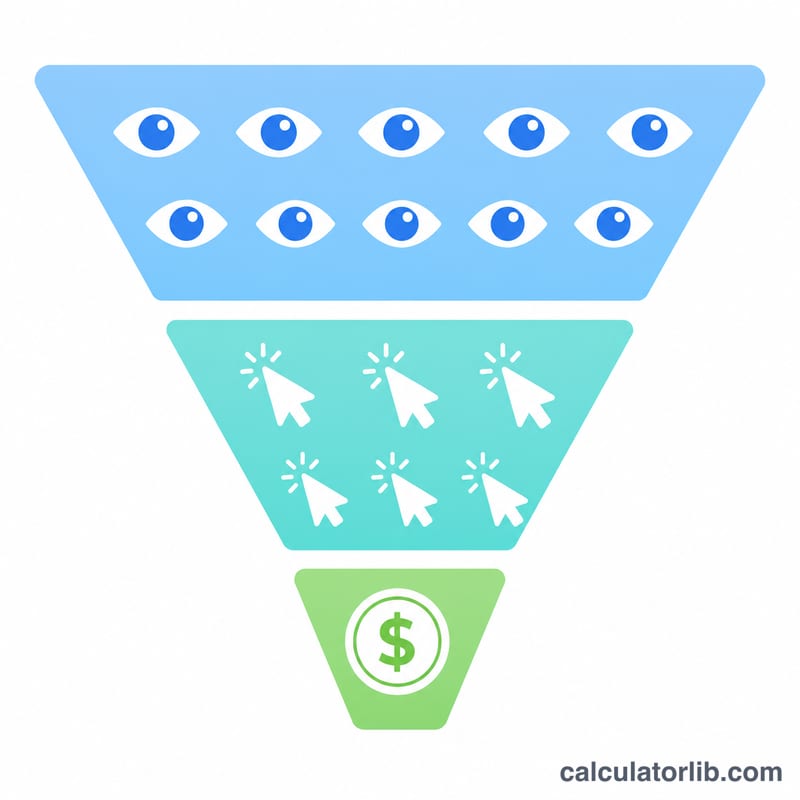
Why include CTR? CTR connects CPC and CPM: a higher CTR generally lowers your effective CPC for a given CPM, since more impressions convert into clicks.