

What is the SaaS Metrics Calculator?
This calculator turns three simple inputs — your total active customers, average revenue per user (ARPU), and the number of customers you lost this period — into the four metrics every subscription business lives by: Monthly Recurring Revenue (MRR), Annual Recurring Revenue (ARR), customer churn rate, and Customer Lifetime Value (LTV). These figures are the backbone of SaaS forecasting, fundraising decks, and unit-economics analysis.
How to use it
Enter your total customers, your ARPU (the average monthly subscription revenue per customer), and the number of churned customers in the same period. The calculator instantly returns MRR, ARR, the churn rate as a percentage, and an estimate of LTV. Use consistent time periods — if ARPU is monthly, the churn should reflect the same monthly window.
The formulas explained
MRR is simply customers multiplied by ARPU. ARR annualizes that by multiplying by 12. The churn rate divides churned customers by total customers. LTV uses the simplified formula ARPU divided by the churn rate, which represents the average revenue earned over a customer's expected lifespan. A lower churn rate produces a higher LTV, because customers stay (and pay) longer.
$$\text{MRR} = \text{Customers} \times \text{ARPU}$$$$\text{ARR} = 12 \times \text{MRR} \qquad \text{Churn} = \frac{\text{Churned}}{\text{Customers}} \times 100\%$$$$\text{LTV} = \frac{\text{ARPU}}{\left(\dfrac{\text{Churned}}{\text{Customers}}\right)}$$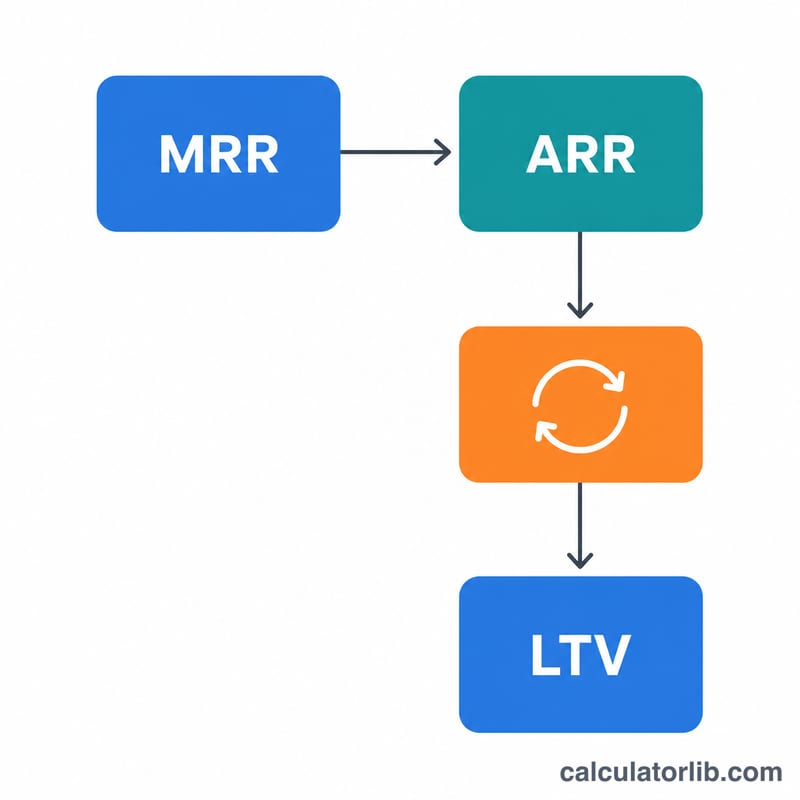
Worked example
Suppose you have 500 customers paying an ARPU of $50 per month, and you lost 25 customers this period.
$$\text{MRR} = 500 \times \$50 = \textbf{\$25{,}000}$$$$\text{ARR} = \$25{,}000 \times 12 = \textbf{\$300{,}000}$$$$\text{Churn} = 25 \div 500 = 0.05 = \textbf{5\%}$$$$\text{LTV} = \$50 \div 0.05 = \textbf{\$1{,}000} \text{ per customer}$$
FAQ
What is ARPU? Average Revenue Per User — total monthly recurring revenue divided by your number of active customers.
Why does LTV depend on churn? LTV estimates total revenue from a customer before they cancel. The reciprocal of churn approximates the average customer lifetime in periods, so dividing ARPU by churn gives lifetime value.
What if churn is zero? Mathematically LTV would be infinite, so this tool returns 0 for LTV when churn is zero — interpret it as "no churn data to estimate lifetime."