
What This Calculator Does
The Impressions Calculator estimates how many ad impressions a media budget will deliver based on the CPM (cost per mille, or cost per 1,000 impressions) you are paying. It is a quick planning tool for digital advertisers, media buyers, and marketers working with display, video, social, or programmatic campaigns where pricing is quoted per thousand impressions.
How to Use It
Enter your total campaign budget in dollars and the CPM rate quoted by the platform or publisher. The calculator instantly returns the estimated number of impressions you can expect, along with the effective cost per single impression. Use it to compare vendors, forecast reach, or sanity-check a media plan before you commit spend.
The Formula Explained
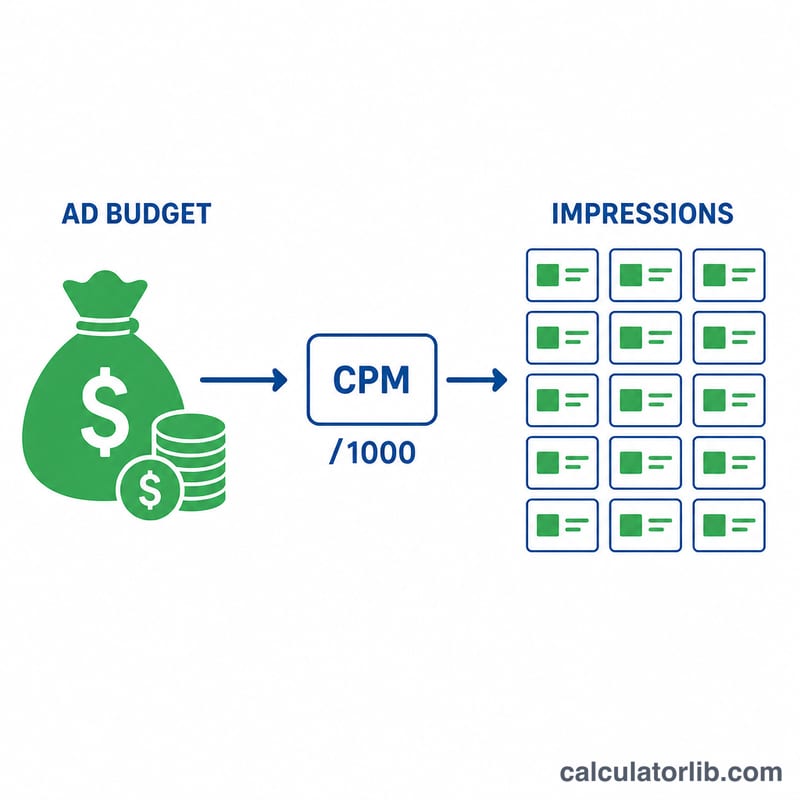
Because CPM is the cost for every 1,000 impressions, dividing your budget by the CPM tells you how many "thousands" of impressions you can afford. Multiplying by 1,000 converts that back into individual impressions:
$$\text{Impressions} = \frac{\text{Budget (\$)}}{\text{CPM (\$)}} \times 1000$$
The cost per single impression is simply CPM divided by 1,000.
Worked Example
Suppose you have a budget of $5,000 and the platform quotes a CPM of $10. The calculation is $$(5{,}000 \div 10) \times 1{,}000 = 500 \times 1{,}000 = 500{,}000 \text{ impressions}.$$ The cost per impression is \(\$10 \div 1{,}000 = \$0.01\).
FAQ
What is CPM? CPM stands for "cost per mille," the price an advertiser pays for 1,000 ad impressions. It is the most common pricing model for awareness-focused display and video advertising.
Are these guaranteed impressions? No. The figure is an estimate based on the quoted CPM. Actual delivery can vary with auction dynamics, targeting, ad quality, and inventory availability.
How do I convert impressions to reach? Reach (unique people) is lower than impressions because the same person may see your ad multiple times. Divide impressions by your average frequency to approximate reach.