

What Is the Conversions Forecast Calculator?
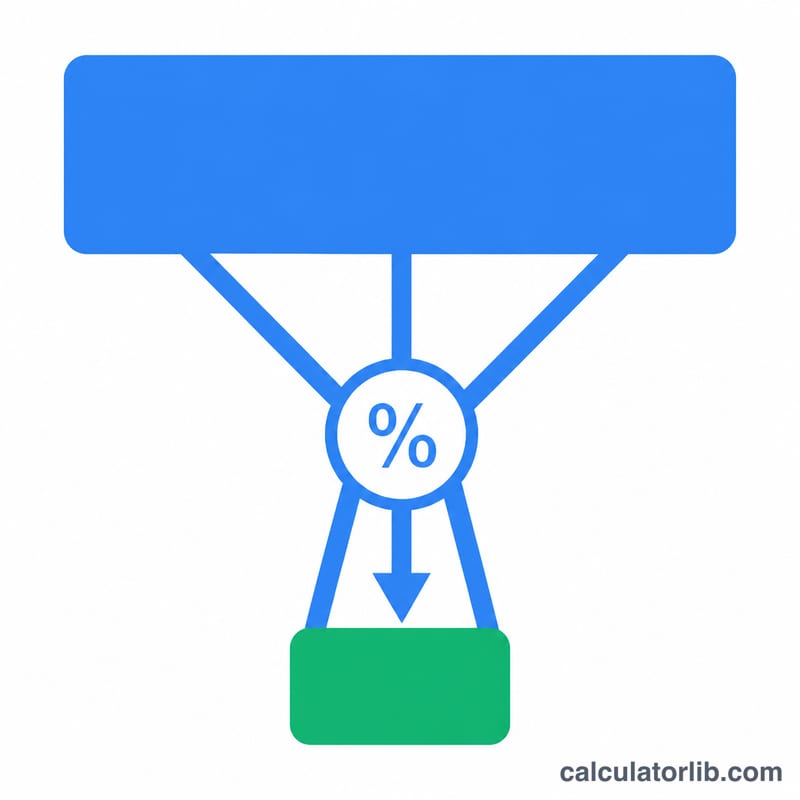
The Conversions Forecast Calculator estimates how many conversions you can expect from a given amount of traffic. A "conversion" is any goal completion you care about — a sale, a sign-up, a lead form, a download, or any other measurable action. By combining your expected visitor count with your conversion rate (CVR), you get a quick, reliable forecast for planning campaigns, budgets, and targets.
How to Use It
Enter the number of visitors you expect (for example from an ad campaign, an email blast, or monthly organic traffic), then enter your conversion rate as a percentage. The calculator multiplies the two and returns the forecasted number of conversions, along with how many visitors are expected not to convert.
The Formula Explained
The math is simple: $$\text{Conversions} = \text{Visitors} \times \frac{\text{CVR (\%)}}{100}$$ The conversion rate is divided by 100 to turn a percentage into a decimal multiplier. A 2.5% rate becomes \(0.025\), so each visitor contributes \(0.025\) of a conversion on average.
Worked Example
Suppose a landing page receives 10,000 visitors and historically converts at 2.5%. The forecast is $$10{,}000 \times \frac{2.5}{100} = 10{,}000 \times 0.025 = \mathbf{250} \text{ conversions}$$ The remaining 9,750 visitors leave without converting.
FAQ
What is a good conversion rate? It varies widely by industry, but many e-commerce sites average 1%–3%, while well-optimized lead pages can exceed 10%.
Can I forecast revenue too? Yes — multiply the forecasted conversions by your average order value or revenue per conversion.
Why is my result a decimal? Conversions are an average expectation, so partial values are normal in a forecast. Round to whole numbers when reporting actual counts.