
What is this calculator?
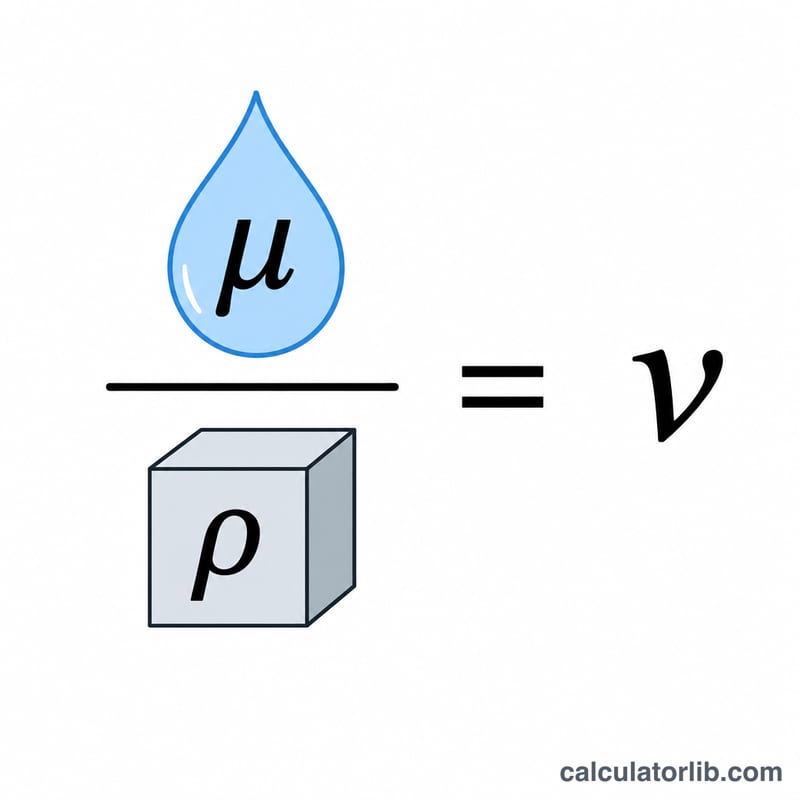
This tool converts dynamic viscosity (also called absolute viscosity, symbol \(\mu\)) into kinematic viscosity (symbol \(\nu\)) by dividing it by the fluid's density \(\rho\). Dynamic viscosity measures a fluid's internal resistance to flow under an applied force, while kinematic viscosity measures how fast a fluid flows under the influence of gravity. The relationship is fundamental in fluid mechanics, lubrication engineering, and the calculation of dimensionless numbers such as the Reynolds number.
How to use it
Enter the dynamic viscosity \(\mu\) in pascal-seconds (\(\text{Pa}\cdot\text{s}\)) and the fluid density \(\rho\) in kilograms per cubic metre (\(\text{kg/m}^3\)). The calculator returns the kinematic viscosity \(\nu\) in SI units (\(\text{m}^2/\text{s}\)) and also in the common CGS-based units centistokes (cSt) and stokes (St). For reference, water at 20 °C has \(\mu \approx 0.001\,\text{Pa}\cdot\text{s}\) and \(\rho \approx 998\,\text{kg/m}^3\).
The formula explained
The defining equation is $$\nu = \frac{\mu}{\rho}$$ Because \(\mu\) has units of \(\text{Pa}\cdot\text{s} = \text{kg/(m}\cdot\text{s)}\) and \(\rho\) has units of \(\text{kg/m}^3\), dividing them yields \(\text{m}^2/\text{s}\) — note that no mass dimension remains, which is why \(\nu\) is called "kinematic." To convert: $$1\,\text{m}^2/\text{s} = 10{,}000\,\text{St} = 1{,}000{,}000\,\text{cSt}$$ Engine and lubricating oils are most often quoted in cSt.
Worked example
Take water at 20 °C with \(\mu = 0.001\,\text{Pa}\cdot\text{s}\) and \(\rho = 1000\,\text{kg/m}^3\). Then $$\nu = \frac{0.001}{1000} = 0.000001\,\text{m}^2/\text{s} = 1 \times 10^{-6}\,\text{m}^2/\text{s}$$ Multiplying by 1,000,000 gives 1.0 cSt, which matches the well-known value for water.
Typical Viscosity Values for Common Fluids
Kinematic viscosity is found by dividing the dynamic (absolute) viscosity \(\mu\) by the fluid density \(\rho\):
$$\nu = \frac{\mu}{\rho}$$Because density appears in the denominator, two fluids with similar dynamic viscosity can have very different kinematic viscosities. For example, mercury is extremely dense, so its kinematic viscosity is tiny even though its dynamic viscosity is comparable to water. The values below are approximate room-temperature figures (unless noted) and are useful as a sanity check on your own calculations. Note that \(1\ \text{m}^2/\text{s} = 10^6\ \text{cSt}\).
| Fluid | Dynamic viscosity \(\mu\) (Pa·s) | Density \(\rho\) (kg/m³) | Kinematic viscosity \(\nu\) (cSt) |
|---|---|---|---|
| Water (20 °C) | 0.001002 | 998 | 1.00 |
| Air (15 °C, 1 atm) | 0.0000181 | 1.225 | 14.8 |
| SAE 30 motor oil (20 °C) | 0.29 | 891 | 325 |
| Glycerin (20 °C) | 1.49 | 1261 | 1182 |
| Honey (20 °C) | 10 | 1420 | 7042 |
| Mercury (20 °C) | 0.00155 | 13534 | 0.115 |
| Gasoline (20 °C) | 0.0006 | 720 | 0.83 |
These figures are representative; actual viscosity depends strongly on temperature, and oils in particular vary by grade and additive package.
FAQ
What is the difference between dynamic and kinematic viscosity? Dynamic viscosity is the ratio of shear stress to shear rate (force-based); kinematic viscosity is dynamic viscosity divided by density (motion-based).
Can I enter centipoise (cP)? Convert first: \(1\,\text{cP} = 0.001\,\text{Pa}\cdot\text{s}\), so divide your cP value by 1000 before entering \(\mu\).
Why is the result so small in m²/s? SI kinematic viscosities for thin fluids are tiny numbers; that is why engineers usually report cSt instead.