
What this calculator does
The Salary to Contractor Day Rate Calculator converts a permanent annual salary into the daily rate you should charge as a contractor or freelancer. Going independent means giving up paid holidays, sick pay, pension contributions, training and job security — and you only get paid for days you actually work. To stay financially equal (or ahead), contractors apply an "uplift" to their old salary and then spread it across the limited number of days they can realistically bill each year.
How to use it
Enter three numbers: your current (or target) annual salary, the uplift percentage you want to add for lost benefits and risk, and the number of billable days you expect to work in a year. A typical year has about 260 working days; after holidays, illness, admin and gaps between contracts, many contractors bill 200–230 days. The calculator returns your suggested day rate plus equivalent hourly and weekly rates.
The formula explained
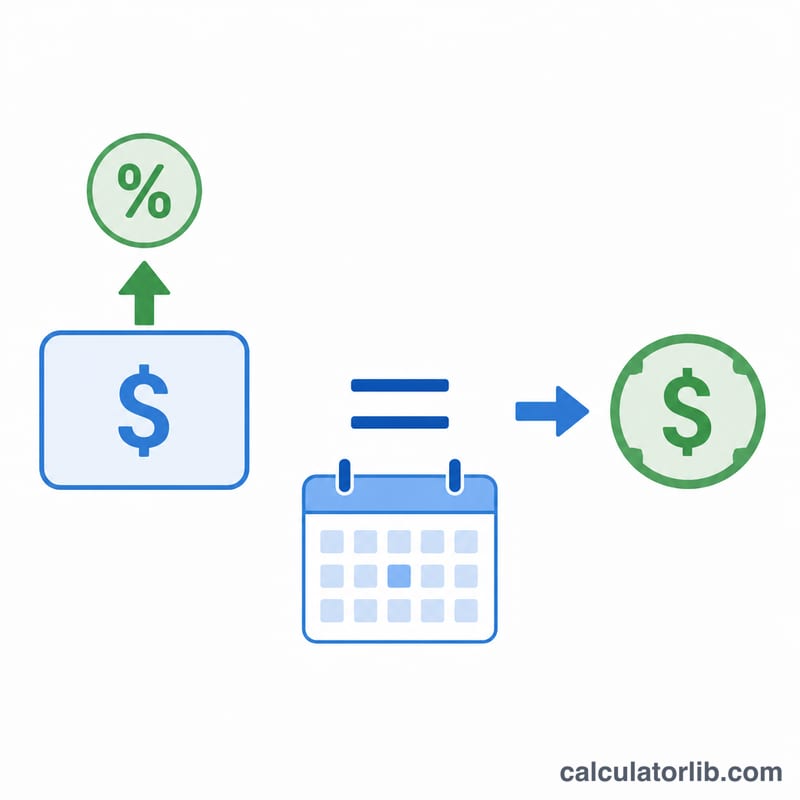
The core equation is $$\text{Day Rate} = \frac{\text{Annual Salary} \times \left(1 + \frac{\text{Uplift \%}}{100}\right)}{\text{Billable Days}}$$. The uplift inflates your salary to cover benefits you'll no longer receive, and dividing by billable days — rather than 365 — ensures non-working days are already priced in.
Worked example
Suppose your salary is £60,000, you add a 20% uplift, and you expect to bill 220 days. Target income = \(60{,}000 \times 1.20 = £72{,}000\). Day rate = \(72{,}000 \div 220 = \) £327.27. That equals about £40.91 per hour (8-hour day) or £1,636.36 per 5-day week.

FAQ
What uplift should I use? Many contractors use 15–30% to cover holiday, pension, sick pay and the risk of gaps between contracts. Higher-skill or short-term work often justifies more.
How many billable days are realistic? Start from ~260 weekdays, subtract holidays, public holidays, training, illness and contract gaps. 200–230 is common for full-time contracting.
Does this include tax? No. This is a gross-to-gross comparison. Contractors face different tax treatment depending on jurisdiction and structure, so check rates with a local accountant.