
What is a biweekly paycheck?
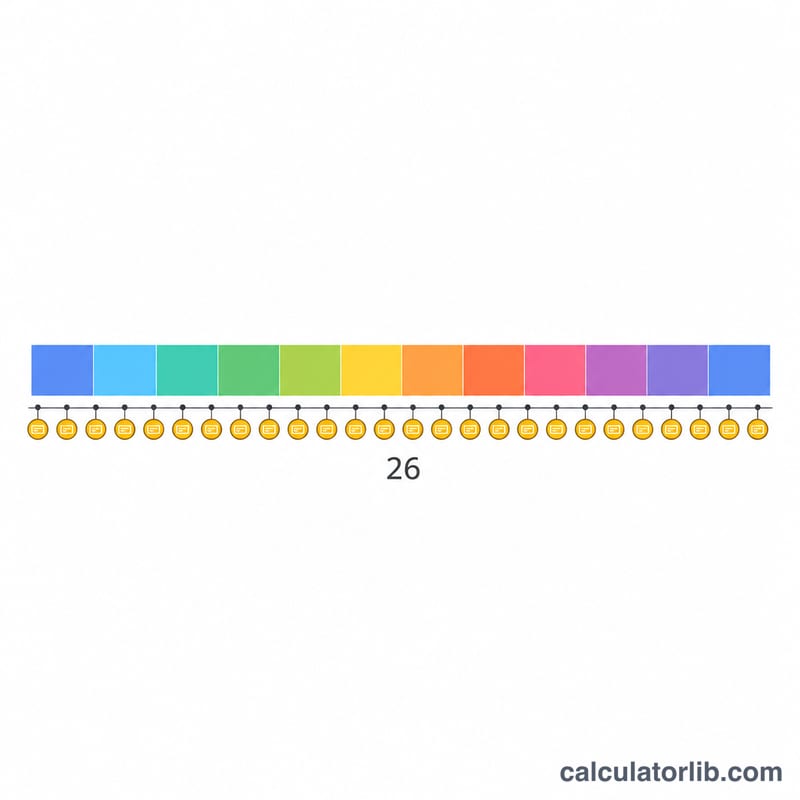
A biweekly pay schedule means you get paid every two weeks — 26 paychecks per year. This is one of the most common pay frequencies for salaried employees. This calculator converts a yearly (annual) salary into the gross amount of each biweekly paycheck before taxes and deductions.
How to use it
Enter your gross annual salary and press calculate. The tool divides your salary by 26 to give the biweekly gross paycheck, and also shows the equivalent weekly (÷52) and monthly (÷12) figures so you can compare pay frequencies at a glance.
The formula explained
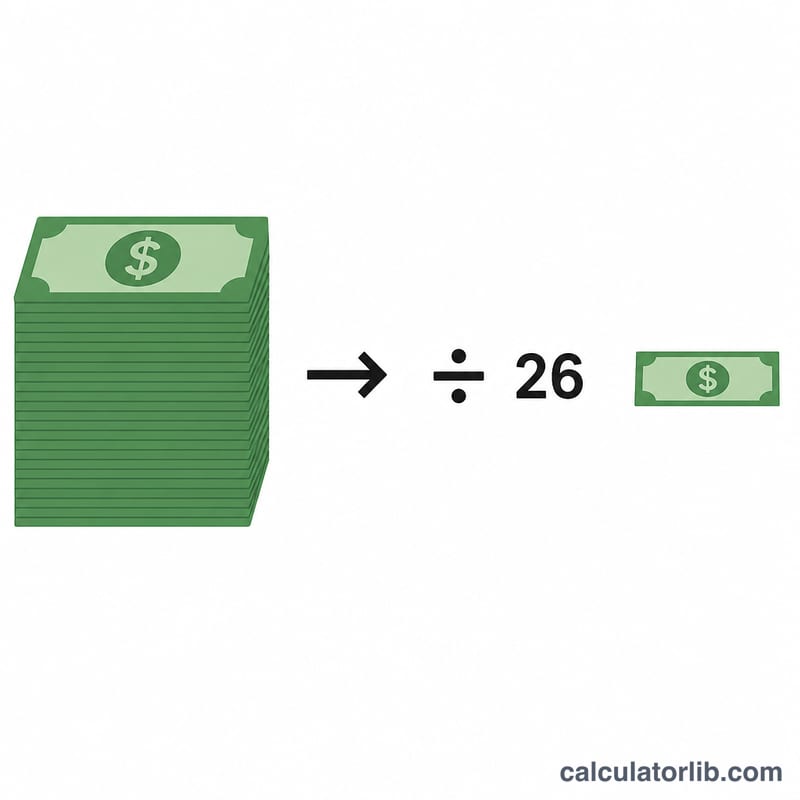
The math is simple: a calendar year contains 52 weeks, and since you are paid every two weeks, that is \(52 \div 2 = 26\) pay periods. So your biweekly gross pay is your annual salary divided by 26. Note this is different from a semi-monthly schedule (twice a month = 24 paychecks).
$$\text{Biweekly Paycheck} = \frac{\text{Annual Salary}}{26}$$
Worked example
Suppose you earn $52,000 per year. Your biweekly paycheck is $$52{,}000 \div 26 = \$2{,}000.00$$ gross. For comparison, weekly pay is \(52{,}000 \div 52 = \$1{,}000.00\) and monthly is \(52{,}000 \div 12 \approx \$4{,}333.33\).
FAQ
Is this take-home pay? No. The result is gross pay before income tax, Social Security, health insurance, retirement contributions, and other deductions. Your net (take-home) check will be lower.
Why 26 and not 24? Biweekly means every two weeks, giving 26 checks a year. Semi-monthly (1st and 15th) gives 24 checks — divide by 24 instead for that schedule.
Some years have 27 paychecks — why? Because 26 biweekly periods is slightly less than a full 365-day year, an extra "27th paycheck" occasionally lands in a calendar year. This calculator uses the standard 26 for a typical year.