
What Is Henry's Law?
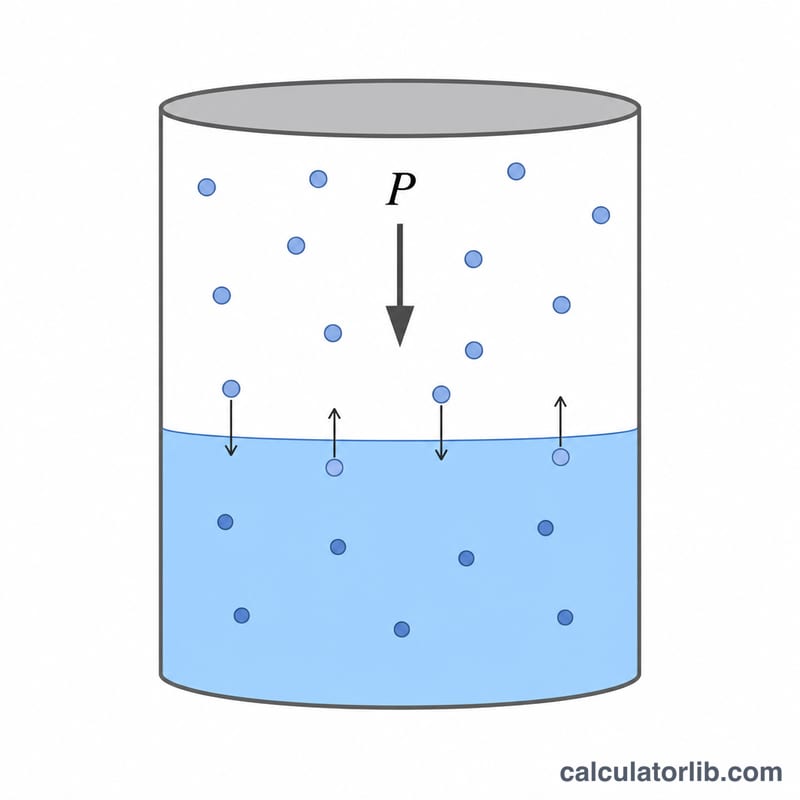
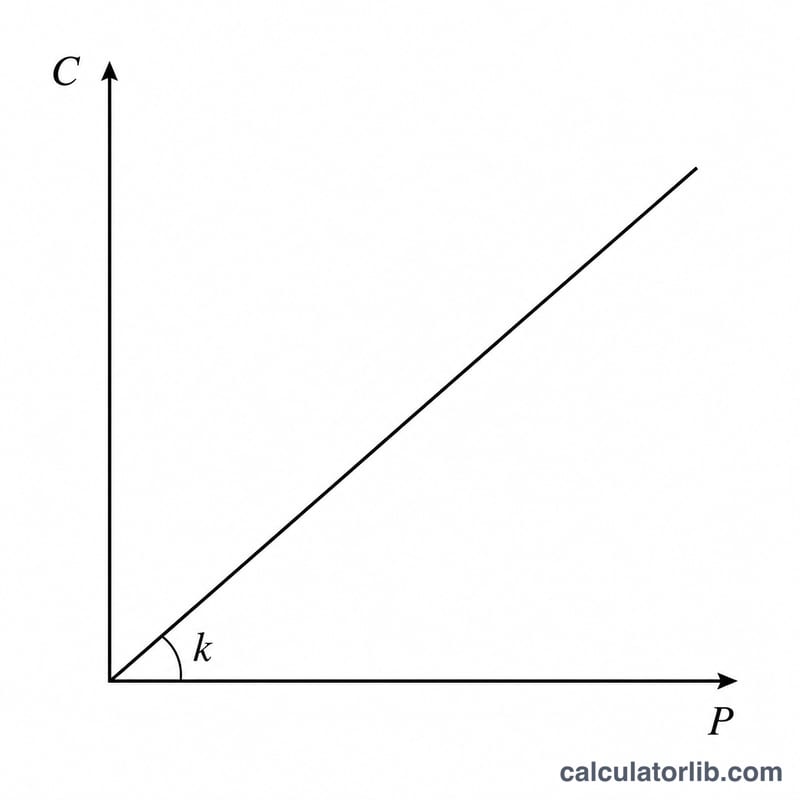
Henry's Law states that the amount of a gas that dissolves in a liquid is directly proportional to the partial pressure of that gas above the liquid (at constant temperature). In the form used by this calculator, the dissolved concentration is \(C = k_H \times P\), where C is the molar concentration of the dissolved gas (mol/L), kH is the Henry's law solubility constant (mol/(L·atm)), and P is the partial pressure of the gas (atm).
How to Use This Calculator
Enter the Henry's law constant for your gas–solvent pair (these are tabulated values that depend on temperature) and the partial pressure of the gas. The calculator multiplies the two to return the equilibrium dissolved concentration. For example, the constant for oxygen in water near 25 °C is roughly 0.0013 mol/(L·atm); for carbon dioxide it is about 0.034 mol/(L·atm).
The Formula Explained
Henry's law works because, at equilibrium, the rate at which gas molecules enter the liquid equals the rate at which they leave. Raising the partial pressure pushes more molecules into solution, raising concentration linearly. The constant kH captures how "soluble" a particular gas is in a particular solvent; larger kH means more gas dissolves at the same pressure. Note that kH decreases as temperature rises, which is why warm soda goes flat faster.
Worked Example
Suppose CO₂ is held above water at a partial pressure of 2.0 atm, with \(k_H = 0.034\) mol/(L·atm). Then $$C = 0.034 \times 2.0 = 0.068 \text{ mol/L}$$ of dissolved CO₂. Double the pressure and the dissolved concentration doubles too.
FAQ
What units does this use? This version uses the concentration form: kH in mol/(L·atm), P in atm, giving C in mol/L. Other conventions express kH as a pressure-over-concentration ratio, so always check which form your tabulated constant follows.
Does temperature matter? Yes. Henry's law constants are temperature dependent, so use a kH value measured at your system's temperature for accurate results.
Is the relationship really linear? Henry's law is an ideal-dilute approximation. It holds well at low to moderate partial pressures but breaks down at very high pressures or for gases that react with the solvent.