
What Is Parts Per Billion (ppb)?
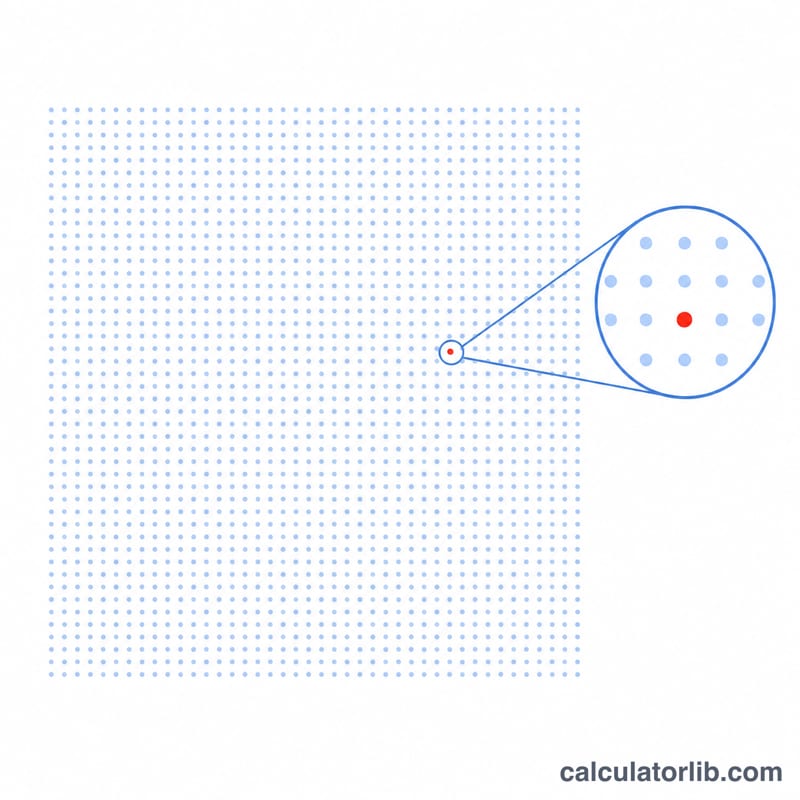
Parts per billion (ppb) is a unit of concentration that expresses how much of a substance (the solute) is present in a very large total amount (the solution). One ppb means one unit of solute for every one billion (1,000,000,000) units of solution. It is widely used to measure trace contaminants in water, air, soil, food, and pharmaceuticals — situations where concentrations are far too small to express conveniently as a percentage.
How to Use This Calculator
Enter the mass of the solute and the mass of the total solution using the same unit (for example, both in grams or both in milligrams). The calculator divides the solute mass by the solution mass and multiplies by one billion to give the concentration in ppb. It also converts the answer to parts per million (ppm) and to a percentage for convenience.
The Formula Explained
The core equation is:
$$\text{ppb} = \frac{\text{mass of solute}}{\text{mass of solution}} \times 10^{9}$$
Because the ratio is dimensionless, the units cancel as long as both masses share the same unit. This makes ppb a relative measure independent of the absolute scale of your sample.
Worked Example
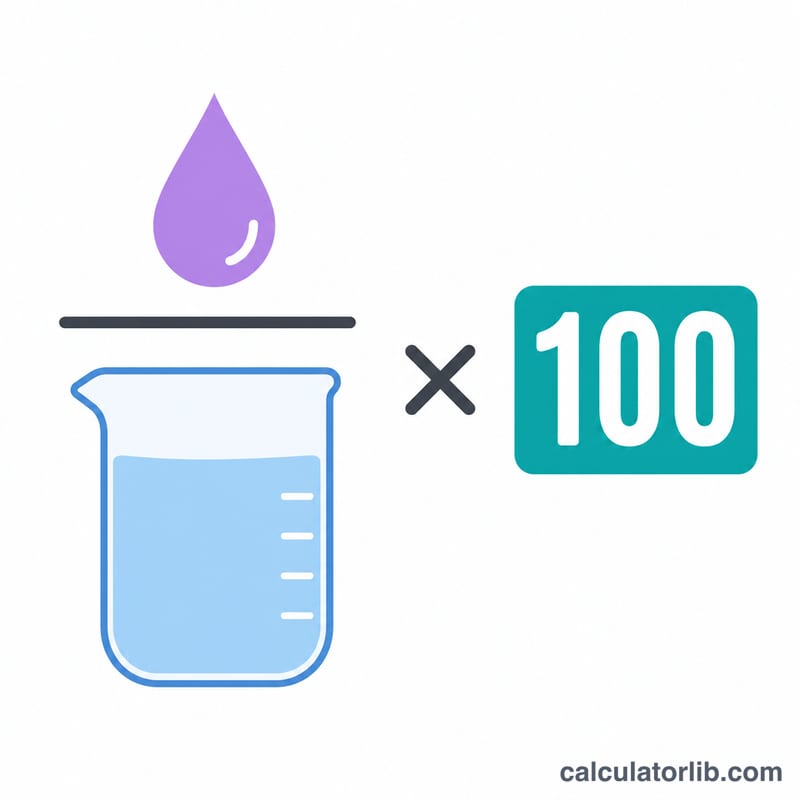
Suppose 0.0005 g of a contaminant is dissolved in 1000 g of water. The ratio is \(0.0005 \div 1000 = 0.0000005\). Multiplying by \(10^{9}\) gives 500 ppb. That is equivalent to 0.5 ppm and 0.00005%.
FAQ
What is 1 ppb in mg/kg? For dilute aqueous solutions, \(1\ \text{ppb} \approx 1\) microgram per kilogram (µg/kg), or 1 µg/L in water where \(1\ \text{L} \approx 1\ \text{kg}\).
How does ppb relate to ppm and percent? \(1\ \text{ppm} = 1000\ \text{ppb}\), and \(1\% = 10{,}000\ \text{ppm} = 10{,}000{,}000\ \text{ppb}\).
Do the masses need the same units? Yes. Mixing units (e.g. grams of solute with kilograms of solution) will give an incorrect result. Convert both to a common unit first.