
What Is the Frost Point?
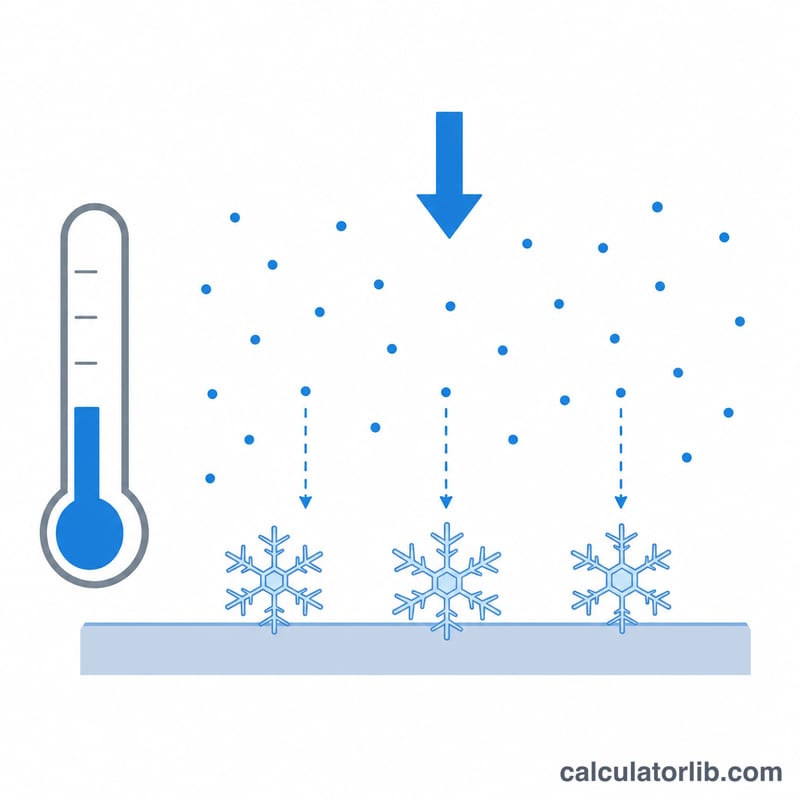
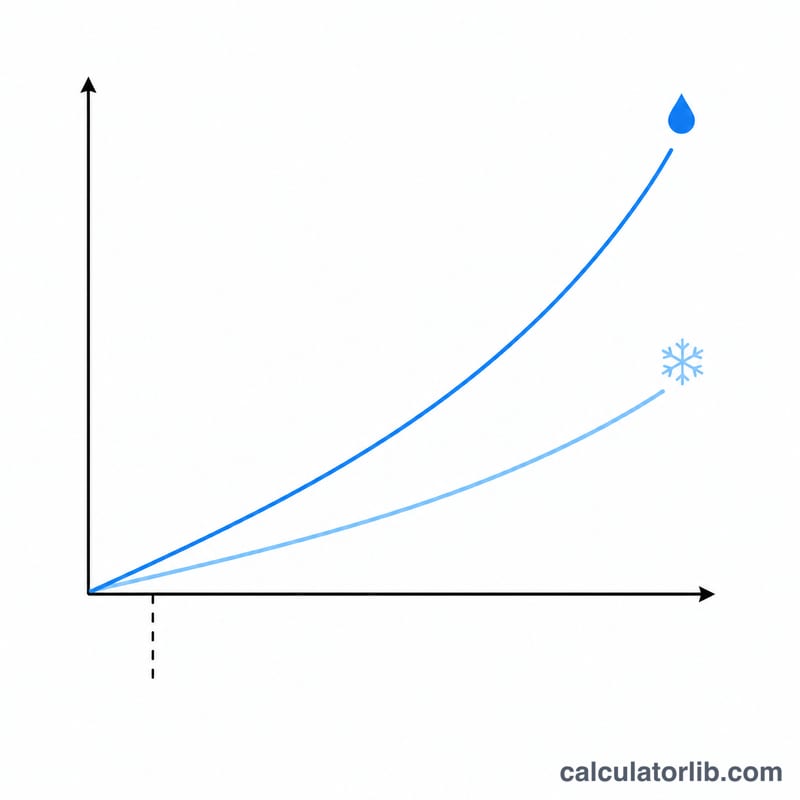
The frost point is the temperature to which air must be cooled, at constant pressure and water-vapor content, for water vapor to deposit directly as frost (ice) rather than condense as liquid dew. It is the sub-freezing analogue of the dew point and uses saturation values calculated over ice instead of over liquid water. The frost point is essential in meteorology, aviation icing forecasts, cold-storage engineering, and frost-protection planning for agriculture.
How to Use This Calculator
Enter the current air temperature in degrees Celsius and the relative humidity as a percentage (0.01–100). The calculator returns the frost point temperature in °C using the Magnus-Tetens approximation with coefficients tuned for saturation over ice. Frost point is most physically meaningful when the air temperature is below 0 °C.
The Formula Explained
We first compute an intermediate term γ that blends the humidity ratio with the temperature:
$$\gamma = \ln\!\left(\frac{\text{RH}}{100}\right) + \frac{22.46 \times T}{272.62 + T}$$
Then the frost point is:
$$T_f = \frac{272.62 \times \gamma}{22.46 - \gamma}$$
The constants 22.46 and 272.62 °C are the Magnus coefficients for the ice phase (Sonntag/Alduchov-style fits). At 100% relative humidity, \(\ln(1) = 0\) and \(T_f\) collapses back toward \(T\), as expected.
Worked Example
Suppose T = −5 °C and RH = 80%. First, $$\gamma = \ln(0.80) + \frac{22.46 \times -5}{272.62 - 5} = -0.22314 + \frac{-112.3}{267.62} = -0.22314 - 0.41962 = -0.64276.$$ Then $$T_f = \frac{272.62 \times -0.64276}{22.46 + 0.64276} = \frac{-175.25}{23.10276} \approx -7.59 \text{ °C}.$$ So frost would form on surfaces cooled to about −7.6 °C.
FAQ
Frost point vs dew point — what's the difference? Below 0 °C, vapor can deposit as ice. The frost point uses ice-saturation coefficients and is slightly higher than the liquid-water dew point at the same conditions.
Can I use this above freezing? The math runs, but the result is only physically meaningful for sub-freezing air where ice saturation applies. Above 0 °C use a dew point calculator.
Why must humidity be above 0%? The formula takes the natural log of RH/100, which is undefined at 0; we clamp tiny values to avoid errors.