
What Is Specific Humidity?
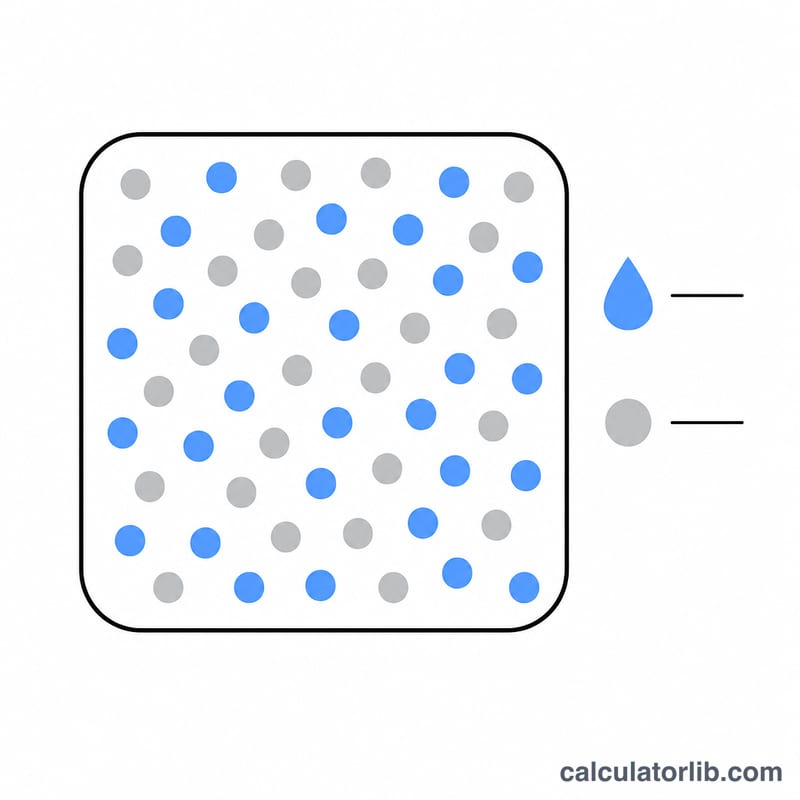
Specific humidity (q) is the ratio of the mass of water vapor to the total mass of moist air in a parcel. Unlike relative humidity, it does not change when air is heated or cooled (as long as no condensation occurs), making it a robust quantity for meteorology, HVAC engineering, and atmospheric science. It is commonly expressed in kilograms of vapor per kilogram of moist air (kg/kg) or, more conveniently, in grams per kilogram (g/kg).
How to Use This Calculator
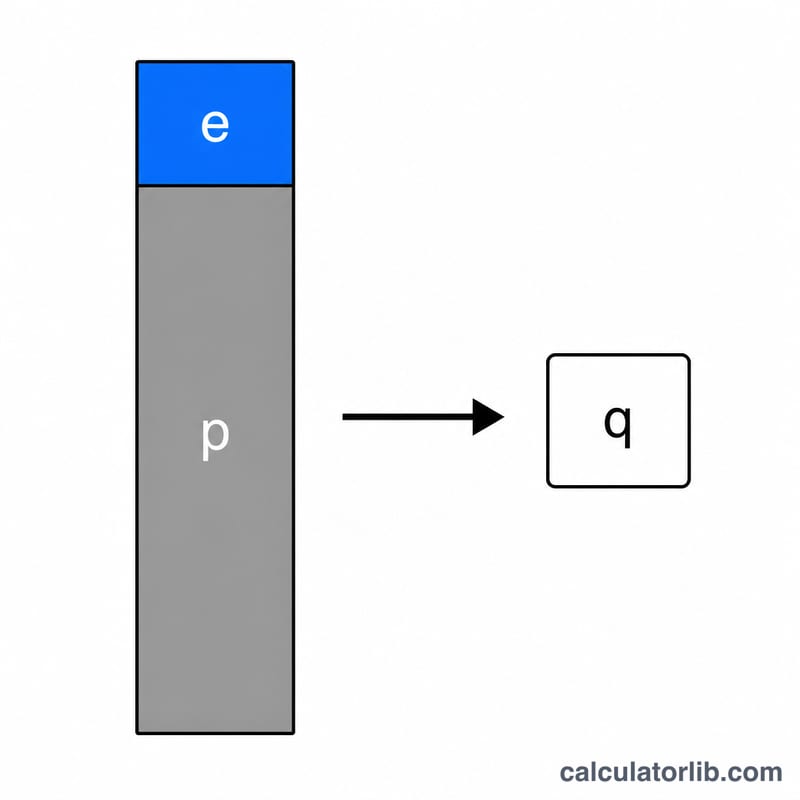
Enter the water vapor pressure e and the total air pressure p in the same units (this tool uses hectopascals, hPa, which equal millibars). The calculator returns specific humidity in both g/kg and kg/kg. To find e, you can multiply the saturation vapor pressure at the air temperature by the relative humidity fraction.
The Formula Explained
The working equation is:
$$q = \frac{0.622 \cdot e}{p - 0.378 \cdot e}$$
The constant 0.622 is the ratio of the molar mass of water (≈18.02 g/mol) to that of dry air (≈28.96 g/mol). The term \(0.378 = 1 - 0.622\) in the denominator accounts for the fact that vapor displaces dry air, correcting the simpler mixing-ratio approximation so that the result is true specific humidity rather than the mixing ratio.
Worked Example
Suppose the vapor pressure is \(e = 20\) hPa and total pressure is \(p = 1013.25\) hPa. Then the denominator is $$1013.25 - 0.378 \times 20 = 1013.25 - 7.56 = 1005.69.$$ The numerator is \(0.622 \times 20 = 12.44\). So $$q = \frac{12.44}{1005.69} \approx 0.012370 \text{ kg/kg},$$ or about 12.37 g/kg.
FAQ
Is specific humidity the same as mixing ratio? No. Mixing ratio is vapor mass per mass of dry air; specific humidity is vapor mass per mass of moist air. They are close in value for normal atmospheric conditions but defined differently.
What units should I use? Use the same pressure unit for both e and p — the ratio is dimensionless. Output specific humidity is then unit-independent (kg/kg), commonly scaled to g/kg.
Why is q stable with temperature? Because it is a mass ratio. Heating air without adding or removing water changes volume and relative humidity, but the masses of vapor and air stay fixed, so q is unchanged.