
What Is Absolute Humidity?
Absolute humidity is the total mass of water vapor present in a given volume of air, expressed in grams per cubic meter (g/m³). Unlike relative humidity, which is a percentage relative to the maximum possible at a given temperature, absolute humidity gives you the actual quantity of moisture in the air. It is widely used in HVAC design, meteorology, greenhouse management, museum and archive preservation, and industrial drying processes.
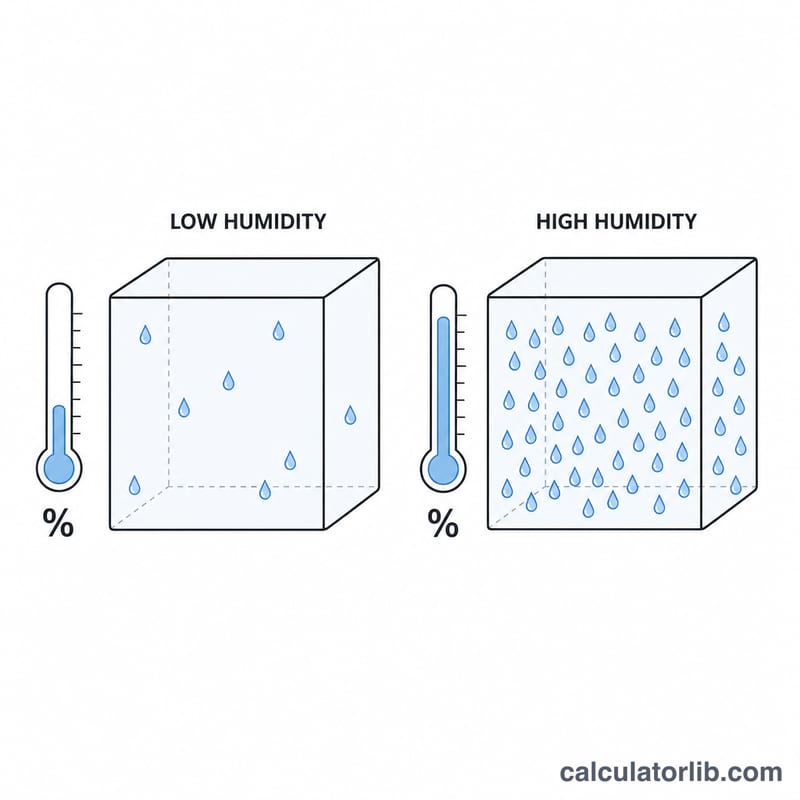
How to Use This Calculator
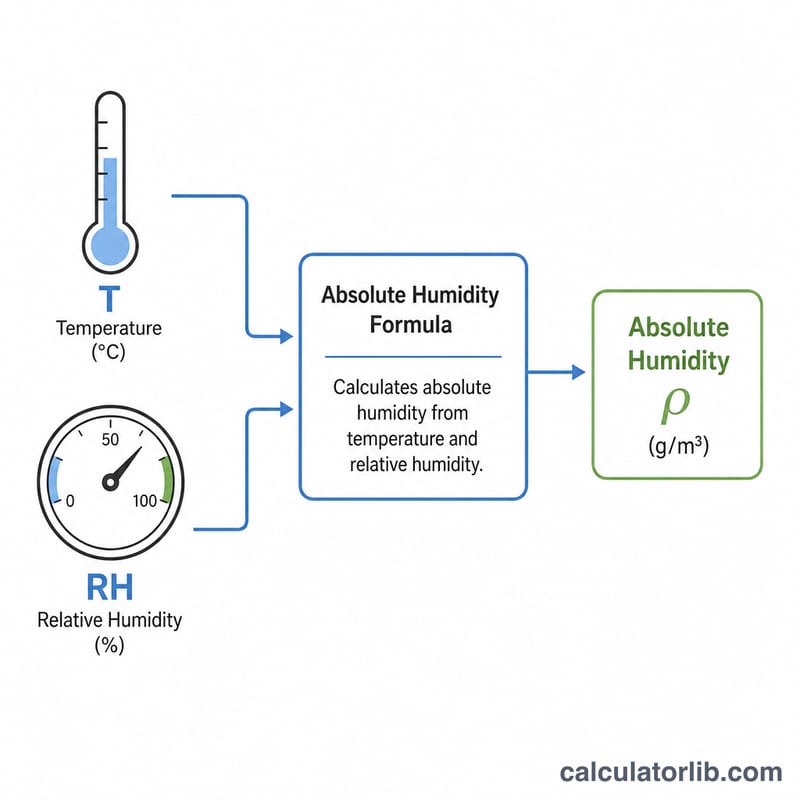
Enter the air temperature in degrees Celsius and the relative humidity as a percentage (0–100). The calculator instantly returns the absolute humidity in g/m³. This tool works for any environment from cold storage to tropical climates.
The Formula Explained
This calculator uses a Magnus-formula approximation for saturation vapor pressure combined with the ideal-gas relationship:
$$AH = \frac{6.112 \cdot e^{\frac{17.67\,T}{T+243.5}} \cdot RH \cdot 2.1674}{273.15 + T}$$
The exponential term estimates the saturation vapor pressure (in hPa) at temperature \(T\). Multiplying by \(RH/100\) gives the actual vapor pressure, and the constant 2.1674 together with division by absolute temperature \((273.15 + T)\) converts pressure into a vapor density in g/m³.
Worked Example
Suppose \(T = 25\) °C and \(RH = 60\%\). The exponent is $$\frac{17.67 \times 25}{25 + 243.5} = \frac{441.75}{268.5} \approx 1.6453,$$ so \(e^{1.6453} \approx 5.182\). Then numerator $$= 6.112 \times 5.182 \times 60 \times 2.1674 \approx 4118.7,$$ divided by \((273.15 + 25 = 298.15)\) gives about \(13.81\) g/m³.
Constants Used in the Calculation
The absolute humidity calculator combines the Magnus equation for saturation vapor pressure with the ideal gas law to convert that vapor pressure into a mass of water per cubic metre of air. The formula is:
$$\text{AH} = \frac{6.112 \cdot e^{\frac{17.67 \cdot T}{T + 243.5}} \cdot \text{RH} \cdot 2.1674}{273.15 + T}$$Each fixed number in this expression plays a specific physical role:
| Constant | Value & Units | Role in the Formula |
|---|---|---|
| Reference saturation vapor pressure | 6.112 hPa | The saturation vapor pressure of water at 0 °C; the leading coefficient that the Magnus exponential scales upward as temperature rises. |
| Magnus coefficient (a) | 17.67 (dimensionless) | The numerator coefficient in the Magnus exponent that sets how steeply saturation vapor pressure grows with temperature. |
| Magnus temperature constant (b) | 243.5 °C | The temperature offset in the Magnus exponent denominator, fitted to liquid-water saturation data over typical ambient ranges. |
| Conversion constant | 2.1674 g·K/(hPa·m³) | Bundles the molar mass of water and the gas constant so that vapor pressure (hPa) divided by absolute temperature (K) yields water mass per volume in g/m³. |
| Celsius-to-Kelvin offset | 273.15 (K) | Converts the input temperature in °C to absolute temperature (Kelvin), which the ideal-gas density step requires. |
Relative humidity (RH) is entered as a percentage (e.g. 50 for 50%), and multiplying by it scales the saturation vapor pressure down to the actual vapor pressure present in the air.
Interpreting Your Absolute Humidity Result
Absolute humidity (AH) reports the actual mass of water vapor contained in each cubic metre of air, expressed in grams per cubic metre (g/m³). Unlike relative humidity, it does not depend on how warm or cool the air is, which makes it useful for comparing moisture content across different temperatures.
The following ranges reflect commonly cited uses; they are general reference points, not personal recommendations:
- Typical indoor comfort: Many occupied indoor spaces sit around 7–12 g/m³, which corresponds to comfortable relative humidity at normal room temperatures.
- Museum, archive and collection preservation: Conservation guidance is usually framed in relative humidity (commonly stabilised near 45–55% RH at controlled temperatures); the corresponding absolute humidity is often tracked because it stays steady even when room temperature drifts, helping detect real moisture changes versus temperature-driven RH swings.
- Mold-risk context: Mold growth on surfaces is driven by sustained high relative humidity at the surface (often cited above roughly 70–80% RH for prolonged periods). Because a fixed amount of water vapor (constant AH) produces higher RH against a cold surface, tracking AH alongside surface temperatures helps explain where condensation and mold risk arise.
Why AH stays constant while RH changes: If a parcel of air is sealed and simply heated or cooled — with no water added or removed — its absolute humidity is unchanged because the mass of water vapor is the same. Relative humidity, however, falls when that air is heated (warmer air can hold more vapor before saturating) and rises when it is cooled, reaching 100% at the dew point. This is why winter heating of cold outdoor air produces very dry indoor relative humidity even though the absolute moisture content barely moved.
This information is general and educational; specific climate-control targets for health, building, or collection settings should follow the relevant published standards or a qualified professional.
Key Terms & Variables
- Absolute humidity (AH)
- The mass of water vapor present per unit volume of air, here in grams per cubic metre (g/m³). It is independent of temperature for a fixed amount of vapor in a fixed volume.
- Relative humidity (RH)
- The ratio of the actual vapor pressure to the saturation vapor pressure at the same temperature, expressed as a percentage. RH indicates how close the air is to saturation, not the absolute amount of moisture.
- Saturation vapor pressure
- The maximum partial pressure water vapor can exert at a given temperature before it begins to condense. It rises sharply with temperature, as captured by the Magnus exponential term.
- Actual vapor pressure
- The partial pressure actually exerted by the water vapor in the air. It equals the saturation vapor pressure multiplied by the relative humidity fraction (RH ÷ 100).
- Vapor density
- Another name for absolute humidity — the density of water vapor in the air (mass per volume), obtained by applying the ideal gas law to the actual vapor pressure and absolute temperature.
- Magnus formula
- An empirical equation of the form \(6.112 \cdot e^{\frac{17.67\,T}{T + 243.5}}\) that approximates the saturation vapor pressure of water (in hPa) as a function of temperature \(T\) in °C, accurate across typical ambient conditions.
FAQ
How is this different from relative humidity? Relative humidity is a ratio (%), while absolute humidity is an actual mass of water per unit volume (g/m³).
Can I use Fahrenheit? No — convert to Celsius first: \(°C = (°F - 32) \times \frac{5}{9}\).
How accurate is it? The Magnus approximation is accurate to within a fraction of a percent for typical atmospheric temperatures (roughly −40 °C to 50 °C).