
What This Calculator Does
Relative humidity (RH) tells you how much water vapor is in the air compared with the maximum the air can hold at a given temperature. This tool computes RH from two readily measured values — the air temperature and the dew point — using the well-established Magnus approximation for saturation vapor pressure. It works in any country and any climate, since it relies only on physics.
How to Use It
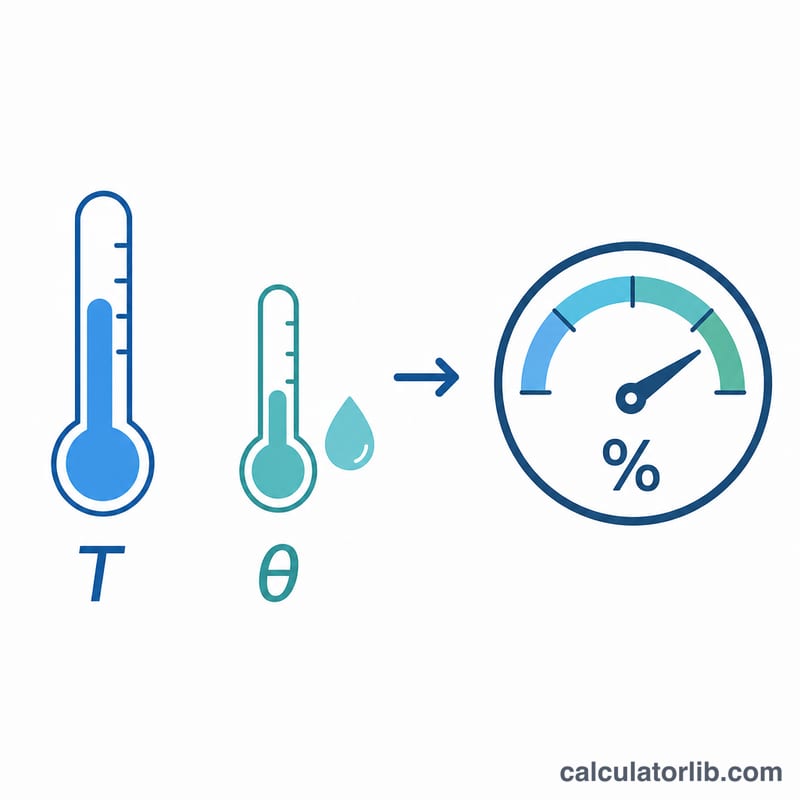
Enter the current air temperature in degrees Celsius, then enter the dew point temperature (the temperature to which air must cool for water vapor to start condensing). Press calculate. The result shows the relative humidity as a percentage, along with the underlying actual vapor pressure (e) and saturation vapor pressure (es) in hectopascals (hPa).
The Formula Explained
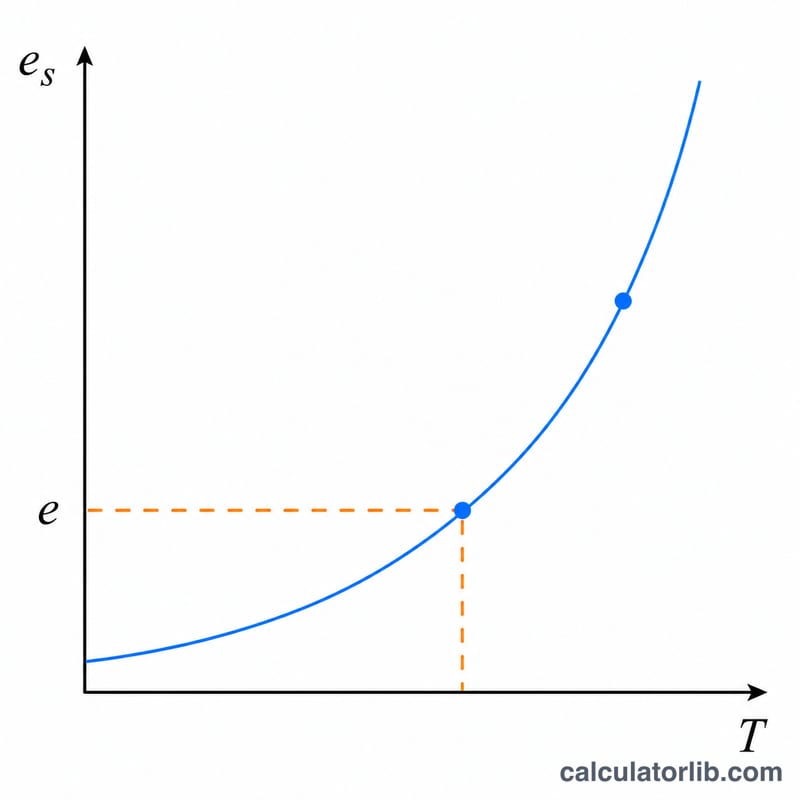
Saturation vapor pressure is found with the Magnus formula $$e_s = 6.112 \cdot \exp\!\left(\frac{17.67 \cdot T}{T + 243.5}\right)$$, where T is temperature in °C. The actual vapor pressure \(e\) uses the same formula but with the dew point substituted for T, because at the dew point the air is exactly saturated. Relative humidity is then the simple ratio $$\text{RH} = \frac{e}{e_s} \times 100$$. Because the dew point can never exceed the air temperature, RH is naturally capped at 100%.
Worked Example
Air temperature 25 °C, dew point 15 °C. Saturation pressure $$e_s = 6.112 \cdot \exp\!\left(\frac{17.67 \cdot 25}{268.5}\right) \approx 31.671 \text{ hPa}.$$ Actual pressure $$e = 6.112 \cdot \exp\!\left(\frac{17.67 \cdot 15}{258.5}\right) \approx 17.040 \text{ hPa}.$$ $$\text{RH} = \frac{17.040}{31.671} \times 100 \approx 53.8\%.$$
FAQ
Why use dew point instead of measuring humidity directly? Dew point and temperature are easy to measure with common instruments and uniquely determine RH.
Why is the result limited to 100%? When dew point equals air temperature the air is fully saturated (100%); values above that are physically impossible, so the result is clamped.
How accurate is the Magnus formula? It is accurate to within about 0.1% for temperatures between roughly −40 °C and +50 °C, which covers virtually all weather conditions.