
What Is Vapor Pressure Deficit (VPD)?
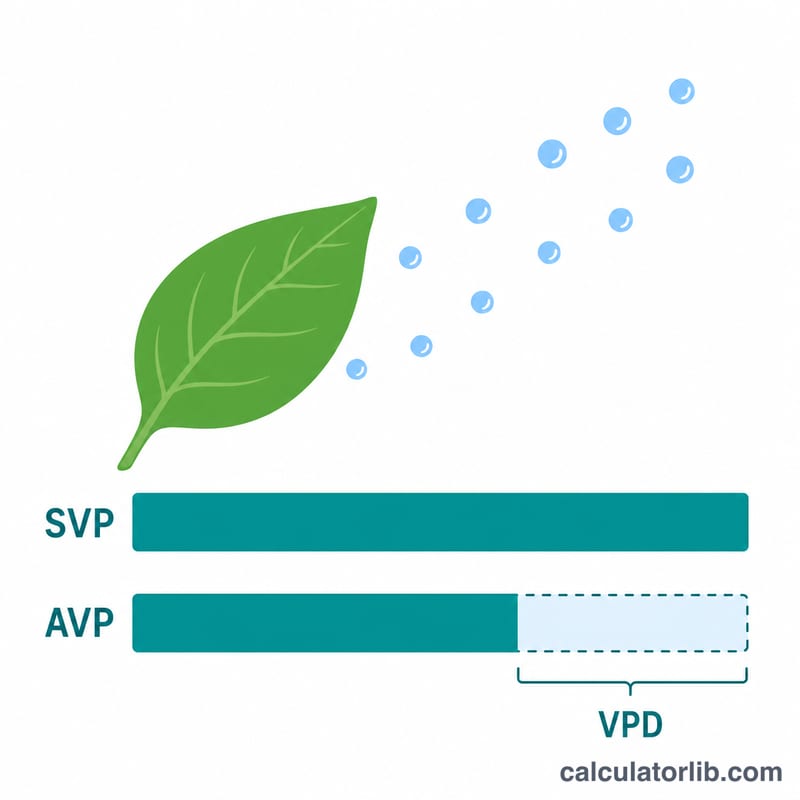
Vapor Pressure Deficit (VPD) measures the difference between the amount of moisture in the air and how much moisture the air can hold when fully saturated. Expressed in kilopascals (kPa), VPD is one of the most useful environmental metrics for greenhouse, indoor garden, and grow-room management because it directly drives how fast plants transpire. A high VPD means dry air that pulls water rapidly from leaves; a low VPD means humid air where transpiration slows and disease risk rises.
How to Use This Calculator
Enter the current air temperature in degrees Celsius and the relative humidity as a percentage. The calculator returns the VPD in kPa, along with the Saturation Vapor Pressure (SVP) and the Actual Vapor Pressure (AVP) so you can see exactly how the result is built. Most growers aim for roughly 0.4–0.8 kPa during early growth and 1.0–1.5 kPa during flowering, though ideal ranges vary by crop.
The Formula Explained
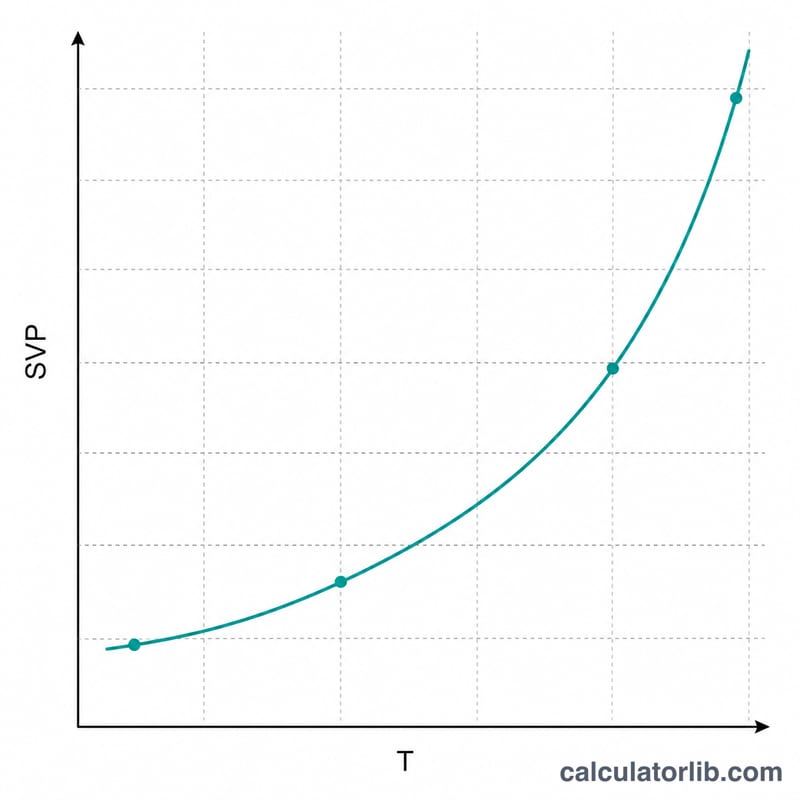
First the saturation vapor pressure is found with the Tetens equation: $$\text{SVP} = 0.6108 \times e^{\frac{17.27 \cdot T}{T + 237.3}}$$, where \(T\) is temperature in °C. The actual vapor pressure is simply \(\text{SVP} \times \text{RH}/100\). The deficit is what is left over: $$\text{VPD} = \text{SVP} \times \left(1 - \frac{\text{RH}}{100}\right)$$. Note this is an air-temperature VPD; if you want leaf VPD, substitute leaf temperature (often a couple of degrees below air) into the SVP term.
Worked Example
At 25 °C and 50% relative humidity: $$\text{SVP} = 0.6108 \times e^{\frac{17.27 \times 25}{262.3}} = 0.6108 \times e^{1.6461} \approx 3.1690 \text{ kPa}.$$ $$\text{VPD} = 3.1690 \times (1 - 0.50) \approx \mathbf{1.585 \text{ kPa}},$$ with an actual vapor pressure of about 1.585 kPa.
FAQ
What is a good VPD? Generally 0.8–1.2 kPa suits most vegetative-to-flowering plants, but check your specific crop's guidance.
Is this leaf or air VPD? It uses air temperature. For leaf VPD, enter the leaf surface temperature instead.
Why use kPa? Kilopascals are the standard unit in horticulture; multiply by 10 to convert to hPa/millibars if needed.