
What Are Cooling Degree Days?
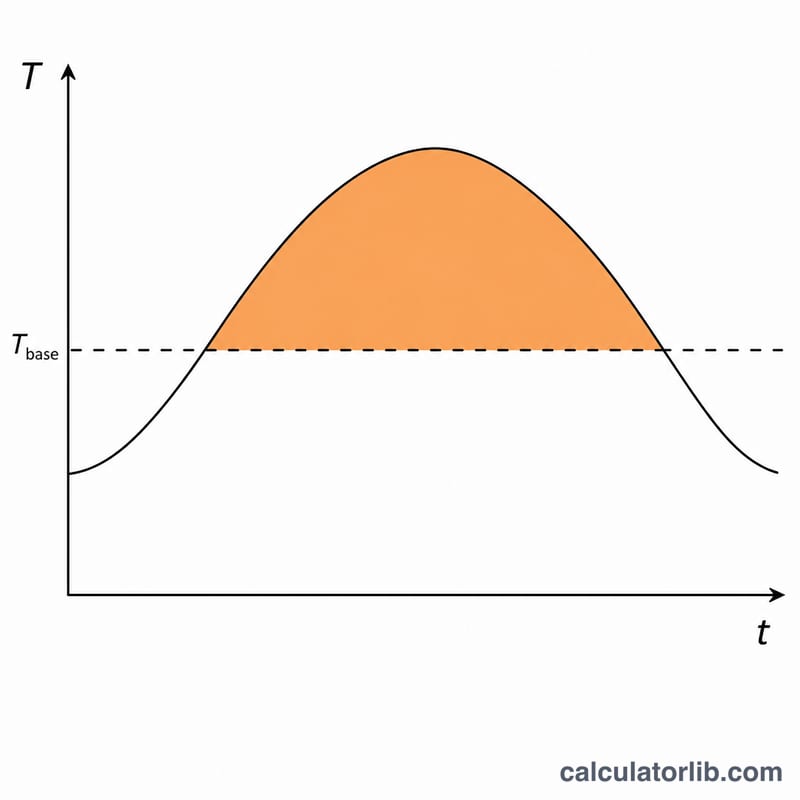
Cooling degree days (CDD) are a measure of how much, and for how long, the outside air temperature is above a comfortable base temperature. They are widely used by utilities, HVAC engineers, and energy analysts to estimate the demand for air conditioning. The higher the CDD value, the more cooling energy a building is likely to consume. This calculator works with any temperature unit (use °F with a 65 °F base, or °C with an 18 °C base) as long as you keep the base and the daily temperatures in the same unit.
How to Use the Calculator
Enter the day's high temperature (Tmax) and low temperature (Tmin), choose a base temperature (commonly 65 °F or 18 °C), and optionally a number of days that share those conditions. The tool computes the mean daily temperature, the CDD for one day, and the running total. If the mean temperature is at or below the base, the CDD is zero — no cooling is needed.
The Formula Explained
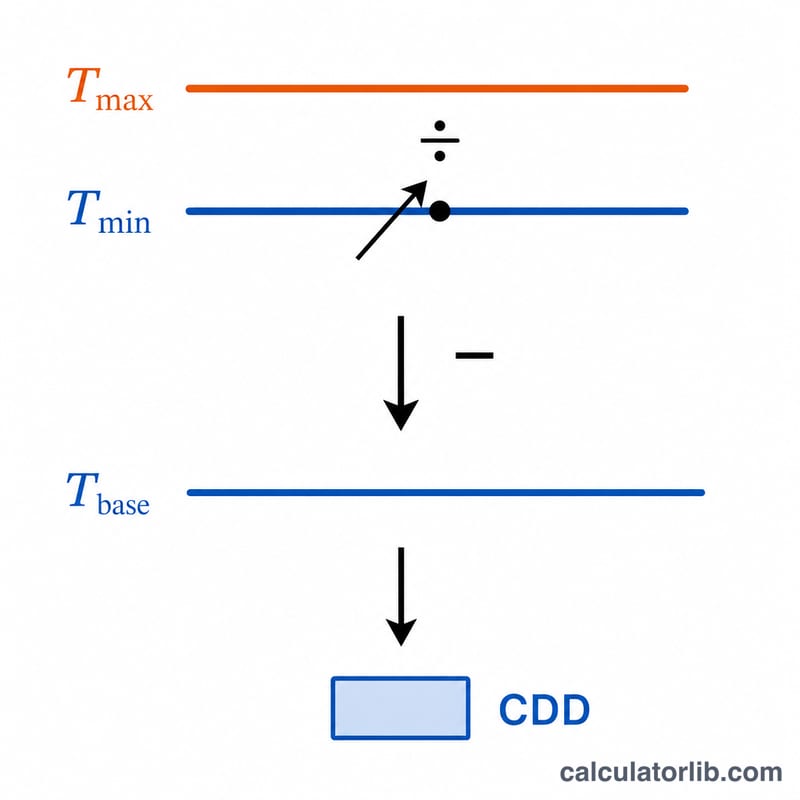
$$\text{CDD} = \max\!\left(0,\; \frac{\text{Tmax} + \text{Tmin}}{2} - \text{Tbase}\right)$$ First the daily mean temperature is found by averaging the high and low. Then the base temperature is subtracted. The \(\max(0, \ldots)\) ensures that cool days never produce negative cooling degree days — they simply contribute zero. Over a season or year you sum the daily values to get total CDD.
Worked Example
Suppose \(\text{Tmax} = 90°\), \(\text{Tmin} = 70°\), and the base is \(65°\). The mean temperature is $$\frac{90 + 70}{2} = 80°$$ Subtracting the base gives \(80 - 65 = 15\) cooling degree days for that day. Over 7 such days the total would be \(15 \times 7 = 105\) degree-days.
FAQ
What base temperature should I use? In the US, 65 °F is the standard. In metric regions, 18 °C (roughly equivalent) is common, though some use 22–24 °C for cooling.
What if my mean temperature is below the base? Then CDD is 0 for that day. Cooling degree days are never negative — that role is filled by heating degree days (HDD).
How are CDD used? They correlate strongly with air-conditioning energy use, so they help forecast electricity demand, benchmark building efficiency, and normalize energy bills for weather.