
What is the Water Cooling Calculator?
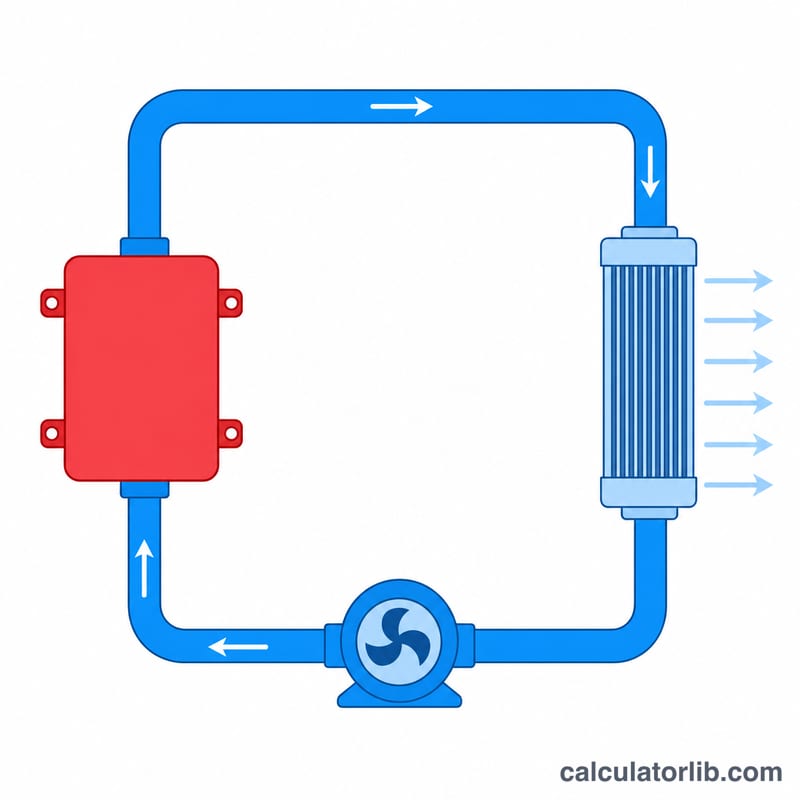
This calculator determines how much heat a liquid cooling loop can remove using the fundamental heat transfer equation \(Q = \dot{m} \cdot c \cdot \Delta T\). It is widely used for PC water cooling, industrial chillers, laser cooling, engine cooling jackets and any closed loop where a pumped fluid carries away thermal energy. The result is given in watts and kilowatts.
How to use it
Enter the coolant flow rate in litres per minute, the temperature rise (\(\Delta T\)) between the coolant outlet and inlet in °C, the coolant density (water ≈ 1000 kg/m³) and its specific heat (water ≈ 4186 J/kg·°C). The tool converts the volumetric flow into a mass flow rate and multiplies by specific heat and temperature difference to give the heat removed.
The formula explained
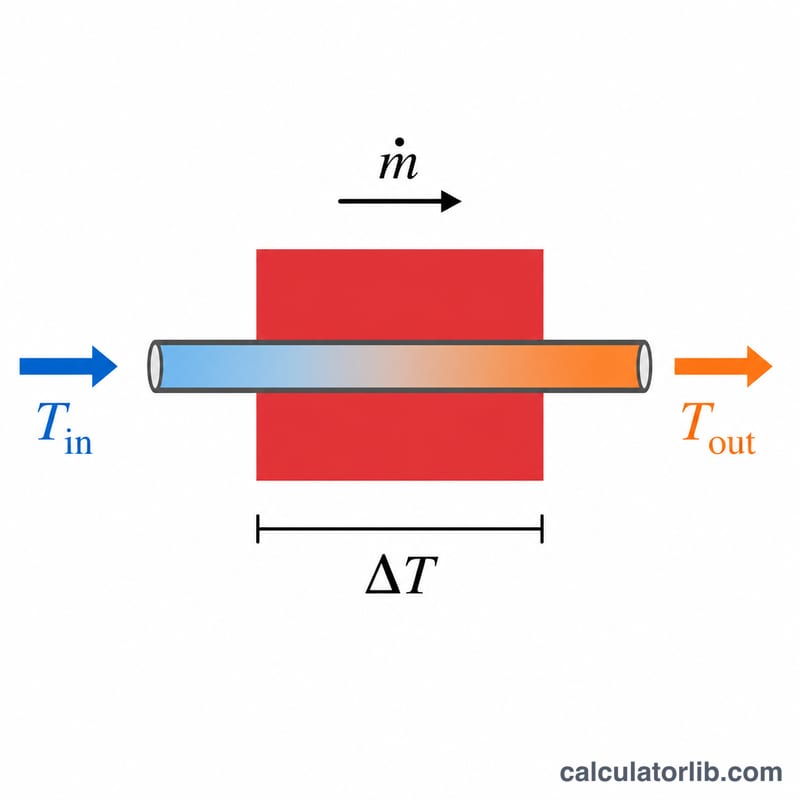
The mass flow rate \(\dot{m}\) (kg/s) is the volumetric flow divided by 1000 (L→m³) and 60 (min→s), times density:
$$\dot{m} = \frac{\text{flow (L/min)}}{1000 \times 60} \cdot \rho$$Multiplying \(\dot{m}\) by the specific heat \(c\) and the temperature change \(\Delta T\) gives \(Q\) in watts — the rate of heat energy carried away by the fluid. A larger flow rate or a larger temperature rise both remove more heat.
Worked example
A loop runs water at 2 L/min with a 10 °C rise. Mass flow:
$$\dot{m} = \left(2 \div 1000 \div 60\right) \times 1000 = 0.03333 \text{ kg/s}$$Heat removed:
$$Q = 0.03333 \times 4186 \times 10 \approx \mathbf{1395 \text{ W } (1.4 \text{ kW})}$$Doubling the flow to 4 L/min doubles the heat removed to about 2790 W.
FAQ
What density and specific heat should I use? Pure water near room temperature: 1000 kg/m³ and 4186 J/kg·°C. A water/glycol mix has lower specific heat (~3300–3800 J/kg·°C) and slightly higher density.
Is \(\Delta T\) the inlet or outlet temperature? \(\Delta T\) is the difference (outlet minus inlet) — the temperature the coolant gained while passing through the heat source.
How do I convert to BTU/hr? Multiply the watt result by 3.412.