What Is the Silver Coin Melt Calculator?
The silver coin melt calculator estimates the intrinsic value of a coin's silver content — the amount you would theoretically receive if the coin were melted down and sold as bullion. This "melt value" is independent of any collector or numismatic premium, and it forms the price floor for circulated silver coins. The calculation works for any silver coin worldwide as long as you know its weight, silver purity (fineness), and the current spot price of silver.
How to Use It
Enter the number of coins, the gross weight of a single coin in troy ounces, the silver purity as a percentage, and the current silver spot price per troy ounce. The calculator multiplies weight by purity to find the actual silver content, then multiplies by the spot price and the number of coins to give the total melt value. It also breaks down the value and silver content per coin.
The Formula Explained
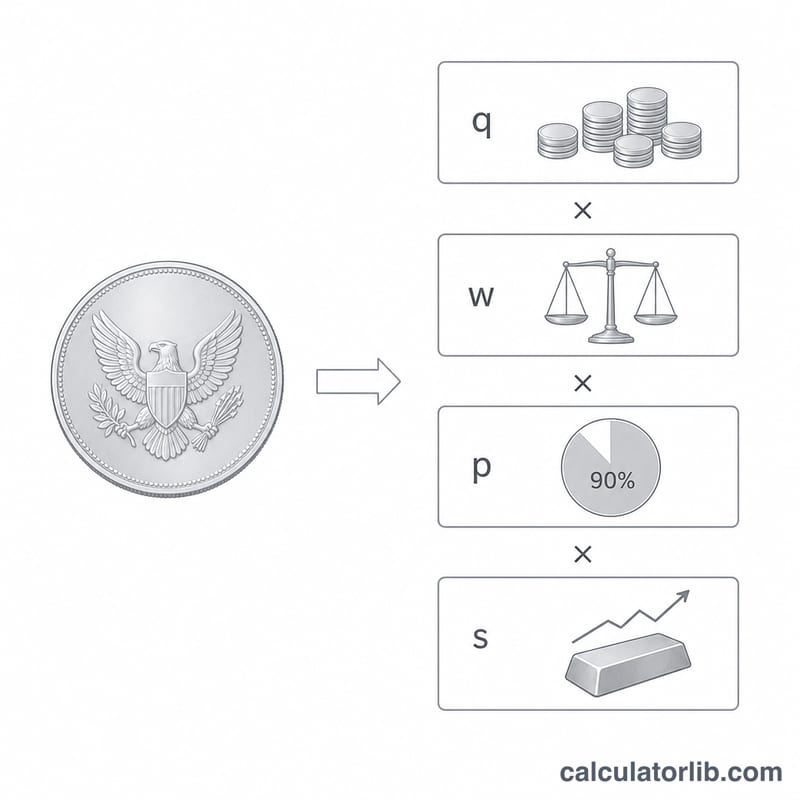
The core relationship is $$\text{Melt} = q \times (w \times p) \times s$$. The term \(w \times p\) converts the coin's gross weight into its pure silver content (its "actual silver weight" or ASW). Multiplying by the spot price values that silver, and multiplying by quantity scales the result to your whole batch.
Worked Example
Take 10 pre-1965 US 90% silver quarters. Each weighs about 0.18084 troy oz at 90% purity, so the silver content is \(0.18084 \times 0.90 = 0.16276\) oz per coin. At a spot price of $30/oz that is \(0.16276 \times 30 = \$4.8828\) per coin, or about $48.83 for all ten.
$$\text{Melt} = 10 \times (0.18084 \times 0.90) \times 30 \approx \$48.83$$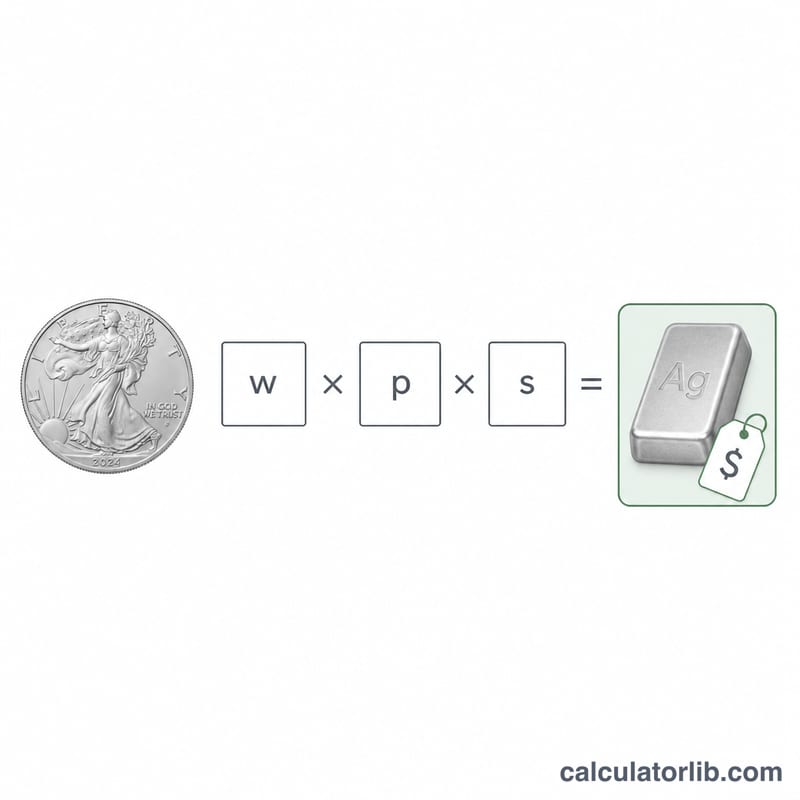
Common Silver Coin Weights and Purities
Enter the coin's gross weight in troy ounces and its purity (%) in the calculator. Or enter the actual silver weight (ASW) with purity set to 100. The silver per coin is weight × purity ÷ 100. The table gives gross weight in grams and troy oz, fineness, and ASW in troy oz. All figures are approximate: nominal mint specifications, and worn coins weigh slightly less.
| Coin | Gross weight (g) | Gross weight (troy oz) | Fineness | Purity to enter (%) | ASW (troy oz) |
|---|---|---|---|---|---|
| US dime, pre-1965 | 2.50 | 0.0804 | .900 | 90 | 0.0723 |
| US quarter, pre-1965 | 6.25 | 0.2009 | .900 | 90 | 0.1808 |
| US half dollar, pre-1965 (incl. 1964 Kennedy) | 12.50 | 0.4019 | .900 | 90 | 0.3617 |
| US Morgan / Peace dollar | 26.73 | 0.8594 | .900 | 90 | 0.7734 |
| US 40% Kennedy half (1965–1970) | 11.50 | 0.3697 | .400 | 40 | 0.1479 |
| US 35% war nickel (1942–1945) | 5.00 | 0.1607 | .350 | 35 | 0.0563 |
| American Silver Eagle (1 oz) | 31.10 | 1.0000 | .999 | 99.9 | ≈1.0 (nominal 1 oz fine silver) |
| Canada 10 cents, 1920–1966 | 2.33 | 0.0749 | .800 | 80 | 0.0600 |
| Canada 25 cents, 1920–1966 | 5.83 | 0.1874 | .800 | 80 | 0.1500 |
| Canada 50 cents, 1920–1966 | 11.66 | 0.3749 | .800 | 80 | 0.3000 |
| Canada 10 cents, 1967 | 2.33 | 0.0749 | .500 | 50 | 0.0375 |
| Canada 25 cents, 1967 | 5.83 | 0.1874 | .500 | 50 | 0.0937 |
| Canada 50 cents, 1967 | 11.66 | 0.3749 | .500 | 50 | 0.1875 |
| UK shilling, pre-1920 (sterling) | 5.66 | 0.1820 | .925 | 92.5 | 0.168 |
| UK half crown, pre-1920 (sterling) | 14.14 | 0.4546 | .925 | 92.5 | 0.4205 |
| UK shilling, 1920–1946 | 5.66 | 0.1820 | .500 | 50 | 0.0910 |
| UK half crown, 1920–1946 | 14.14 | 0.4546 | .500 | 50 | 0.2273 |
Notes: US coins are those struck by the United States Mint, Canadian coins by the Royal Canadian Mint, and UK coins by the Royal Mint. The Canadian rows apply to the 10, 25 and 50 cent coins only; Canadian silver dollars differ. Check a specific date and denomination against a mint reference before relying on these numbers.
Weight Conversions: Grams, Troy Ounces, and Ounces
Precious metals are priced per troy ounce, which is heavier than the everyday (avoirdupois) ounce. The calculator's weight field expects troy ounces, so convert any weight in grams or ordinary ounces first.
| Unit | Equivalent |
|---|---|
| 1 troy ounce | 31.1035 g |
| 1 avoirdupois ounce | 28.3495 g = 0.9115 troy oz |
| 1 gram | 0.03215 troy oz |
| 1 pennyweight (dwt) | 1.5552 g = 0.05 troy oz |
| 1 kilogram | 32.1507 troy oz |
Converting grams to troy oz: divide the grams by 31.1035, or multiply by 0.03215. For example, a 2.50 g dime is \(2.50 \div 31.1035 \approx 0.0804\) troy oz. Enter 0.0804 as the weight and 90 as the purity.
Do not enter grams or avoirdupois ounces directly. A gram figure would overstate the melt value by about 31 times, and an avoirdupois ounce figure by about 9.7%. Enter the spot price per troy ounce in your own currency.
FAQ
Does melt value include numismatic premium? No. Melt value is only the silver content's worth; rare or graded coins can sell for far more.
What purity should I use? Common values are 90% (US "junk silver"), 92.5% (sterling), and 99.9% (.999 bullion). Check your coin's specification.
Why troy ounces? Precious metals are measured in troy ounces (~31.103 g), which differ from standard avoirdupois ounces.