
What is the average reaction rate?
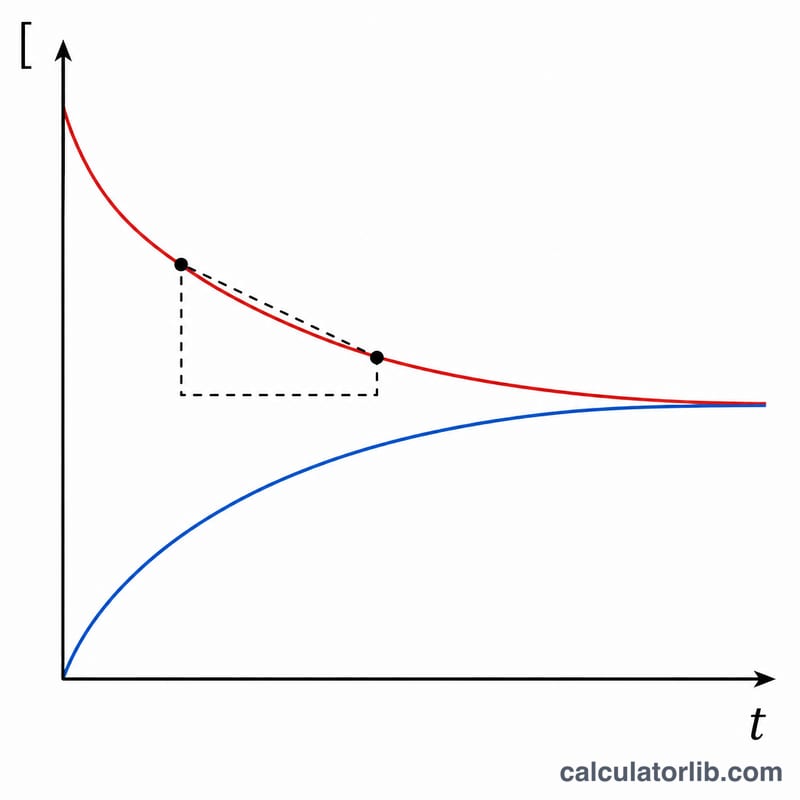
The average reaction rate measures how quickly the concentration of a reactant or product changes over a period of time during a chemical reaction. It is expressed in units of mol/(L·s). Because reactants are consumed and products are formed, a stoichiometric coefficient is used to express one common rate of reaction that all species agree on.
How to use this calculator
Choose whether you are tracking a reactant (concentration falls) or a product (concentration rises). Enter the initial and final concentrations in mol/L, the initial and final times in seconds, and the stoichiometric coefficient of that species in the balanced equation. The calculator returns the average rate of reaction, along with the change in concentration and time it used.
The formula explained
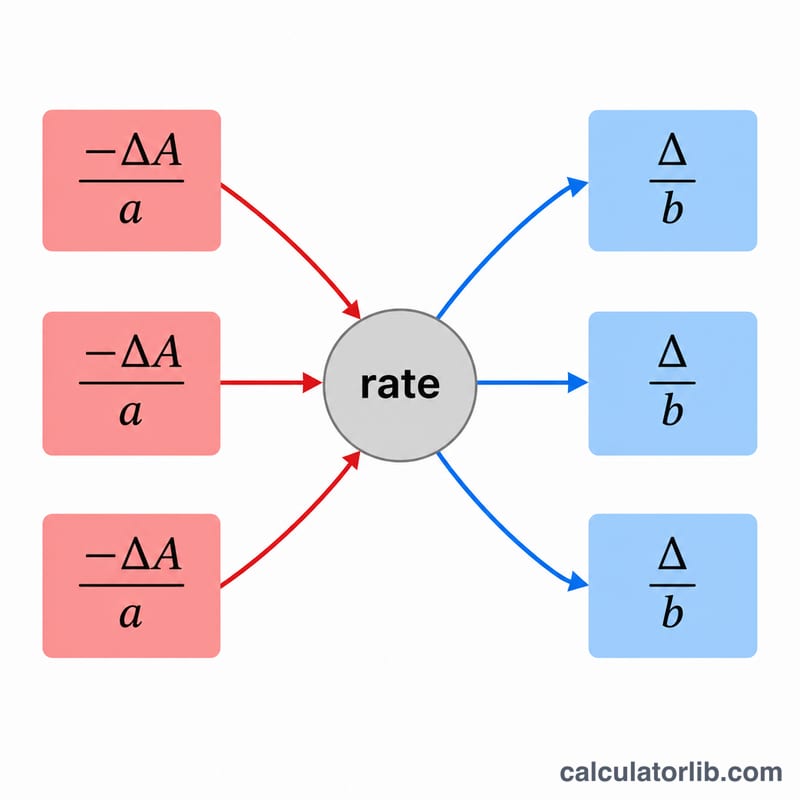
For a reactant A: $$\text{rate} = -\frac{\Delta[A]}{a \cdot \Delta t}.$$ The minus sign converts the negative concentration change into a positive rate. For a product P: $$\text{rate} = \frac{\Delta[P]}{b \cdot \Delta t}.$$ Dividing by the coefficient (\(a\) or \(b\)) normalizes the rate so every species gives the same value of the overall reaction rate.
Worked example
Consider 2 N₂O₅ → 4 NO₂ + O₂. Suppose [N₂O₅] drops from 1.00 mol/L to 0.60 mol/L over 10 s, with coefficient 2. \(\Delta[A] = 0.60 - 1.00 = -0.40 \text{ mol/L}\), \(\Delta t = 10 \text{ s}\). $$\text{rate} = -\frac{-0.40}{2 \times 10} = \frac{0.40}{20} = 0.02 \ \text{mol/(L}\cdot\text{s)}.$$
FAQ
Why divide by the coefficient? So that the rate of disappearance of reactants and appearance of products all yield the same single "rate of reaction" for the equation.
Why is the result positive for reactants? The leading minus sign cancels the negative concentration change, so reaction rates are reported as positive numbers.
What if I leave the coefficient as 1? Then you get the rate of change of that specific species, not normalized to the balanced equation.