

What Is the Weighted Average Interest Rate?
The weighted average interest rate (WAIR) is the single blended rate that represents the true cost of borrowing across several loans. Unlike a simple average, it accounts for how much you owe on each loan, so a large balance at a high rate counts more than a small balance. This makes WAIR the correct figure to use when comparing your current debt against a consolidation loan or refinance offer.
How to Use This Calculator
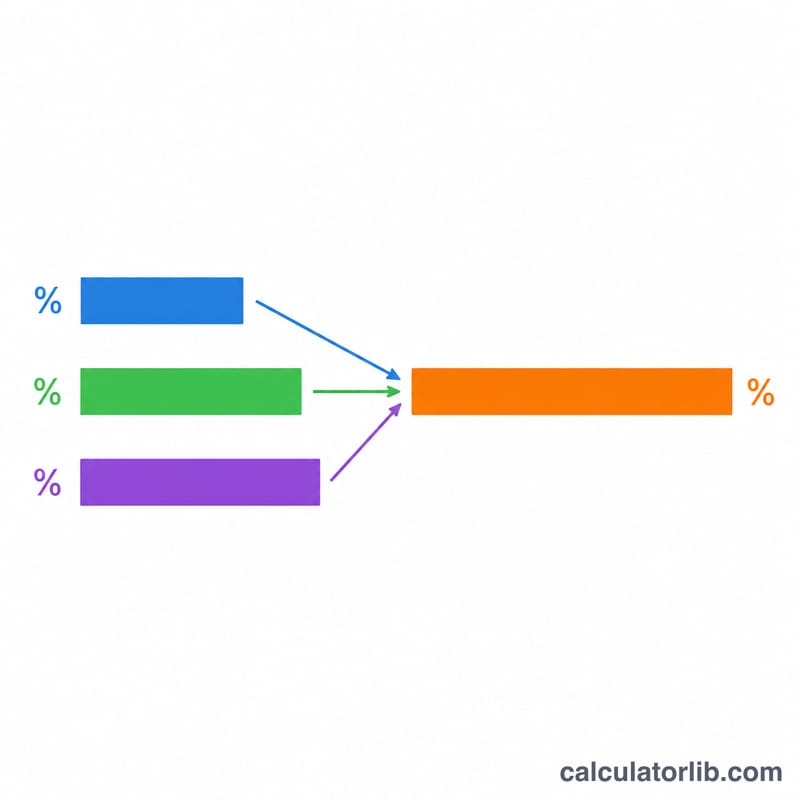
Enter the outstanding balance and the annual interest rate (as a percentage) for each of your loans. Leave any unused loan rows blank. The calculator multiplies each balance by its rate, sums those products, and divides by your total balance to return the blended rate.
The Formula Explained
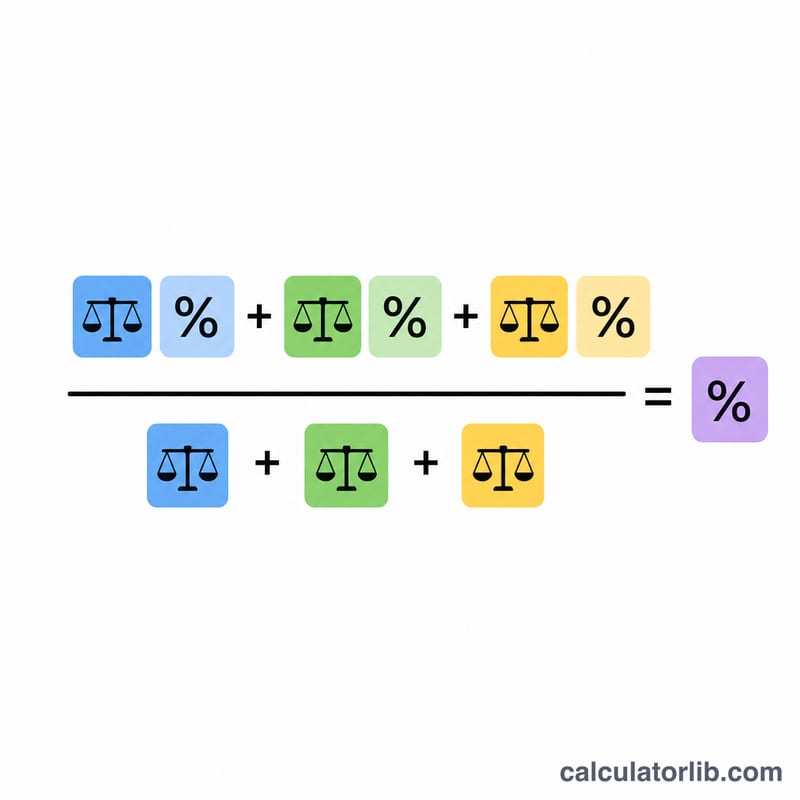
$$\text{WAIR} = \frac{\sum(\text{Balance} \times \text{Rate})}{\sum \text{Balance}}$$ The numerator is the sum of every loan's balance multiplied by its rate; the denominator is the combined balance of all loans. The result is a percentage that lies between your lowest and highest individual rates.
Worked Example
Suppose you have a $10,000 loan at 5% and a $20,000 loan at 4%. The weighted sum is $$(10{,}000 \times 5) + (20{,}000 \times 4) = 50{,}000 + 80{,}000 = 130{,}000.$$ The total balance is $30,000. $$\text{WAIR} = \frac{130{,}000}{30{,}000} = 4.333\%.$$ Note this is below the simple average of 4.5% because more money sits at the lower rate.
FAQ
Why not just average the rates? A simple average ignores balance size. If most of your debt is at one rate, that rate should dominate the blended figure — which only weighting captures.
Should I include all my debt? Include every loan you want represented in the blended rate, such as student loans, mortgages, or credit cards you plan to consolidate.
Does this account for loan term? No. WAIR blends rates by balance only; it does not factor in differing repayment terms, fees, or compounding frequency.