

What Is the Real Interest Rate?
The real interest rate is the rate of return on money after stripping out the effect of inflation. While a nominal rate tells you how many more dollars you have, the real rate tells you how much more you can actually buy. This calculator converts a nominal interest rate and an inflation rate into the true, inflation-adjusted return using the Fisher equation.
How to Use It
Enter the nominal interest rate (the headline rate quoted by a bank or bond) and the expected or actual inflation rate, both as percentages. The calculator returns the exact real rate along with the common quick approximation so you can compare the two.
The Formula Explained
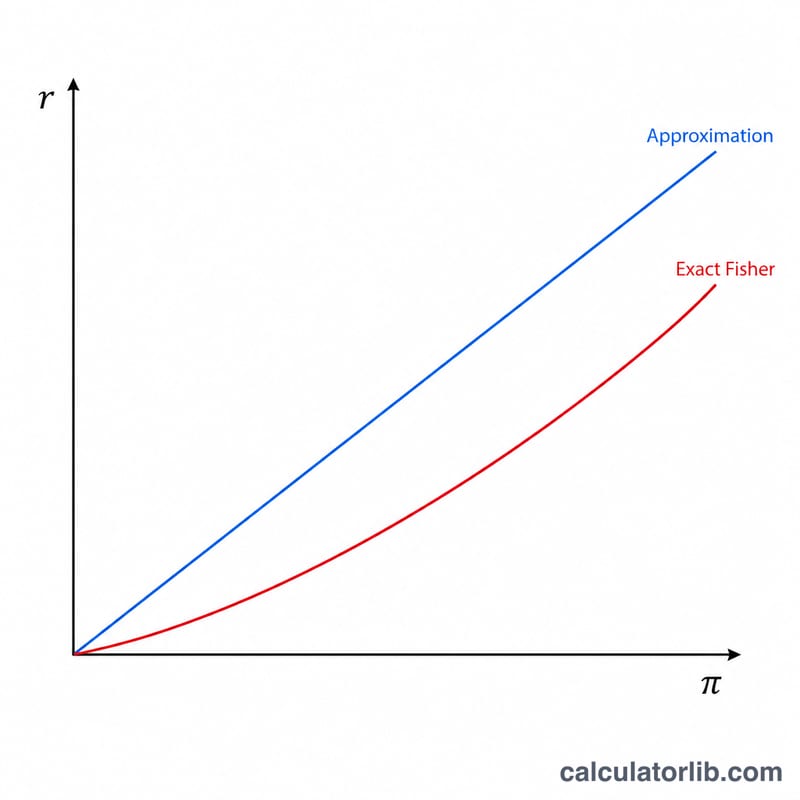
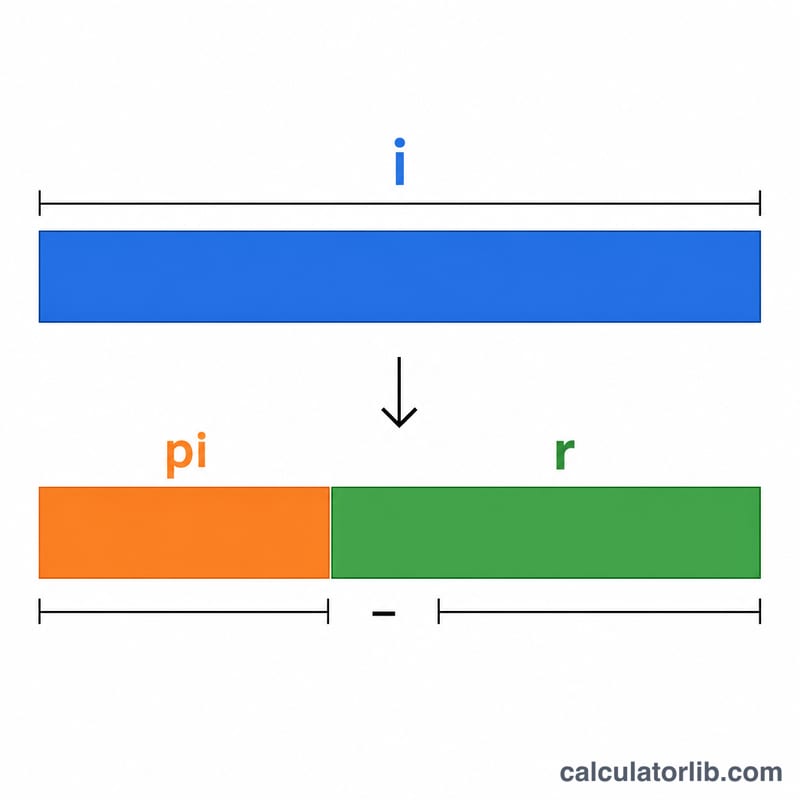
The exact Fisher relationship is $$r = \frac{1 + i}{1 + \pi} - 1$$ where \(i\) is the nominal rate and \(\pi\) is inflation, both expressed as decimals. For everyday use a simpler version works well: \(r \approx i - \pi\). The approximation drifts from the exact answer as rates get larger, which is why the precise formula is preferred in finance.
Worked Example
Suppose a savings account pays a nominal 5% while inflation runs at 2%. The exact real rate is $$\left( \frac{1.05}{1.02} \right) - 1 = 0.029412$$ or about 2.94%. The quick approximation gives \(5\% - 2\% = 3\%\). The 0.06 percentage-point gap shows why precision matters for larger figures.
FAQ
Can the real rate be negative? Yes. When inflation exceeds the nominal rate, your purchasing power shrinks and the real rate is negative.
Why use the exact formula instead of subtraction? Subtraction ignores the compounding interaction between interest and inflation, so it overstates the real return slightly, especially at high rates.
Is this the same as the after-tax return? No — this figure adjusts only for inflation. To get an after-tax real return you would first reduce the nominal rate by your tax rate, then apply the Fisher equation.