

What Is the Taylor Rule?
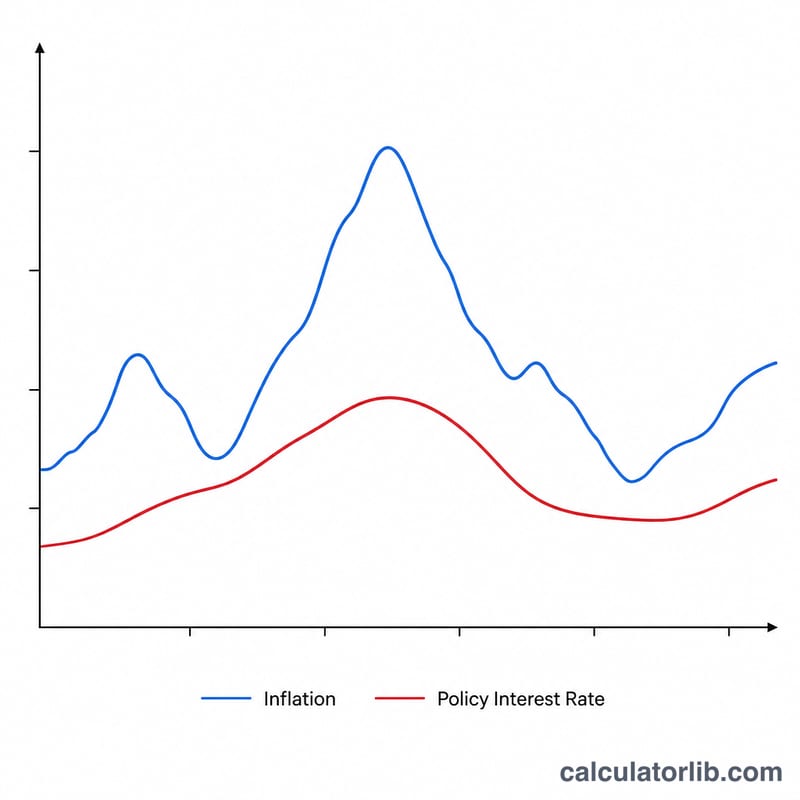
The Taylor Rule is a monetary policy guideline proposed by economist John B. Taylor in 1993. It prescribes how a central bank, such as the U.S. Federal Reserve, should set its short-term nominal interest rate in response to economic conditions — specifically the gap between actual and target inflation and the gap between actual and potential output. This calculator applies the classic version with equal 0.5 weights on both gaps; it is a model and not official policy guidance.
How to Use This Calculator
Enter four values: the current inflation rate (\(\pi\)), the target inflation rate (\(\pi^*\), often 2%), the neutral or equilibrium real interest rate (\(r^*\), often assumed near 2%), and the output gap — the percentage difference between actual and potential GDP. The calculator returns the recommended nominal policy rate along with a breakdown of the inflation-gap and output-gap contributions.
The Formula Explained
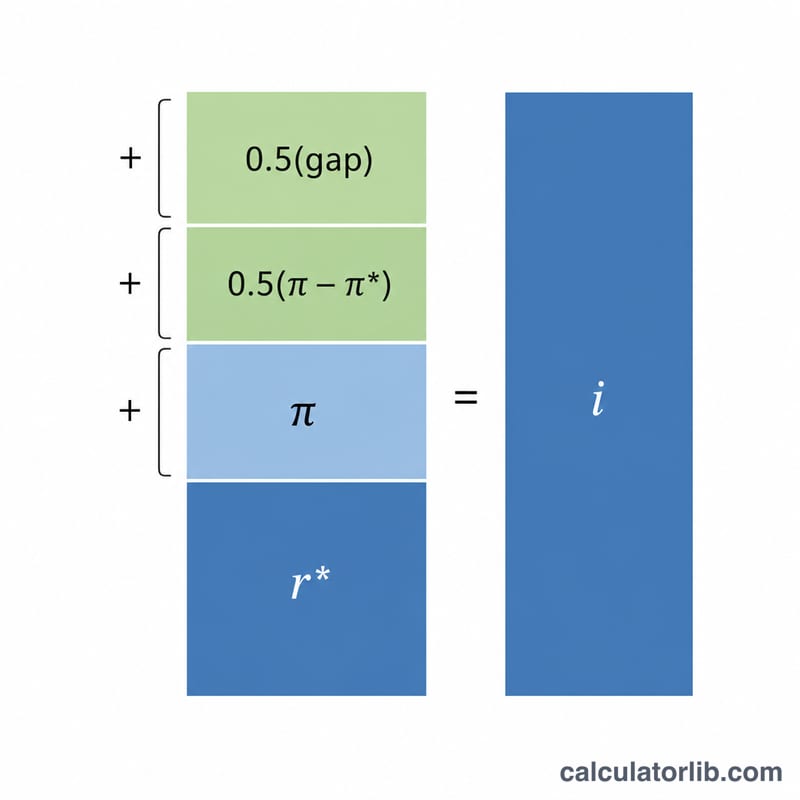
The equation is $$i = r^* + \pi + 0.5\left(\pi - \pi^*\right) + 0.5 \times \text{Output Gap}$$ The first two terms recover the long-run nominal rate (neutral real rate plus inflation). The third term pushes rates up when inflation exceeds its target, and the fourth raises rates when the economy is running hot (a positive output gap). When inflation is on target and the output gap is zero, the prescribed rate simply equals \(r^* + \pi\).
Worked Example
Suppose inflation is 4%, the target is 2%, the neutral real rate is 2%, and the output gap is 1%. Then $$i = 2 + 4 + 0.5(4 - 2) + 0.5(1) = 2 + 4 + 1 + 0.5 = 7.5\%$$ The rule recommends a meaningfully higher policy rate to cool the economy and bring inflation back to target.
FAQ
Why use 0.5 weights? Taylor's original 1993 specification used 0.5 for both the inflation and output gaps; some "balanced approach" variants use 1.0 on the output gap.
What is the output gap? It is actual GDP minus potential GDP, expressed as a percent of potential. A positive gap means the economy is overheating.
Is this the actual rate the Fed sets? No. The Taylor Rule is a benchmark; real-world policy also weighs financial stability, employment, and forward guidance.