

What Is the Reserve Ratio?
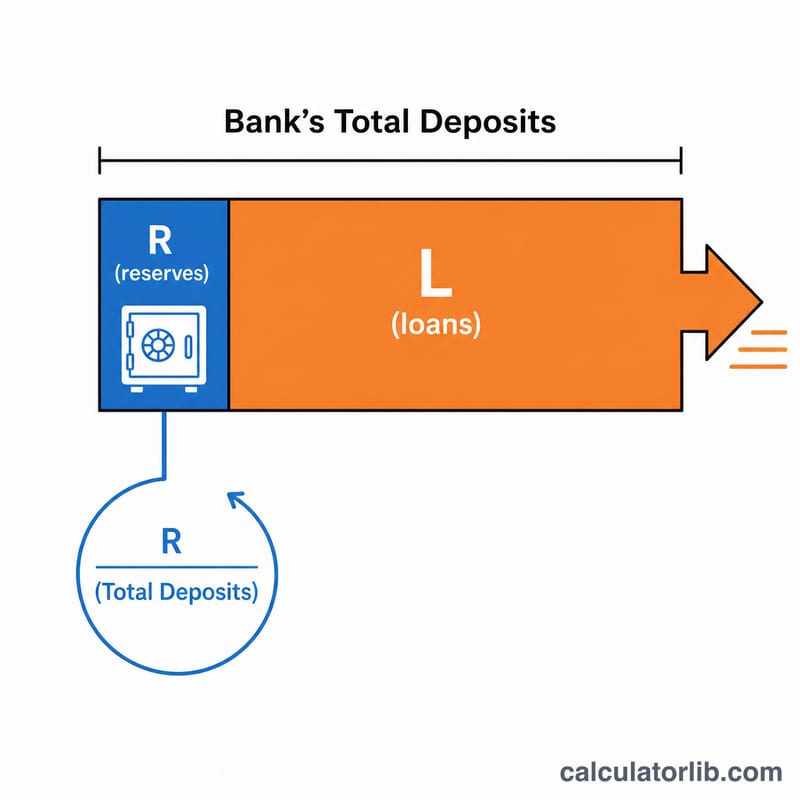
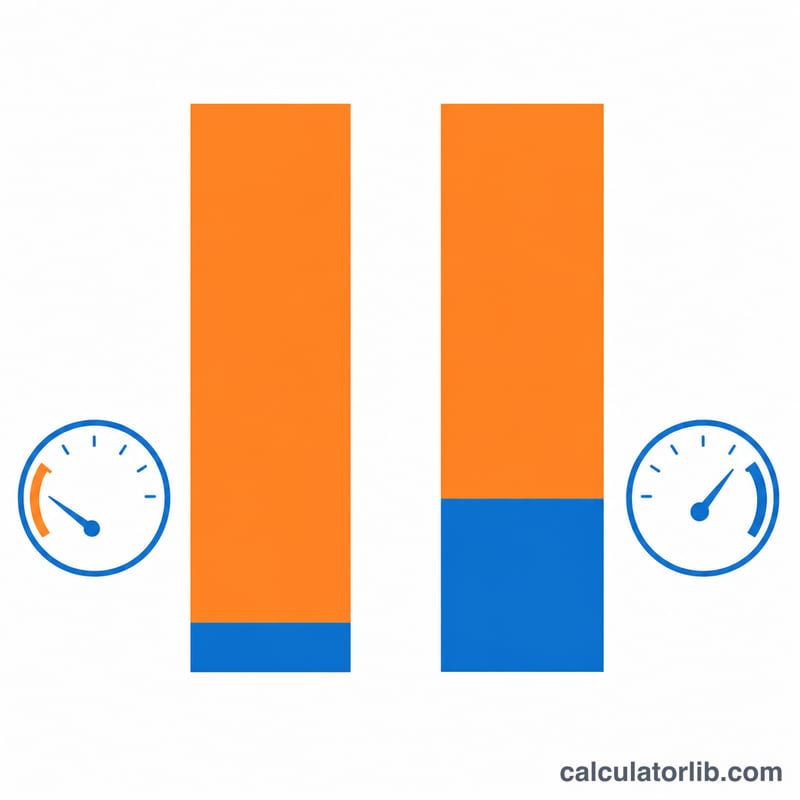
The reserve ratio (also called the cash reserve ratio or reserve requirement) is the portion of a bank's total customer deposits that it holds in reserve rather than lending out. It is a key tool used by central banks to control the money supply and ensure banks can meet withdrawal demands. A higher reserve ratio means a bank keeps more cash on hand and lends less, while a lower ratio frees up money for loans.
How to Use This Calculator
Enter the bank's total reserves (vault cash plus deposits held at the central bank) and its total customer deposits. The calculator divides reserves by deposits and multiplies by 100 to express the result as a percentage. Both figures should use the same currency and time period.
The Formula Explained
The calculation is simply:
$$\text{Reserve Ratio} = \frac{\text{Reserves (\$)}}{\text{Total Deposits (\$)}} \times 100\%$$
If reserves equal $10,000 and total deposits equal $100,000, the reserve ratio is \((10{,}000 \div 100{,}000) \times 100\% = 10\%\). This tells you the bank keeps 10 cents of every deposited dollar in reserve and can lend the remaining 90 cents.
Worked Example
Suppose a bank reports $45,000 in reserves against $300,000 of total deposits. The reserve ratio is $$(45{,}000 \div 300{,}000) \times 100\% = 15\%.$$ With a 15% ratio, the bank has $255,000 available for lending and investment.
FAQ
What is a typical reserve ratio? Required ratios vary by country and have historically ranged from 0% to about 10% for commercial banks; many central banks set tiered requirements based on deposit size.
Is the reserve ratio the same as the reserve requirement? The reserve requirement is the minimum ratio set by regulators; the reserve ratio is the actual ratio a specific bank maintains, which can be equal to or higher than the requirement.
What happens with a 0% reserve ratio? A 0% requirement means banks are not legally obligated to hold reserves against deposits, though they typically still keep some cash for liquidity and operational safety.