
What Is the Velocity of Money?
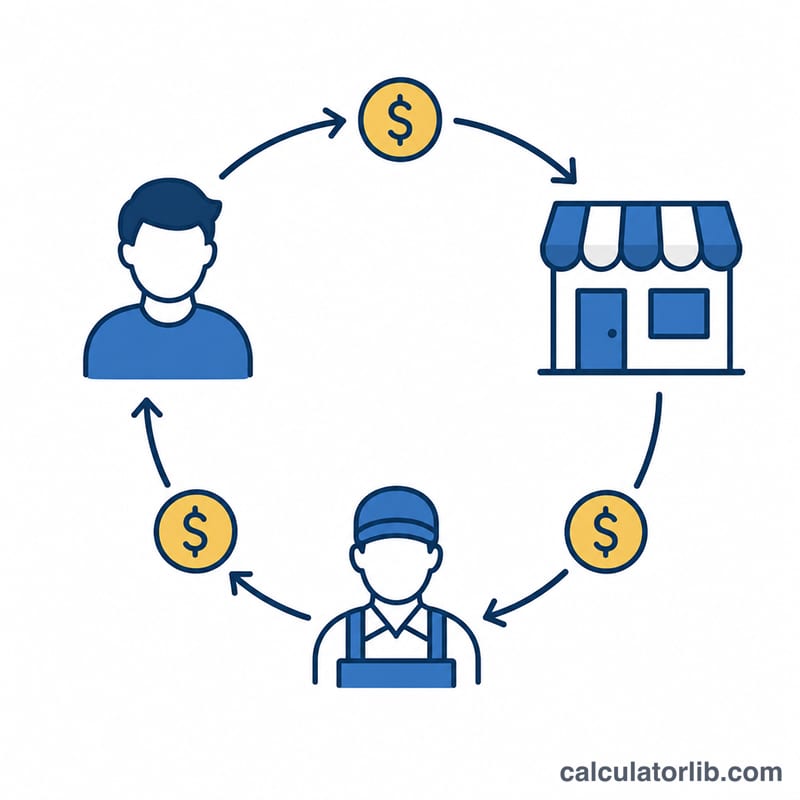
The velocity of money measures how frequently a single unit of currency is used to purchase goods and services over a given period. A high velocity means money changes hands quickly and the economy is active; a low velocity suggests people are saving or hoarding cash. It is a core variable in the quantity theory of money, often written as \(MV = PY\).
How to Use This Calculator
Enter your nominal GDP (the total value of goods and services, equal to the price level P multiplied by real output Y) and the money supply M (such as M1 or M2). Use the same currency and time period for both figures. The calculator divides GDP by the money supply to return the velocity, expressed as the number of times each currency unit was spent during the period.
The Formula Explained
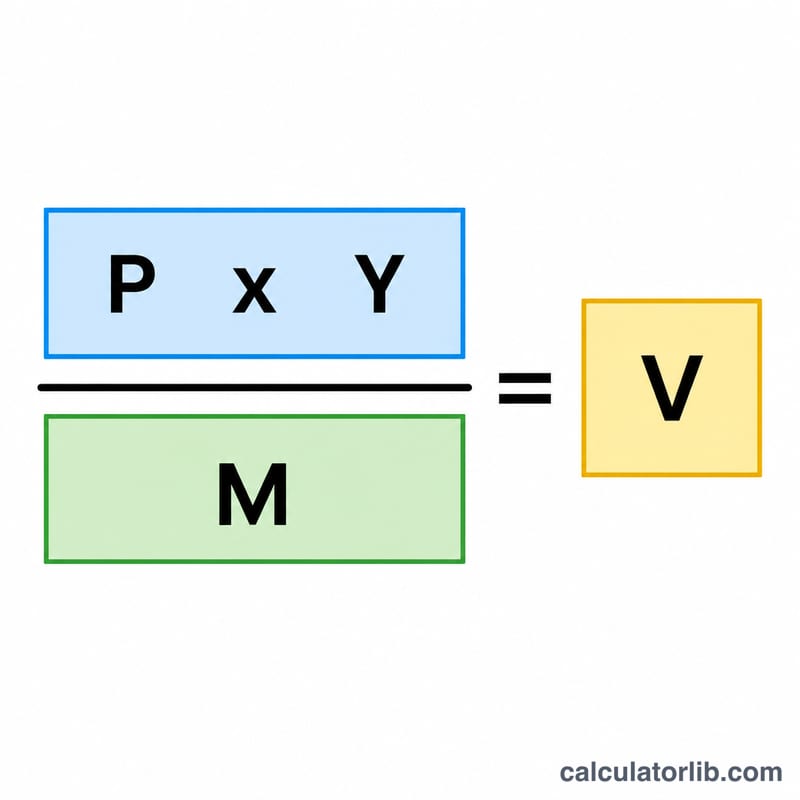
The equation is $$V = \frac{P \times Y}{M} = \frac{\text{Nominal GDP}}{\text{Money Supply}}$$ Because nominal GDP already equals price level times output, you can simply plug in the published GDP figure. The denominator is whichever money-supply aggregate you choose — results differ depending on whether you use M1, M2, or the monetary base.
Worked Example
Suppose a country's nominal GDP is $21 trillion and its M2 money supply is $15 trillion. Then $$V = \frac{21{,}000{,}000{,}000{,}000}{15{,}000{,}000{,}000{,}000} = 1.4$$ On average, every dollar was spent 1.4 times that year.
FAQ
Which money supply should I use? M2 is the most common for broad velocity, but central banks publish velocity for several aggregates. Pick the one that matches your analysis.
What does a falling velocity mean? It often signals reduced spending, increased saving, or expansionary monetary policy that has not yet translated into transactions.
Can velocity be less than 1? Yes. With very broad money measures, velocity can fall below 1, meaning the money stock is larger than annual nominal GDP.